All rise for the mourner’s Kaddish, for here lies Jewish culture—70 years are the life of man, and maybe society, too, which puts us rather nicely in the shiva period for American Judaism’s golden age. Or at least the hospice stage. That’s the logic behind David Denby’s latest work, Eminent Jews: Bernstein, Brooks, Friedan, Mailer, a lazy river of a book that illuminates Denby’s pessimism more than it does the luminaries he highlights. Denby insists it’s “a celebratory book, a happy book,” but it reads like a eulogy.
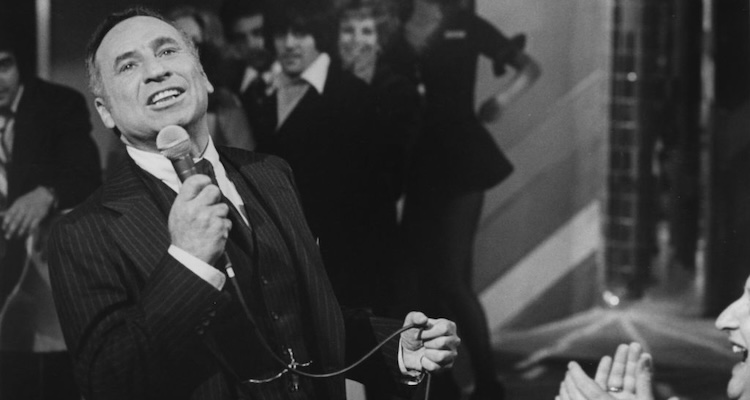
Denby, formerly the movie critic of the New Yorker, leads us pleasantly, if often in a workmanlike mode, through the lives of his four case studies: Mel Brooks, Betty Friedan, Norman Mailer, and Leonard Bernstein. He insists this is no hagiography, but he stumbles quickly in the face of Mel Brooks’s charm onslaught. Denby has spoken with Brooks many times, noting the comic’s habit of talking over everyone else—“the noisiest man in New York”—so perhaps it’s appropriate that Denby hardly gets a word of analysis in for the Borscht Belt veteran.
Brooks is lovable, and Denby doesn’t seem to probe too deeply in his sketch of Mel’s early rise and greatest hits—The Producers, Blazing Saddles, the Spanish Inquisition musical number in History of the World, Part I—while mostly glossing over the deep anger and impotence that propelled his humor against anti-Semitism, Nazis, and Hitler. “Comedy can’t stop murder,” writes Denby. “But it can change the way we think of murder… . Comedy can help us deal with murder, stop us, perhaps from murdering ourselves.” Aside from the inconsistency (can comedy stop murder, or can’t it?), was Brooks good for the Jews? Are we less likely to be murdered because of his “Hitler on Ice” sketch? There’s plenty of Jewy stuff in Brooks’s bio, but Denby can’t resist reaching, asking, at a low point in Brooks’s life, “was it not a very Jewish soulfulness that saved him?” and insisting that the very funny and not very Jewish Young Frankenstein is “a Jewish monster movie.”
Denby moves onto shakier ground with Betty Friedan, who, of all the book’s subjects, he seems the least comfortable with—and interested in. He respectfully documents her role in second-wave feminism as the author of The Feminine Mystique, and though he admits that “in her methods, there was nothing particularly Jewish,” he feels her Jewishness revealed itself in her “temperament” and the “peculiar American Jewish contempt for time wasted.” I’m not sure where that peculiar contempt comes from, though I solemnly affirm it to be entirely absent in my own family.
Friedan “had, perhaps, the Jewish vice of worrying too much about everything,” and she taught one of her sons “‘to think for himself and not swallow someone else’s line,’ qualities he considered intrinsically Jewish.” She admitted to reciting the Sh’ma as a girl, but also to saying the Christian prayer “Now I Lay Me Down to Sleep,” so perhaps we should be talking about the subtle Christian themes in Friedan’s work. After all, she grew up in Peoria, Illinois, not exactly the Lower East Side. Denby uses much of the chapter to define Judaism and Jewish values. In his broad definition:
[Jewish identity] should require, at a minimum, an assertion, either public or silent, that one is Jewish, that one acknowledges, in doubt or belief, the power of monotheism in the Jewish version—a single, indivisible, overpowering God whom one cannot see but one has to imagine and that one further acknowledges that the Messiah has not come and that the gifted young man who taught in Judea and Galilee two thousand years ago was not the son of God. It should also mean, one hopes, that one accepts the burden and glory of Jewish history and perhaps some of the humor and complication of Jewish temperament, and that, given the persistence of oppression in that history, you understand the situation of the outsider and the scorned.
Denby finds his footing again with Mailer, a man he knows he shouldn’t admire but can’t help himself from liking, taken as he is by Mailer’s pugnacious insanity in the way many others were. Mailer apparently understood the “situation of the outsider and the scorned,” having once lobbied for the release of a convicted murderer who went on to kill again.
Still, the conceit of the book wears thin here. It feels churlish to deny that a figure was influenced and inspired by his Jewishness, especially when, as in Mailer’s case, Judaism clearly did play a big role in his life. But it’s equally tiresome to claim artists were influenced by “tribal memory,” as Denby frequently does: He believes Brooks invoked a biblical scene that Brooks had never heard of and insists Mailer’s “reproduction of these [biblical] texts” was “unconscious—tribal if you like.”
I don’t like. Mailer believed in God, reincarnation, and the tough Brooklyn streets—plenty to be getting on with without fretting that his novelistic romp through ancient Egypt was “a strange book for a Jew to have written, since mainstream Jewish monotheism is eager to dispel or at least ignore such fanciful goings-on.” It makes me sympathize with Philip Roth, who was adamant about calling himself an American writer, not a Jewish writer.
Much more than his Jewish-ness-ity, Denby identifies with Mailer’s dislike of technology, and here Denby’s pessimism seeps through: “Many more of us are now jostled, harassed, frightened, even depressed by… rapid changes (AI spreading through us like a virus). Yes, depressed, even though these ‘advances’ again make our lives easier and more prosperous. Cultural criticism of great eloquence does not become obsolete, easily dismissed as if it were itself a piece of technology.” I empathize with Denby. Is that the source of the distracted feeling of the book? The inconsistent focus?
When it comes to Leonard Bernstein, Denby cares an awful lot about his sexual proclivities and work as “prime liberator of the Jewish body” and not as much about his works that are steeped in Jewish text (the oratorio Kaddish and the song cycle called “Chichester Psalms”). In an odd contrast, Denby seems more interested in teasing out shards of Jewish meaning from the musical On the Town than in grappling with Bernstein’s close—possibly romantic—relationship with a former Nazi. I’m sure Mel Brooks, who “humiliated Nazism by embedding it in the moldiest conventions of the commercial theater” and who never lost his taste for hating Hitler, might have a thing or two to say about it. Denby slots a stealth review of the Bradley Cooper biopic Maestro into his discussion of Bernstein and gets a lot of his details from the memoir by Bernstein’s daughter. He declares Bernstein a humanist rabbi and seems satisfied with that.
_____________
“Jews are not under serious threat” in America, Denby assures us, in the epilogue to this supposedly celebratory, happy book. He wants us to rejoice at the stability of American Jewish culture—something we can all be happy about, so far as it goes. But how far does it go? There’s an undeniable pall hanging over American Jewish culture these days—even if rumors of its death are greatly exaggerated. We worry about the end of the golden age of American Jewry in the Atlantic. We hear about the death of another genius of 20th-century letters. We read about the epic intellectual battles once fought between Jewish writers, artists, editors, and philosophers and wonder whether the fire has gone out.
It isn’t that Jews aren’t still writing and working. It isn’t that Jews haven’t produced great artists of the 21st century. But the crassness of the modern world drenches us and makes us retrench, makes us write comforting books like Eminent Jews and check Instagram to see which actors are Jewish, and which ones have commented on Israel, as if culture is a listicle of famous Hebrews. That can be part of the culture but a shallow part that won’t inspire the next generation of Jewish creatives. Maybe this isn’t just a Jewish problem—artists throughout America fear that creativity is dying. But if it isn’t a uniquely Jewish problem, our coping methods, perhaps, are.
Denby’s chapter titles all begin with the words “The End of”…Self-Pity, Shame, etc., to signify that the figures in his book have pushed us as Jews and Americans past certain character flaws and into new freedoms. But really, the end is that of the “Jewish century”: It’s the twilight of the superheroes, and we fear that a long night of social media slop rushes in to take the place of demigods who built our culture with words on the page and battles in the press. God help us all.
Photo: Michael Ochs Archives/Getty Images
We want to hear your thoughts about this article. Click here to send a letter to the editor.