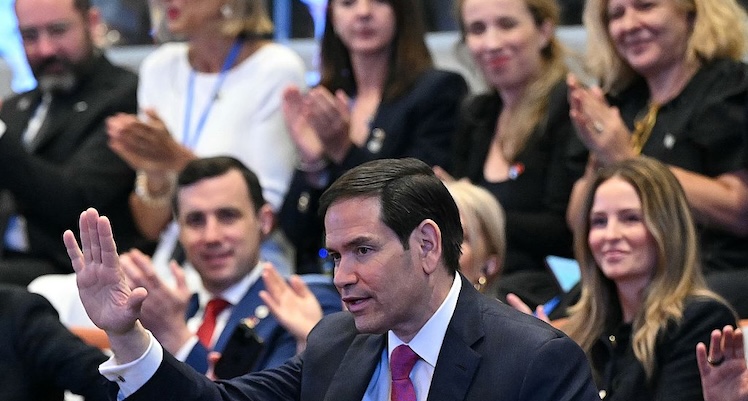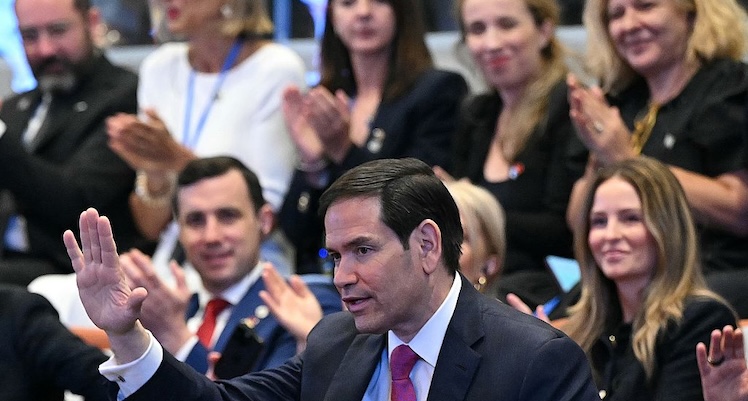
In September, Secretary of State Marco Rubio delivered one of the most meaningful American speeches in recent memory. Rubio was in Jerusalem, and the setting was dramatic. In the wake of all that has transpired since—the assault on Gaza City, the negotiations to end the war, the arrangement for the return of the hostages—Rubio’s remarks have been overlooked, and perhaps understandably so. Nevertheless, it is vital that his speech not be forgotten by Americans, because though it was delivered in Jerusalem, it was really about America—about the uniqueness of our founding and history and what the 250th anniversary of the United States should mean to all of us.
The speech was framed around Zionism in its most literal sense, given that it was delivered inside Zion itself. “Zion” is the name that King David assigned to the mountain where his capital Jerusalem was founded, where his psalms were written, and where his dream of a Temple was given expression—a site known, then as now, as the “City of David.”
Rubio had come with Prime Minister Benjamin Netanyahu to attend the inauguration of the opening of the “Pilgrimage Road”—a path by which hundreds of thousands of pilgrims, millennia ago, ascended to the Temple from the pool of Siloam within David’s city to Judaism’s holiest site. Its discovery and excavation are among the triumphs of archaeology in our time. The road is, one might say, the ultimate reminder of who the “indigenous people” of Zion really are, demonstrating as it does continuity between their presence there at least 3,000 years ago and the presence of 7 million Jews in the Jewish state today.
Rubio implicitly referenced this fact in the opening of his remarks, making mention of America’s upcoming anniversary and how America was actually “young” compared to the nation whose story is represented by where he stood. He then turned to the meaning of the Founding and what set America apart.
The United States was founded on a powerful idea, defined not by geography, ethnicity, or anything else. It was founded on the very powerful principle that the rights of mankind come from their creator.
These are words whose constant reiteration is necessary and proper, especially from a Republican administration, since we are now hearing from some affiliated with the conservative movement that America is not really defined by an idea. The secretary of state was not, of course, saying that America is utterly disconnected from the circumstances of its location. Rather, he was asserting that, at its core, America is a covenantal nation, defined by a set of principles. And by linking America’s more recent founding to the ancient and modern capital of Israel, he implicitly reminded us that, as Rabbi Jonathan Sacks put it, “America and Israel, ancient and modern, are the two supreme examples of societies constructed in conscious pursuit of an idea.”
Appropriately, Rubio then turned in his remarks to the site where he stood and gave voice to Isaiah’s vision of all the earth learning from biblical teachings in God’s sacred city that “from Zion shall go forth the Torah, and the word of the Lord from Jerusalem.” It was only because of this word of God, Rubio argued, that the American idea came to be enunciated.
It was here that God fulfilled his promise to his people. It was here that the lessons that formed the base rock and the foundations of our laws, of the principles upon which we decide what is right and what is wrong, was built upon. If you think about the things that today we, in civilized societies, use as rules to govern us, these things did not come because good people wrote them. They came because they were rooted in ancient teachings. For deep inside of us, we all know that we were created for a purpose and for a reason, that our dignity comes from our creator.
This, too, is deeply significant. There are those affiliated with the right today who describe the notion that “all men are created equal” as a paradigm of Enlightenment liberalism utterly unrooted in the ancient past and therefore unworthy of being placed at the locus of American exceptionalism. Rubio reminded us that the notion of human equality did not emerge ex nihilo from the mind of European philosophers, or from the sages of Athens. The latter city may have been a democracy in a certain sense, but its greatest philosophers took human inequality for granted. The embrace by America’s founders of an equality “endowed by our Creator” was rooted in a bond to the Bible, to the concept that human beings are created in God’s image. American exceptionalism, Rubio was arguing, is bound up with the biblical teachings, and therefore with the sacred site where he was speaking.
This helps explain why those, from the progressive left to the woke right, who seek to undermine the creedal nature of the American story also seek to foster hatred against the Jewish people and against Israel. It was therefore fitting that Rubio, in conclusion, pointed out to all those assembled that the City of David itself is a reminder that, while Jew-haters may fulminate, they will ultimately fail:
To stand here today on the very road where, not 2,000 years ago, so many from everywhere ventured to fulfill that desire to be closer to the creator is a humbling and honoring experience. As you go through the layers of history, you realize that all the civilizations that conquered this city, all the ones who tore it down and built on top, are all gone. The Roman Empire is no more, nor any of the others that sought to conquer and rule this land. But one people remain. They have returned. For God’s promise is eternal, and it is perfect, and his word is always true. And I’m honored to be a part of its fulfillment here with you tonight.
These have been difficult months and years, a time worrying for Jewish Americans who love this country and the place that Jews have found in it. So we should also count ourselves blessed to be living at a moment when the secretary of state of the most powerful nation on earth felt free, and was inspired, to give a speech such as this. How striking it is to know that while most of the political leaders of Europe would refuse to celebrate the Israeli connection to the City of David, a biblically inspired American political leader recognized not only its spiritual sublimity, but also America’s intellectual indebtedness to it. As we prepare to mark the 250th anniversary of the Founding, more debates about the meaning of America will unfold. We must make sure that this seminal address in Jerusalem is front and center in those debates so that it can serve as a beacon to all of us.
Photo: Saul Loeb – Pool/Getty Images
We want to hear your thoughts about this article. Click here to send a letter to the editor.