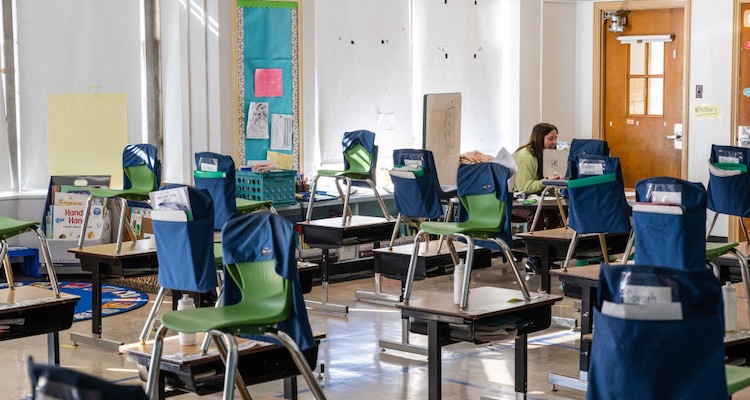
‘Five years after the global COVID pandemic was declared, there is widespread agreement that closing classrooms was devastating for children,” read a March 16 article in the New York Times titled “What We’ve Learned About School Closures for the Next Pandemic.” The piece includes interviews with a variety of public health experts and officials in the education sphere, who all seem to agree that the strategy of school closures during the pandemic was misguided, and that the social and educational harms from remote learning and hybrid schooling were not properly taken into account at the time.
The article was likely received with mixed emotions by David Zweig, the author of An Abundance of Caution: American Schools, the Virus, and a Story of Bad Decisions. On one hand, the emerging consensus on the grim realities of school closures and their lasting negative effects on children might have been heartening to a writer who since May 2020 had been publishing stories on the folly of closing schools and keeping them closed. On the other, the continued abdication of responsibility by those who had the power and influence to carve out a different path surely left a bitter taste in his mouth. “I thought I was pretty loud,” American Federation of Teachers President Randi Weingarten told the Times regarding her self-professed prioritizing of children, including their in-person instruction, during the pandemic. Her only regret was that she could have been “even louder” about it. Few people have ever lied so baldly.
Zweig’s An Abundance of Caution lays to rest one central myth about the national response to the coronavirus pandemic—that public health and education officials were merely responding to unprecedented events using the best information they had at the time, and that they adjusted to a rapidly shifting situation as facts on the ground changed. In reality, overbroad public health policies were implemented hastily based on shoddy statistical projections and in contradiction of previously established epidemiological knowledge. Emerging political polarization around Covid drove conformity and rigidity on mitigation measures. This atmosphere was exacerbated by an incurious media, craven politicians, and a general unwillingness by many to take any perceived risk, even if the data existed to show that the risk was illusory. The problem, writes Zweig, “has to do with information—how it is presented to the public, and who is afforded a platform to present it.”
It can be easy to dismiss a book that so thoroughly lays out the failure on schools during the pandemic as “hindsight is always 20/20,” but Zweig carefully outlines historical data, robust studies conducted both before and during the pandemic, and numerous other decisions by public health officials, medical professionals, reporters, and politicians. And it all points to the same conclusion: This reality was avoidable at the time. And those who tried to steer us clear of the iceberg were rebuffed by those in power and often villainized and ostracized by their own communities.
_____________
The book’s narrative is global and national, but also local and personal. Zweig, the father of two young children forced to navigate the frustrating and crippling world of remote learning in New York, is also a journalist and former fact-checker—a combination that initially led him to cast a critical eye on public health measures at the start of the pandemic. In early 2020, a New York Times science editor rejected a pitch by Zweig for a story containing optimistic hard evidence that the dangers to children from the virus were being overstated. The data came mostly from Europe, where schools had largely reopened in April. According to the editor, they were already “covering the story.” Zweig’s piece on the topic was eventually published on May 11 of that year in Wired. The Times published nothing of the kind.
After his article, Zweig found himself on the receiving end of criticism that was political but not substantive from opponents of reopening schools. “No one took issue with any of the sources cited in the piece,” he writes. But “there was close to zero dissent among politicians or in the framing by legacy media outlets on the topic. The narrative was set.”
The narrative Zweig mentions is one he traces back to the initial reliance on epidemiological models and projections—powerful scientific tools, to be sure, but only as useful as the data and statistical assumptions fed into them. Yet time and again, his book shows that studies widely cited by public health officials and the media, and used as the basis for far-ranging public policy, often included unsourced data, unproven assumptions, or both. These include studies on case and death projections, the effectiveness of school closures, and mitigation measures taken upon reopening. Additionally, these models did not take into account the harms of the closures and mitigation measures themselves. Notably, the authors of the Imperial College of London’s March 16, 2020, report on the “impact of non-pharmaceutical interventions (NPIs) to reduce COVID-19 mortality and healthcare demand,” known as Report 9, explicitly stated that they did “not consider the ethical or economic implications” of their proposed suppression and mitigation strategies. Nevertheless, the report directly informed the policy recommendations of White House Coronavirus Response Coordinator Deborah Birx. So, in effect, the models were doing what they were designed to do, but that design excluded the likely harms that would be caused by the closures and mitigation strategies.
An Abundance of Caution traces how these flawed models helped foster an atmosphere of public fear of the virus. They were cited repeatedly by leading figures including New York Governor Andrew Cuomo and NIAID Director Anthony Fauci and heavily informed their decision-making processes. The political polarization around schools, fueled by President Trump’s calls to reopen, further entrenched a largely liberal education world in its position that schools were not safe. Proponents of reopening were accused of wishing death on teachers and children, and parents who wanted their kids back in class were lambasted as lazy. “Teachers are not babysitters and I’m not returning back to school,” wrote one teacher in July 2020. By this point, European schools had been open for months, and the EU had released two official reports in May and June, stating that there was “no indication that reopening [schools] furthered the spread of COVID-19.”
The American media, for its part, breathlessly published every frightening study and anecdote about the pandemic, flagrantly ignored the data coming out of Europe, and did not challenge public health guidelines that went against decades of epidemiological knowledge and experience. “As a result,” writes Zweig, “much of the official guidance, and the policies that stemmed from it, was based on subjective values yet was presented to the public as objective science” (emphasis in original).
_____________
An Abundance of Caution takes the reader on a journey that starts long before Covid, tracing the origins of existing epidemiological playbooks on pandemic mitigation and showing how they were distorted into the public health policies implemented during the pandemic. It weaves through the political realities of the moment and offers a scathing indictment of media stenography and conformity. It also features related stories that demonstrate how frequently public guidelines and policy lag substantially behind practical experience and real-world observation. This narrative is interwoven with the author’s own story of attempting to help his children adjust to pandemic life and schooling and his efforts to reopen schools in his own district—efforts that often ran into brick walls despite overwhelming evidence that schools were safe and did not drive the spread of the coronavirus.
While this book could have served as a victory lap on Zweig’s part, he treats the subject matter fairly and evenly, stopping only on occasion to point out the most ludicrous statements and policies. Instead of spiking the football, he primarily focuses on how things could have been done better, and in fact were done better in Europe, and later in certain parts of the United States. “Ultimately, this book is not about the pandemic,” Zweig wrote on X. “It is about the failure of the expert class.”
There is some solace to be taken in the growing consensus that school closures and in-school mitigation measures left a trail of ruin through children’s social skills, mental health, and education—if only because it means there might be sustained efforts at healing those wounds. But An Abundance of Caution lays bare how the experts had the knowledge and the data to make the right decisions early on; that the media had enough information to assess new guidelines with a critical eye; and that politicians who actually cared had the authority and the tools to ensure that children would be largely safe and healthy. The data on the well-being of the young Americans who lived through the pandemic and its disruptions of the standard journey from childhood to adulthood will reveal over time the degree of the disaster. But that it was a preventable disaster can no longer be questioned, as David Zweig’s essential book demonstrates.
Photo: Jon Cherry/Getty Images
We want to hear your thoughts about this article. Click here to send a letter to the editor.