‘Sometimes a flare goes up and you get to see exactly where everyone is standing.” So begins Douglas Murray’s On Democracies and Death Cults, his definitive account of October 7. No one has offered as clear a historical and moral telling of that’s day’s story.
The book is difficult reading. It reminds us again that October 7 didn’t rally the world around the Jewish cause. It was rather the opposite: “Within a couple of months of the war starting there was a narrative that went something like this: Israel had the world’s sympathy and support in the immediate aftermath of the 7th, but had squander-ed it by prosecuting its war against Hamas in Gaza. In fact, it isn’t true that the world’s sympathy lasted hours or even minutes.”
Before the bodies of the dead had even been identified, a flood of anti-Semitism was unleashed by Islamists and progressive activists prowling for a new cause. “Palestine” soon metastasized into the cause of marchers at elite college campuses across the nation. “Queers for Palestine.” “Novelists for Palestine.” “BLM for Palestine.” It was an arms race in moral idiocy. Murray notes that in his home of Manhattan, a protest broke out in Times Square as Israelis were still fighting the remnants of Hamas in southern Israel. These crowds were festooned with genocidal slogans like “From the river to the sea,” “Resistance is justified,” and “Resistance is not terrorism.”
Incidentally, not one Israeli soldier was in Gaza proper on the morning of October 7.
Since that day, attacks on Jews have proliferated, not only in obvious places like France and Germany and Harvard, but on the Upper West Side and in Brooklyn. Murray does more than document the alliance between domestic Islamists and spoiled campus ignoramuses. He also exposes the rot within “nearly every elite educational institution in the country,” where professors regularly justify and celebrate the death cult in Gaza.
If I have one nitpick with this excellent book, it’s that it largely ignores the worrisome growth of paleo-populists who often have a monomaniacal fixation on Israel and Jewish influence. There might not be a GOP equivalent of Rashida Tlaib yet, but there is still only a hair’s breadth of ideological gap between Noam Chomsky and MAGA figures like Tucker Carlson. It could be argued that a podcaster who platforms a Hitler apologist to his millions of followers is more dangerous than a Columbia professor ranting about colonialism.
Speaking of which, after a recent debate with a Palestinian apologist on Joe Rogan’s popular podcast, Murray himself was roundly criticized for appealing to authority when he pointed out that visiting the region might offer a better perspective about the war. There are, of course, limits to this argument. But after reading On Democracies and Death Cults, I understand why Murray brought it up. The book is more journalism than polemic. Or rather, its formidable journalism makes the polemics far more persuasive. It’s fitting that Murray mentions the Russian-Jewish writer Vasily Grossman, who gave us some of the earliest accounts of the Nazi death camp, and Oriana Fallaci, the Italian interviewer whose confrontational journalism was driven by a zealous loathing of moral relativism. He evokes both.
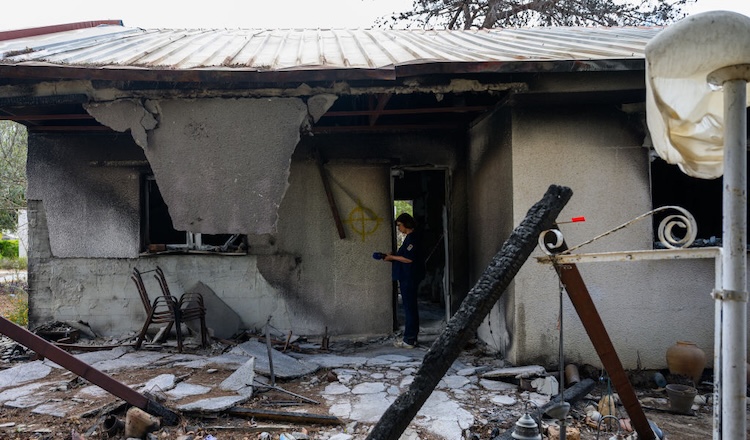
The book’s power lies in the fact that Murray doesn’t spare us. The British writer visits a heartbreaking reunion of survivors and relatives of the dead and tells their tragic stories. He meets with Israeli officials who have the unfathomable task of identifying the bodies of murdered women. Murray brings us back to the Nova music festival, vividly depicting the topography and atmosphere and the chilling reality that it was nearly impossible to escape. He takes us to the Nir Oz kibbutz in the northwestern Negev desert where barbarism shattered the peace. Murray ventures from house to house to recount the massacre.
Most of us have already heard the October 7 death toll put into perspective: It was around the equivalent of some 44,400 Americans being killed by terrorists on a single day. Or approximately 15 9/11s. It is far more haunting and powerful to hear those stories one by one.
Reading Murray’s harrowing retelling of that day should repulse any decent person. I’ve paid close attention to this conflict for decades, and I still found myself naively struggling to comprehend how Palestinians can gleefully rape, torture, and murder defenseless women and children. How could any American rationalize such horrors?
Murray drills to the heart of the conflict by raising a question: “What can people who value life do in the face of those who worship death?” The uncomfortable truth is that there is no good answer. Palestinianism is more ideology than ethnicity, driven almost exclusively by a preternatural hatred of a single people who are blamed for every calamity and struggle. The Arab Palestinian is largely an invention of the 20th century, an antidote to Zionism, which is why its history boils down to a single grievance about a needless war launched and lost against the nascent Jewish state in 1947–48. Others—Arab satrapies, Soviets, and then Iranians—have tapped into the aggrievement over this perceived injustice to create a proxy army of civilians against a Jewish state. Once the bogus nationalistic cause petered out with the two intifadas, the Palestinians adopted a more insidious theological basis for their struggle: a death cult.
All the time, as Murray writes, Western academics and fellow travelers began creating a mythology to justify the terrorism and anti-Semitism, convincing us to adopt ahistorical words and ideas like “settlers” or “West Bank” or “occupation” to create the perception that “Palestine,” which has never exist-ed, would inevitably exist again. This might be the world’s first postmodern conflict.
No other people in the world embraces an ideology predicated on the notion of sweeping a vibrant, wealthy democracy (and nuclear power) into the sea. And everyone who perpetuates this doomed cause rather than demanding that Palestinians accept reality shares in the responsibility for the tragedy that has unfolded in the region.
Murray deftly pierces holes in the deceitful accusations of Israeli “genocide” and “starvation” and “apartheid.” He exposes the inane idea of proportionality and disproportionality: “It is a curious concept that has gained prominence almost solely in wars involving Israel,” Murray points out.
After visiting points of Hamas infiltration on the Gaza border, Murray walks the decimated streets of Rafah in Gaza’s south. It’s difficult to read this portion of the book without thinking about Yahya Sinwar, the deceased Hamas leader, referring to the Palestinian dead as “necessary sacrifices,” or about those vile bloated terror “leaders” of Hamas who sit in Qatari five-star hotels while Arab children are sacrificed as martyrs to the grinder of war. Just as campus anti-Semites rely on the Western ideal of open expression to spread their authoritarian message, Islamists use the humanity of the West to spread their propaganda.
Murray is often portrayed as a Likud propagandist by his critics. But On Democracies and Death Cults does not shy away from criticizing those who allowed one of the most devastating security failures in the Jewish state’s history—perhaps only the Yom Kippur War compares. In his interview with Benjamin Netanyahu, the author presses the prime minister to take responsibility for the catastrophic failure. No luck.
At first reading, Murray’s book makes it hard for the reader not to feel pessimistic about the future. But he also tells the story of a dramatic transformation of the region since October 7. Hamas, perhaps the most immediate threat to both Jewish and Arab lives, is dramatically weakened. Hezbollah, the theocratic militia that has kept Lebanon in a state of turmoil and war for decades, is reeling after a series of inspired hits by Israel. That victory over Hezbollah helped send Bashar al-Assad, a real-world genocidal dictator, into Russian exile. And Iran, which spent decades and great treasure building these proxies throughout the Middle East, has been dealt another blow with the destruction of its air defenses.
Even more than all that, it’s heartening—and perhaps unduly idealistic—to read Murray’s book and know that Israel is on the side of civilization. Western elites like to say that the Israel–Palestinian problem is impossible to crack because it’s exceptionally complex, pitting dueling faiths against each other in a battle that harkens back thousands of years. This is just uneducated puffery. Israel isn’t engaged in a holy war. In 2005, it emptied Gaza of Jews, by force, to make peace—one of many fruitless sacrifices the country has made in pursuit of normality and space.
Indeed, there’s perhaps no conflict in the world with brighter moral lines. “Choose life,” Murray writes, “is one of the most important commandments of the Jewish people. It is also one of the fundamental values of the West.” Like any modern democratic state, Israel is a raucous and often imperfect place, to say the least. But the Jewish state can’t just talk about its values. It’s impelled to fight for them—and win.
Photo: Alexi J. Rosenfeld/Getty Images
We want to hear your thoughts about this article. Click here to send a letter to the editor.