In the spring of 2002, Los Angeles Times senior editor David Lauter was being grilled on his paper’s anti-Israel bias during a panel discussion at a local synagogue. The second intifada was raging, and to Jewish consumers of American media, it appeared that the Israeli military could do no right and the Palestinians’ terror-sponsoring leadership could do no wrong. Near the end of the discussion, one woman told Lauter that she missed the days when the press portrayed Israel as a plucky David taking on the belligerent Goliath of the Arab world.
Lauter responded: “Ninety-nine percent of the time Goliath wins. So stick with Goliath.”
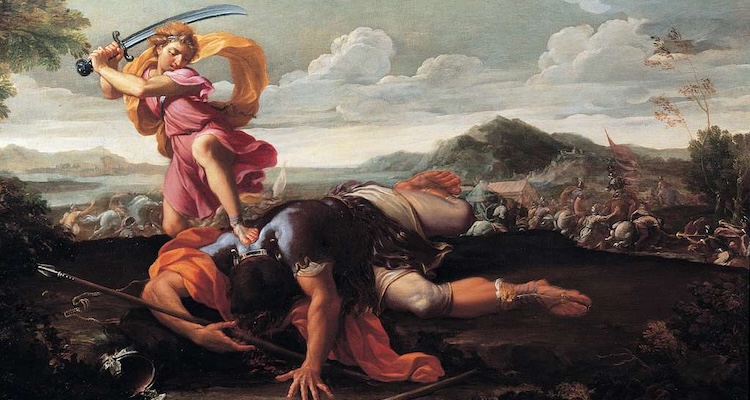
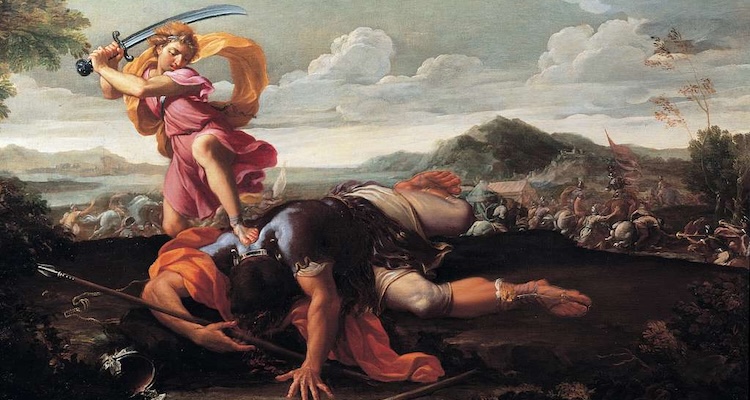
The David-Goliath analogy, forever a metaphor for the Jewish people’s ability to find their way through a seemingly impossible situation and triumph at the end, has been a workhorse for 80 years—especially in the United States. For decades, Americans saw Israel’s rebirth through the lens of the biblical tale of the modest shepherd who defeats the terrifying giant with a slingshot, setting in motion a series of events that culminates in the establishment of a sprawling Jewish kingdom and a dynastic line that is said to include the Messiah himself.
But for decades now, and especially since the Israeli counterassault on Gaza, Israel has invariably been cast as the terrifying giant. Two months into the war, Ksenia Svetlova, a former member of the Knesset, noted the media’s reliance on this framing: “Israel was now Goliath, while the Palestinians in Hamas-controlled Gaza were David.”
It has not ceased. “Once the David of Middle Eastern conflict, Israel is now the increasingly vilified Goliath, even as it sees itself in a struggle for survival that it did not initiate,” declared Roger Cohen in the New York Times on the first anniversary of the current war.
Jackie Calmes of the Los Angeles Times in July 2025: “The suffering, and the transformation of Israel’s image from David to Goliath, from righteous to wrathful, is in turn transforming U.S.-Israel politics.” DePaul University professor Tom Mockaitis took to the Hill in June to explain “How Israel evolved from the Middle East’s David to its Goliath.”
Previous generations of American liberals prided themselves on sticking up for the underdog, and for decades Israel fit comfortably in that box. The story went something like this: After the UN decreed there would be two states in what had been Mandatory Palestine, 22 Arab countries rejected the plan and sought to destroy the newborn Israel in its crib. Outnumbered and outgunned, Jews fought valiantly in the face of what would have been a second Holocaust against the combined forces of their Arab neighbors and brought their war for independence to a successful end.
For the next two decades, Israel was viewed as a plucky glorified refugee camp of a left-liberal’s dream; it might have been a Jewish state on the site of ancient Hebrew kingdoms, but it was wonderfully up-to-the-minute, secular in governance and affect, and with socialist tendencies. It was a society of equals fighting for their own equality among the nations. Harry Truman and Josef Stalin raced to be the first world leader to recognize Israel’s existence.
The Communist folk-singing group called the Weavers, who were followers of Stalin’s lead rather than America’s, made a huge hit out of an Israeli tune called “Tzena, Tzena, Tzena” about a young girl being coaxed to a dance, with lyrics in English that would come to have horrifying ironic resonance after the Nova music festival massacre on October 7 nearly 80 years later: “Join the celebration / There’ll be people there from every nation / Dawn will find us laughing in the sunlight.”
But then, after Israel’s second triumph in the Six-Day War, the narrative began to shift on the left as Israel began to mature and change into a politically complex country. Over the next few decades, militarily powerful and unashamed to press its advantages, the Jewish state became less socialist and more religious. The Eastern European Jews who had dominated the state’s founding and politics for its first three decades were dismissive of the Middle Eastern Jews who had flooded into the state by the hundreds of thousands after their expulsion from Arab countries and who had their own ideas of how to run a Jewish nation.
Good liberals could not ignore this seismic shift in the power structure inside the supposedly glorious social-democratic state that was making the desert bloom. Nor could they avoid the conclusion that there was a new underdog to champion: the very Palestinians, whose absolute rejection of their own state in 1947 had led to Israel having to fight a war to save its life.
Older American liberals were attached to a certain idea of Israel, an Israel that met specific conditions that flattered their ideological worldview. When that conditional love began to fray, American Jews for whom Israel remained a defining cause grew worried for the future of the U.S.-Israel relationship. But it turns out that there was something far more troublesome lurking. At least older liberals wanted to love Israel again. The response to October 7, 2023, revealed that they are being succeeded on the left by new generations of progressives who don’t see the conflict as former-David versus former-Goliath. To these younger progressives, Israel was never worth rooting for. They don’t see a justification for Israel to exist at all.
One inadvertent perversity of the Zionist left was that its love of Israel was in part due to Israel’s weakness and perilous strategic position. Its perpetual fragility mirrored the idea that the Jewish people exist in a state of existential fragility that makes a Jewish state necessary…and means the Jewish state will not be a threat to anyone.
Today’s progressive left wants Israel to be weakened not because that will make the Jewish state more sympathetic but because a weaker Israel is one step closer to its own destruction. This is the fundamental lesson of the post–October 7 world, in America and elsewhere.
_____________
If David versus Goliath was the biblical reference point for Americans rooting on the young Jewish state, Leon Uris’s Exodus, published in 1958, and the film adaptation of it released two years later were the modern pop-culture equivalent. The epic novel about Israel’s founding was a literary phenomenon. Americans loved it—the book stayed on the New York Times bestseller list for a year and, according to the Times, sold 5 million copies in hardcover by the time a paperback was released seven years later. The movie (and Paul Newman’s casting as the lead) played into Americans’ impression of the story as a Jewish version of their own revolution against colonial Britain. The tough New Jew was a welcome departure from the stereotype of the Jew as history’s perpetual victim.
It’s not clear when exactly the New Jews began to fall out of favor, but two events stand out. The first was Israel’s victory in 1967, which saw it suddenly in charge of stateless Palestinian Arabs, thus marking the moment when there was someone lower on the regional food chain than the Israelis. Palestinian Arab nationalism, still relatively young and raw and violent, went from being the Arabs’ responsibility to being Israel’s, which put it on the West’s plate and left it there.
The second event was the Lebanon War of 1982. Five years earlier, a revolution in Israeli politics had brought the Israeli right to power for the first time, led by the Revisionist Zionist and former Irgun commander Menachem Begin. Born in Russia, Begin was a religious man who resented relinquishing any part of the Land of Israel. “Israeli citizens, the American Jewish community, and I were shocked” by Begin’s victory, recalled President Jimmy Carter, who had recently taken office. Carter pronounced Begin’s hard-line politics “frightening.” The Likud leader, the president said, “seemed to look on himself as a man of destiny, cast in a biblical role as one charged with the future of God’s chosen people.” The Israeli left-wing establishment that had governed the country for its first three decades was suddenly off the stage, and Americans—many American Jews included—were unnerved by the new government’s outward religiosity and hawkishness.
Even after Begin signed the Camp David peace agreement with Egypt in 1979, which remains the most significant land-for-peace deal in Israel’s history, he was viewed as an extremist. Ronald Reagan, whose presidency began in 1981, was far better disposed toward the Jewish state, but he still held Begin and his team—which included the war hero Ariel Sharon as defense minister—in suspicion.
Until this point, all of Israel’s wars had been defensive land wars against invading armies. But the fight to suppress Palestinian terrorism was different. Led by Yasir Arafat, the Palestinians created a portable terror statelet. First they established a beachhead in Jordan, conducting terrorist attacks and hijackings until King Hussein sent his army in 1970 to slaughter as many of them as they could in a conflict that came to be known as Black September. Hussein allowed the surviving remnant to escape to Lebanon in 1971. Between the 1973 Yom Kippur War and Arafat’s expulsion from Lebanon in late 1982, the PLO shelled towns in northern Israel more than 1,500 times while also carrying out terrorist attacks within Israel.
There was one other Palestinian innovation in Lebanon that came about with Israel’s decision to invade Lebanon to end the PLO shelling. In previous wars, to save face, Arab countries had gone to great lengths to conceal from their own people the true results of their confrontations with Israel. The last thing they wanted to publicize was their forces getting routed by the IDF. Photos and videos of the decisive battles would have been humiliating. The Palestinians, however, knew they could not defeat Israel militarily. Nor did they care what happened to Lebanon, which they treated the way any parasite treats its host. The PLO invited the world to witness Israel at work, as losses mounted on both sides and the IDF eventually moved north and to Beirut. It worked: The media portrayed Israel as a brutal, merciless war machine, and a new narrative took firm hold. In private, the New York Times reported, President Reagan declared “that Israel had moved from being the ‘David’ to the ‘Goliath’ of the Middle East.”
The American public had some doubts about the alliance as well. Late in the war, the Washington Post reported on polling that “strongly suggests that many Americans are in a process of reappraising their thoughts about the relationship between the United States and Israel.” Regarding whether their sympathy was with Israel or the Arab nations, 52 percent still said Israel; a mere 18 percent said the Arabs. But cracks were forming. On whether Israel’s invasion of Lebanon was justified, Americans were split: 41 percent said it was, while 37 percent said it wasn’t. Their judgment of Israel’s reliability as an ally dropped from 54 percent before the war to 44 percent two months in.
By 1985, polls showed more Americans believed “the United States should reduce its ties to Israel in order to lessen the acts of terrorism against us in the Middle East.” As the 1990s rolled around, increasing numbers of Americans supported giving the Palestinians a state in the West Bank and Gaza, and fewer backed maintaining high levels of aid to Israel. (Economic aid to Israel was ended in 2007; currently, all U.S. aid to Israel is military aid and is spent on American companies.) One of those reconsidering their support for Israel, a New Jersey production worker, told the New York Times it was because “they aren’t the little boy on the block anymore who need our help. They have the right to exist, but not to expand their borders. Just as the Arabs once threatened to push them into the sea, now they are trying to push the Arabs off their land.”
The peace process that took off soon after would lock this framing into place. Put simply, it held that the Palestinians lived on their own land, so all Israel needed to do was release that land to them and the conflict would subside. No matter that the Palestinian Arabs had always rejected statehood alongside a Jewish state or that they had become a cat’s-paw of the Arab world, whose land and population dwarfed Israel’s. The Arab–Israeli conflict was transmuted into the Israeli–Palestinian conflict. In this new framing, Israel was big and strong, the Palestinians small and weak and dependent upon the patronage of others to survive. As if to drive this point home, Hamas named its most recent war strategy in Gaza “Stones of David.”
But is this fair to David? After all, he wasn’t weak—just underestimated. The actual David became king, united the Jews, and expanded his kingdom by winning wars of annihilation that were waged against his people. David Lauter was wrong—Goliath doesn’t win 99 percent of the time. We only know about Goliath because he lost. David beats Goliath every time, otherwise he isn’t David. The enemies of Israel are wishcasting when they claim that Israel has become Goliath. They should be so lucky, because, again, Goliath loses; mere size isn’t enough to vanquish canny innovation and strategic thinking. Instead, they’re stuck with David.
This explains why anti-Zionists needed to think up an entirely new backstory for the Jews and Arabs of Palestine, one in which the ongoing presence of Jews in the Holy Land from time immemorial is a myth and the idea of Israel is simply an outgrowth of 19th-century European nationalism that used stories from the Hebrew Bible to create a false history.
This is what Yasir Arafat told Bill Clinton at Camp David, a ludicrous piece of revisionism considering that the Tel Dan Stele, a piece of carved stone from the ninth century b.c.e discovered in 1993 (seven years before Arafat’s conversation with Clinton), literally mentions “the House of David” in the Aramaic language. Pretending that the Jews are foreign colonizers was and is intended to dissociate them from the Davidic legacy and raises the anti-Semites’ hope that perhaps Israel can be defeated.
Whatever the motivation for the big lie of Israel as a European colony, the implications are unambiguous: The Jewish state must be dismantled in the name of justice. Older generations of American liberals didn’t feel this way. They still liked the Ari Ben Canaan of Exodus, the strapping Jewish man of action who sought to break bread with neighboring Arabs and simply find a place on earth for his suffering people. To them, Israel’s post-1967 expansion was the problem, but Israel’s rebirth in 1948 was still right and just.
The formative domestic experience for those American liberals was the civil rights movement. And since the large majority of 20th-century American Jews became loyal Democrats, the world of left-of-center activism contained a lot of common ground; American Jews sought full rights for American blacks just as they sought full recognition of Israel’s right to exist.
_____________
Had that tradition of American liberalism persisted into the 21st century, the aftermath of October 7, 2023, inside the United States might have looked a lot different. In an earlier era, left-wing activist groups likely would have seen it as the perfect opportunity to demonstrate that they would leap to the defense of a Jewish victim just as quickly as they would for any other victim.
But that’s possible only in a world in which Jews could, under the right conditions, be victims. That’s not something the newer generations of progressive activists believe. They had long ago internalized the concept of the irredeemable Israeli. They subscribed to the dogma of decolonization, and October 7 affirmed their worldview. Hamas’s murderous and genocidal spree was, grotesquely, proof to them that the arc of history still bent toward justice.
American Jewish organizations were blindsided by this. Suddenly their calls to other minority-rights groups went straight to voicemail. The decades they had spent building relationships in good faith crumbled overnight.
Should they have expected this turn of events? Those who cast a critical eye on the “David and Goliath” framing certainly did. In 2014, Joshua Muravchik published his extraordinary book, Making David into Goliath: How the World Turned Against Israel. What begins as a chronicle of the well-known narrative ends with a bit of foreshadowing. Muravchik wrote of the new anti-Zionist realignment taking shape on the left: “As with the proletariat under classical Marxism, the favored groups—blacks, browns, former colonials—were not merely objects of sympathy; they were regarded as the vessels of universal redemption. Not only were Gandhi and Mandela seen in this light, but even, to some, Ayatollah Khomeini. The French social theorist Michel Foucault wrote rapturously of the Iranian revolution in Le Nouvel Observateur in 1978, seeing in it an ‘attempt to open a spiritual dimension in politics,’ a ‘possibility we [Westerners] have forgotten since the Renaissance and the great crisis of Christianity.’”
Under the old regime, victimhood could be temporary. But “former colonials” are forever. One can never stop being a “former colonial,” no matter one’s current station. And the anti-colonialist takeover of American academia ensures there will always be an intellectual framework to prop up this Weltanschauung.
For American Jews, then, the days of apologizing for Israel’s strength should be over. And no matter one’s position on the settlements, the Jewish connection to the land should never be downplayed or denied. Finally, American Jews should remember the difference between criticizing Israeli government policies and painting the state or its government as illegitimate or inhuman. Today’s anti-Zionists are not arguing about what kind of state Israel should be. They want it gone entirely. The American Jewish community must adjust to this new reality and celebrate Israel as David—not the lowly shepherd, but David, the author of the Psalms, the father of a divinely inspired nation, Melech Israel.
We want to hear your thoughts about this article. Click here to send a letter to the editor.