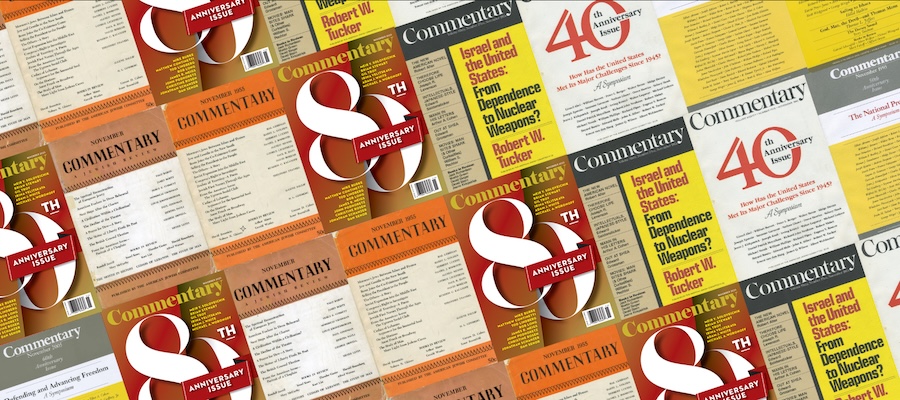
Commentary Magazine turns 80 this month. Back in November 1945, it was a modestly funded intellectual exercise with spectacularly immodest ambitions: to explain America to the Jewish people and to explain the Jewish people to Americans.
We live in a culture now so drenched in layers of irony that the idea of a new magazine openly adopting such an ambition would trigger nothing but scorn and eye-rolling among the social media cognoscenti. If you can, though, try to imagine a world in which a small magazine could come into being with a purpose so lofty, especially after a war whose scale and destruction dwarfed anything the world had ever seen.
There was nothing risible about it at all.
Today, when we talk about the twin horrors of the 20th century, Communism and Fascism, we do so from a thousand different historical perspectives involving the coming of mass media, the development of unimaginably destructive weaponry, power politics, and the like. But the deepest truth of all is that these creeds that murdered more than 100 million and nearly destroyed the world’s oldest people—these creeds emerged from…pamphlets. From articles, published magazine-style, in other words.
The Communist Manifesto was a pamphlet. The revolutionary work published in Russia that seeded the ground for the coming of Marxism-Leninism there seven decades later was a pamphlet titled What Is to Be Done? Mein Kampf was a book-length pamphlet. And why consider only the pamphlets that gave birth to evil? A year before the Founders would establish the moral and philosophical framework for independence, Thomas Paine made the populist case for the American Revolution in his pamphlet Common Sense. And perhaps the most enduring of the world-altering pamphlets of the 19th century—the one that helped give birth to a nation whose longevity has put the lifespans of Nazi Germany and the Soviet Union to shame—was Herzl’s The Jewish State. It’s all of 25,000 words. To give you a sense of how long that is, this issue of Commentary comprises about 60,000 words of text.
Just what can a pamphlet do? It can set people’s minds on fire. In Tom Stoppard’s Leopoldstadt, the greatest play of the 21st century, two Jewish brothers-in-law living in Vienna in 1896 have an argument about The Jewish State—at a party in the home of the one so eager for assimilation that he has married a non-Jew and converted. This assimilationist dismisses Herzl and his pamphlet. Why, he says, even the magazine of which Herzl is the literary editor will not review it, and no Jew in Vienna has any interest in Herzl’s Zionist fantasies! His brother-in-law is not so sure. He has just returned from Galicia, the poor province of the Austro-Hungarian Empire where he was born, to visit his parents in their shtetl. And there, he reports, “everywhere we went I was asked about Herzl. His book was going around like an infection. These are people whose parents arrived with their parents running for their lives from the Cossacks, and mentally they’re living with their bags packed. In Galicia the Jews are hated by the Poles, in Bohemia by the Germans, in Moravia by the Czechs. A Jew can be a great composer. He can be the toast of the town. But he can’t not be a Jew. In the end, if it doesn’t catch up with him, it will catch up with his children. Ordinary Jews understand this…. So when someone comes along and says, ‘We lost our territory and we can have it again, a territory where we’re not on sufferance, where we can be what we once were. Where we can be warriors.’”
The Jews of Galicia and elsewhere outside the cosmopolitan centers of Central and Eastern Europe helped make up the population of the Yishuv, the Jewish settlement in the Holy Land, with tens of thousands emigrating around the turn of the century—summoned by a vision of the future presented to them by Herzl’s pamphlet.
This is the case for intellectual argumentation. For polemic. For con-flicts in words and not just on the floors of legislatures, or on streaming and cable, or on actual battlefields. The case is that the words matter because words convince. Authoritative arguments laid out with precision and care at the highest level of insight are, in the awful but catchy parlance of our day, “sticky” in a way nothing else is. Who can remember the Twitter battle of three days ago that consumed the attention of millions for a few hours? No one. That’s why these battles flare up and die off, because there’s always another petty fight coming down the pike to take its place.
I’m as guilty as anyone of falling prey to the dopamine rush that comes from engaging in these ludicrous and pointless skirmishes. But a dopamine rush comes, it spikes, it dissipates. An idea, a new idea, a new way of looking at something, a fresh approach when it comes to arguing against something—these do not dissipate. They plant themselves in our minds, and then they germinate. They provoke new thinking, either in ways that help the argument to grow and flourish, or they prune it down to its essentials, or they reveal a fatal weakness that allows you to pull it out by its roots and make sure it dies on the vine.
That is the gift of the intellectual magazine, and the profound service it provides its readers and the culture at large. The deep human impulse to make these arguments, the need to have these things out, is still everywhere and is unchanged. So new media have arisen to make them possible. The citizen journalism practiced by bloggers has now been professionalized, by Substack, for example, and the free market of ideas supported by readers who feel they profit from these ideas has never been more vibrant. Here at Commentary we play with ideas in a new way every weekday on our podcast.
But the greatest of all modern vehicles for the presentation of ideas in readily consumable but still formidable fashion is still the magazine. And there are so few of any value still left, still publishing, still thriving. Well, Commentary is still here. Still publishing. And judging by the enthusiasm of our audiences, we are not only thriving at present but show every sign of continuing to thrive in the future.
I have been the editor of Commentary for 16 years now, constituting one-fifth of its lifespan. The arguments and analyses that have been hosted in these pages during my tenure have spanned the Obama, Trump, Biden, and second Trump administrations; the rise of a dangerous new left activism; the emergence of a politically destabilizing populist movement on the right; the politicization of gender itself; the poisoned chalice that higher education has become; the weaponization of public health; the deserved collapse of trust in once-unassailable institutions; a psychic crisis of meaning for America’s youth that seems to be related to the omnipresence of always-connected internet devices; and an explosion of Jew-hatred without precedent in this country’s history.
The Jewish state faced the worst threat in 50 years on October 7, 2023. We were all forced to note, with horror and disappointment, how voices expressing sympathy and understanding for our plight began to go quiet while the fight to speak freely as Jews and for Jews to live freely in their own nation stretched across two long years. We saw such people lose their stamina, their heart, their spine, and go supine.
But not you. Not you, reading these words. I hope we did our part to help you retain your stamina, to strengthen your heart, and to stiffen your spine. And I hope that we set your minds on fire.
May Commentary live to be 120.
We want to hear your thoughts about this article. Click here to send a letter to the editor.