Just a dozen years ago, small drones were mostly high-tech playthings for hobbyists. DIYers assembled backyard drones from kits, while a handful of U.S. start-ups—including 3D Robotics, a company launched by former Wired magazine editor Chris Anderson—were developing quadrotors for photographers and tech buffs. At the same time, the Chinese company DJI Technology was entering the U.S. market with its inexpensive and easy-to-use Phantom drones.
Then, small drones were mostly deployed for fun or used by small businesses like wedding photographers and realtors. Anderson and a few others saw that drones would be valuable in more critical applications, such as high-tech agriculture and search-and-rescue operations. A few people also foresaw that small, hard-to-spot drones would someday be useful on the battlefield. But Pentagon officials and military contractors alike showed only modest interest in the new class of small airborne gadgets that seemed more akin to toys than to weapons of war.
While the Pentagon slept, the civilian market for small drones boomed. DJI undercut all competitors with its cheap, highly capable quadrotors. Based in Shenzhen, China, the company has several advantages over U.S. manufacturers. One is relatively low-cost labor, of course. But DJI also has easy access to all the high-tech components needed to make a consumer drone: small, high-torque motors; powerful, lightweight batteries; microchips; GPS sensors; digital cameras, and more. China leads the world in manufacturing all those items—right down to the rare earth elements, lithium, cobalt, and other raw materials critical for modern electronics.
By 2016, Anderson and 3D Robotics recognized that they couldn’t compete with the flood of imports. The company stopped producing consumer drones and pivoted to developing software for more advanced drone applications, including autonomous operation. In this move, 3D Robotics was following a pattern established by Apple and other American tech companies. Typically, U.S. firms invent new tech products and develop the software they run on, but the hands-on manufacturing usually gets done in China and other lower-wage countries. Often, as in Apple’s case, those manufacturers are suppliers. Sometimes, they wind up being competitors. (Today, DJI produces about 90 percent of the small consumer drones sold around the world.) At the time, not too many people noticed that the U.S. was losing its nascent niche of domestic drone manufacturers. Fewer still thought the trend might have geopolitical implications.
Then came Ukraine.
It’s a truism that revolutionary shifts in military technology are rarely appreciated until they’ve been painfully revealed in battle. World War I showed the crushing power of heavy artillery and the need for armored vehicles. Pearl Harbor and Midway proved that aircraft carriers, not battleships, would henceforth rule the seas. Today, the next era of warfare has become visible on the ravaged plains of Ukraine.
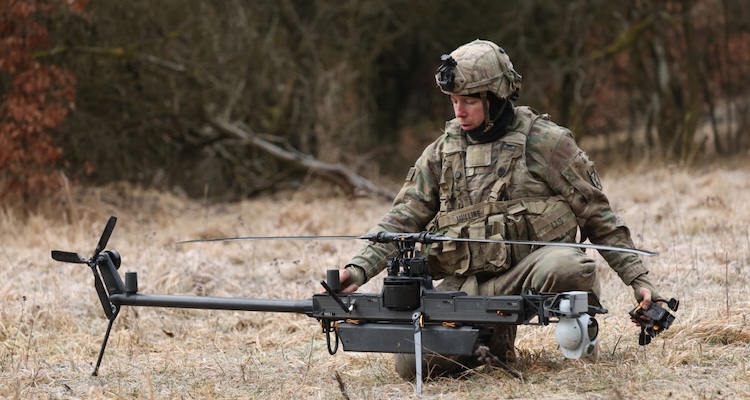
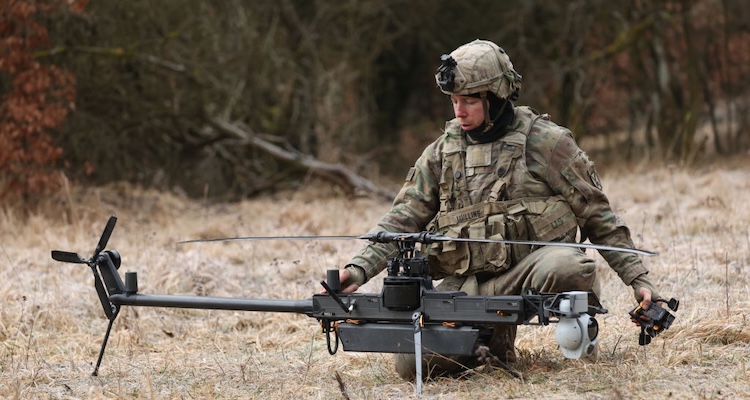
In 2022, when Russia launched the current invasion, it sent airborne troops and columns of armor against the Ukrainian capital of Kiev. These were classic tactics. But those attacks bogged down, and the Ukrainian military soon began finding ways to compensate for its relative lack of heavy armor and artillery shells. Off-the-shelf DJI drones proved useful in surveilling Russian troop movements. Then, savvy Ukrainian technicians began adapting first-person-view (FPV) drones to carry modified grenades and other explosive payloads. Delivered with pinpoint precision, these tiny weapons can take out tanks and armored personnel carriers, or target individual soldiers on foot or motorcycle. In 2024 alone, such attacks contributed to Russia’s reported loss of over 3,600 tanks and nearly 9,000 armored vehicles. Russian troops have suffered an estimated 1 million casualties in the war so far. About 80 percent of those losses have been inflicted by drones, according to one estimate.
“We are inventing a new way of war,” one Ukrainian drone builder told New Yorker military reporter Dexter Filkins. The Russians, with their vastly greater resources, are catching up fast, deploying myriad varieties of drones and copying every Ukrainian innovation. Both sides fill the skies with electronic-warfare transmissions meant to jam communications between FPV drones and their hidden pilots. The war has become a lightning-fast technological ratchet. As a result, the Russia-Ukraine battle space today looks like nothing a 20th-century military expert could have imagined. Tanks and other armor are rendered nearly useless. Squads of infantrymen can barely move. With so many eyes in the sky, any soldier or vehicle moving in the open will likely be targeted and destroyed within minutes.
Meanwhile, inexpensive drones allow each nation to extend its destructive reach far into the other’s territory. Earlier this year, Ukraine managed to deploy over 100 drones close to air bases thousands of miles inside Russia. The attack damaged or destroyed at least 20 of the country’s virtually irreplaceable strategic bombers. The entire operation probably cost less than a single American cruise missile. And this is all happening even before swarms of autonomous, AI-controlled drones enter the fray in force. Ukrainian engineers are working on those, too. “It’s a totally DIY-drones conflict,” Anderson told me.
The lessons from Ukraine are clear—and ominous. The next major war will likely be won by whichever combatant has the industrial capacity to manufacture, deploy—and continuously improve—millions of drones per year. That leaves the U.S. in a scary position for two reasons: First, the Pentagon’s weapons-procurement system is famously slow and backward-looking, while the prime contractors who build our ships, planes, and other hardware seem to grow more lethargic each year. Second, we simply don’t have a civilian industry capable of producing large numbers of inexpensive drones. During World War II, the U.S. had a huge industrial base that was able to pivot to military production. But in this century, America’s homegrown drone industry never got off the ground.
This will make things awkward if we ever face a war with China. It’s not like the Pentagon can call up DJI and say, “We’d like 10 million of your very best drones, please.” And the problem goes deeper than drones alone. As economist Noah Smith and others have pointed out, the ability to produce drones depends on an entire ecosystem of components, raw materials, software, and expertise. Smith calls it the Electric Tech Stack. The tech-stack concept is borrowed from the world of software, where it describes the layers of technology and capabilities—databases, programming languages, coding expertise—needed for a piece of software to work. All advanced industries rely on some version of this stack. Nineteenth-century steelmaking, for example, required coal and iron mines, railroads and ships to deliver those inputs, Bessemer blast furnaces, expert metallurgists to run them, and more. Without the whole stack, there would be no steel.
The tech stack needed to build drones includes batteries, high-performance motors, power electronics, and various chips for telemetry, communication, and so on. None of these components are terribly expensive today. In fact, unlike conventional, high-grade military equipment—a Predator drone, say—this stuff is all mass-produced for consumer products. And that’s a problem. The U.S. has gotten in the habit of outsourcing this kind of mass production. Ditto for the raw materials that go into batteries, motors, and other components. Right now, the U.S. has only one working mine producing the rare earth elements vital to cutting-edge electronics. According to a 2022 report, China controls most of the world’s rare earth mining and processing, and accounts for 92 percent of rare earth magnet production.
There’s a reason analysts describe these as “chokehold” technologies. “If you want to defend your country, you simply have no choice but to secure the Electric Tech Stack,” Smith writes. And reliable access to tech-stack materials and components isn’t just important for making drones. Our technological world is changing, shifting away from fuel-driven machines and toward precise, electrically powered systems. We see this trend in everything from cars and backyard tools to aviation and manufacturing. Ryan McEntush, a partner at the Andreessen Horowitz investment firm, explains: “Electrified systems, built on batteries, power electronics, and high-torque motors, are more efficient, more precise, and more responsive to software.” The same inputs and skills needed to build drones will also be crucial to mastering this next wave of innovation. As Smith notes, “If you have the ability to make drones domestically, you can also manufacture an increasingly large percentage of everything else.”
So, how do we bring this ecosystem back to U.S. shores? After all, we invented many of these technologies in the first place. The easy answer is that we need some kind of industrial policy to prop up American ventures, and we need tariffs to handicap foreign competitors. As a free-market true believer, I’m leery of this path, and not just philosophically but practically. Back in the 1920s, Congress passed the Jones Act, which mandates that only America-made, -owned, and -operated ships can carry goods between U.S. ports. The act was intended to protect our domestic shipbuilding industry. The law utterly failed at that goal, but it imposes huge, unnecessary costs on U.S. consumers and businesses to this day. Similarly, presidents from Jimmy Carter to George W. Bush have imposed tariffs on steel imports. These actions didn’t bring back the glory days of American steel hegemony, but such tariffs continue to hurt other U.S. manufacturers by raising the cost of one of their key inputs. In short, crude attempts to protect U.S. industries usually backfire.
I asked Chris Anderson whether there were any policies that might have helped companies like his keep drone manufacturing in North America. He gave me a two-pronged answer: 3D Robotics aimed to supply drones to high-tech farmers and other commercial users who needed systems that could fly autonomously and travel beyond the operator’s line of sight. But FAA regulations, which were geared more toward toys than tools, held them back. “The whole point of what we developed—flying robots—was that they could go beyond remote-control or piloted aircraft, multiplying human potential by operating on their own or at least in a many-to-one ratio with a human operator,” he told me in an email. Even today, FAA regulators allow such operations only in limited trial projects. As long as such advanced applications remain in regulatory limbo, there’s “no real path to scale,” Anderson said.
In other words, the best way to help U.S. drone makers and other innovators isn’t to offer handouts to certain, politically fashionable businesses. It’s to remove the regulatory barriers that hold back the smartest companies. (In a Manhattan Institute report earlier this year, I argued that simplifying FAA rules and other regulations is also the key to helping our homegrown space-launch industry thrive.)
Anderson’s company also had some frustrating talks with the Department of Defense about military applications for drones. When it comes to fostering a domestic drone industry suitable for defense, “I don’t think tariffs or bans would have really helped much,” he said. “What we needed was strong demand signals.” At that time, the Pentagon’s approach to drones reflected its time-honored dedication to “fighting the last war.” It was most comfortable working with established military contractors building small quantities of expensive weapons systems. The notion of deploying vast numbers of small, cheap, highly expendable weapons didn’t fit that paradigm. Since then, the war in Ukraine has been a wake-up call, Anderson notes, and “may finally lead to an embrace of what we were pitching.” Sadly, a decade of progress has been lost.
What if, instead, the Pentagon had fostered a bottom-up approach? Beginning in 2004, the Defense Advanced Research Projects Agency (DARPA) sponsored a series of competitions to find the best autonomous-vehicle tech. Winning teams won modest cash prizes. Those contests helped jump-start the U.S. AV industry. NASA took a related approach two decades ago when it invited private launch companies to propose new space vehicles to carry cargo, and eventually astronauts, to the International Space Station. The winning proposals—including one from the then-unproven SpaceX—won grants to help develop their vehicles. Since then, NASA’s resulting commercial space program has saved taxpayers billions. The Pentagon could have launched a similar contest to surface the best emerging military drone technology. In fact, it still can.
Anderson envisions DARPA-style competitions pitting teams against each other, “drone swarms on one side, and counter-drone technologies on the other.” A series of such face-offs would reveal the best technology on each side, and the winning companies would then receive significant funding to keep developing their platforms. NASA’s commercial space experiment helped it partially break its dependence on bloated legacy aerospace contractors. The Pentagon could do the same by catalyzing entrepreneurial start-ups instead of pouring more money into today’s broken procurement system.
The potential to win Defense Department contracts would “trigger the resumption of venture capital funding big time,” Anderson predicts. It would also have spin-off effects. NASA’s commercial space program helped spur the now-booming U.S. private space industry, which in turn attracts billions in private investment. An entrepreneurial military drone program could do the same for the U.S. drone industry—and for the Electric Tech Stack more broadly.
Developing a competitive market for military drone technology is only one step in building an American Electric Tech Stack. In fact, reforms are needed at all levels of the stack. For example, we must streamline the regulations that hold back the mining and refining of critical raw materials. We also need to make it easier to manufacture microchips and other high-tech components—not by offering billions in subsidies, as the Biden-era CHIPS Act does, but by reducing the regulatory and legal burdens that make it so hard to build factories in this country. We don’t need an old-school industrial policy to bring back the tech stack. We do need the government to step forward as a customer for the best new technologies. NASA proved that this approach can work. Now the Pentagon needs to follow suit.
Photo: Sean Gallup/Getty Images
We want to hear your thoughts about this article. Click here to send a letter to the editor.