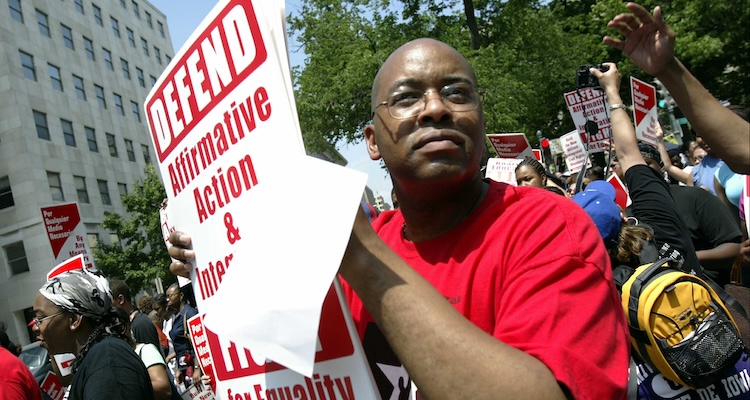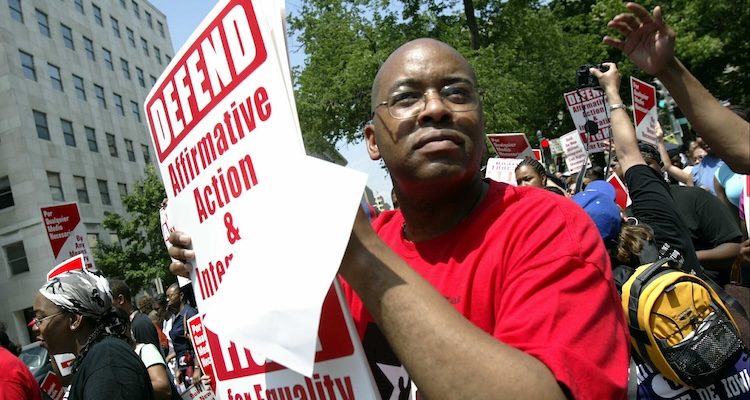
In The Affirmative Action Myth, the Manhattan Institute’s Jason Riley makes an important and timely observation: Affirmative action is not necessary to maintain America’s black middle class because black progress was generally faster before affirmative action began.
This is an empirical claim, not a political one. As Riley, who also writes a weekly column for the Wall Street Journal, points out, between 1940 and 1960—a period of black educational and business gains and improved civil rights, entirely before the passage and implementation of the first affirmative action laws in 1967—the black poverty rate dropped from 87 percent to around 45 percent.
Making judicious use of some largely forgotten historical records, Riley contrasts African-American advancements during this period and even before with those made by Russian serfs, who were white quasi-slaves in a near-peer state. The serfs were freed at the end of 1861, a year before the Emancipation Proclamation. By comparison, African Americans come out well ahead. Fifty to 60 years after the abolition of slavery, black Yanks had managed to acquire $700 million in total real property (valued in the dollars of that era) versus just $500 million for a similarly sized population of striving Russians.
Many such black trends—regarding economic mobility, property acquisition, and more—have slowed measurably or stopped since 1970. Indeed, as the blunt Riley says, it sometimes seems difficult to pick out a population-wide “black trend” that has not worsened. Such noticeable patterns range from crime (murders, half of them with a black victim, increased from 8,640 to about 25,000 between 1963 and 1993) to single motherhood—which surged from 11 percent in 1939 to 23 percent at the time of the Moynihan Report in 1965 and 69 percent today. Remarkably, although this is not Riley’s focus, residential segregation decreased by only 32 percent between 1960 and 2000, and likely increased among lower-income populations—with crime a major, if hidden, driver of continued interracial wariness.
_____________
Riley’s sober analysis of this data brings several points to the fore. Most important, it is simply not the case that gaps in performance between American blacks and whites (and, for that matter, between other groups) are due entirely to racism and so can and must be solved by race-conscious policies. Indeed, this is a logically falsifiable claim. If problems like single motherhood became more prevalent in black communities as racism measurably decreased, and they today affect working-class whites to a far greater extent than they do Asian or Nigerian immigrants, then they are not plausibly caused by racial bias and are unlikely to be resolved by campaigns against that variable.
Against the flawed conventional narrative, Riley refreshingly invokes the concept of group culture. He points out that, at least since Eldridge Cleaver in the 1960s and the wildly popular sitcom Good Times in the 1970s, the semi-criminal ghetto resident has been presented to America as the properly authentic black person. “Respectability culture,” centered on such arcane ritual practices as studying for exams and showing up on time for meetings, has been roundly condemned as being mere useless kowtowing, at least until the U.S.’s “genocidal racism” ends. At the same time, songs like “(My) Wet-Ass Pus*y” have become international hits praised for their black and feminist authenticity.
It has become taboo to point out—when we see, say, data indicating that black kids study half as much as white students and less than one-third as much as their Asian classmates—that such trends explain most of that gap. The Affirmative Action Myth does not shy away.
The text also tackles the question of why large-boost affirmative action does not work very well—and provides specific and coherent answers. Most notably, as Riley explains in detail, affirmative action does not significantly increase the total number of black (or female, etc.) students enrolled in university. This is a key, often ignored point. Because the bottom 75 percent of U.S. colleges and universities are in practice non-selective, and historically black colleges and universities like the one at which I teach will generally give a chance to any SAT-1,000+ black student willing to strive, the actual impact of Harvard and Berkeley bestowing a 150–200 point test-score boost on applicants of color (never to be confused with “colored applicants”) is not really to increase the total population of black or Hispanic collegians. Rather, it is to mismatch them. A talented black high-school quarterback who also posted a solid 1,270 SAT score finds himself at Yale, and hopelessly underwater, rather than at Purdue or Nebraska. Because his move up the academic ladder has opened a spot at Purdue, a 1,090-SAT Southern Illinois man now finds himself there, facing similar tides and sharks. As Riley says, this mismatch almost certainly explains the remarkable rate of major changes among minority matriculants at the top-100 schools.
At Duke University, for example, no fewer than 76 percent of admitted black males initially declare a “preference” for engineering or one of the hard sciences. However, only 35 percent of these solid freshmen go on to achieve a B.S. degree in these subjects, with the rest moving into sociology, various “studies” majors, and the like. Arguably, we are wasting a great deal of time and treasure creating a socially detrimental cadre of revolutionary poets and HR quota-crunchers, rather than simply letting Hispanic engineers at the top of the second tier go to Kent State.
There is more to the book. Riley notes (albeit in passing) that affirmative action programs apply to all blacks, Spanish speakers, and other non–North Asian minorities, whether or not they can claim a family history of discrimination. A recent Nigerian immigrant from a hyper-successful family, seeking to become a doctor, can still gain preferential admission to every Ivy League school—and some have. In a country where West African immigrants are a bit more successful than whites overall, this quirk has had predictable results: Ivy éminence noire Henry Lewis Gates Jr. once noted that perhaps two-thirds of all black Harvard undergraduates are either foreign lairds from Africa and the Caribbean or half-white.
At greater length (and in passages that warm my heart), Riley has fun with “woke” statistics. Debunking a now-common claim, he clarifies that chattel slavery could only ever have been responsible for half of U.S. GDP—a much-discussed assertion—if we employ the eighth-grade-science-fair trick of attributing every step of the textile sales process, such as the shipment of finished clothing to England on armed merchantmen, to the enslaved persons who produced raw cotton. Even more remarkably, Riley points out that most past quantitative studies arguing that affirmative action works fairly well cheat a bit by analyzing data for all minority scholars rather than the half who were admitted through affirmative action programs. His ideological opponents play games of this kind. Riley does not.
I can only say of The Affirmative Action Myth something I hope others might say about my own work: I wish it were longer.
Photo: Brendan Smialowski/Getty Images
We want to hear your thoughts about this article. Click here to send a letter to the editor.