In March 2024, the London Review of Books featured a lengthy, politically charged article by Pankaj Mishra entitled “The Shoah After Gaza.” The author, a prominent cultural critic and novelist, accuses Israel of acting out of “its survivalist psychosis” to exercise “unbridled brutality” against Gazans, perhaps as a prelude to “ethnically cleansing” them. Israel, he said, is threatening nothing less than “the global order” itself and, thus, is a danger to everyone and not just the people in Gaza. As for his specific reading of the Israeli–Palestinian conflict, he claims that Israeli Jews are in thrall to a hyped-up, never-ending sense of victimization and are perpetrating crimes against the Palestinians so great as to render them unfit custodians of Holocaust memory. In his view, they abuse the painful legacy of their people’s past by conceiving of their Arab neighbors as latter-day Nazis and treating them accordingly. In response, Israel’s victims, “unable to endure their misery any longer, rise up against their oppressors with predictable ferocity.” To the degree that the author offers any explanation for Hamas’s horrific assaults against the Jews of southern Israel on October 7, 2023, that is about it. Otherwise, the atrocities carried out on that day do not seem to matter much to Mishra.
What does matter, he writes, is to redeem the “moral significance” attached to “the memory of the Shoah.” In his quest of such redemption, Mishra quotes copiously from Jean Améry, Primo Levi, Elie Wiesel, Hannah Arendt, and others who wrote important works on the Holocaust. His aim, in virtually every instance, is to cite the voices of these and other leading scholars and survivor writers to turn the moral imperatives of the Holocaust against Israel. Given what he claims are Israel’s intentionally brutal aims and savage actions against its neighbors, Mishra argues that Gaza, and not Auschwitz, “has become for countless powerless people the essential condition of political and ethical consciousness in the 21st century.” As he describes them, Israeli Jews and Palestinian Arabs are now in a reversed relationship: The Palestinians are the new Jews, and Jews are, if not exactly the new Nazis, rapidly on their way to becoming such.
Mishra is hardly the first critic of Israel to think along these lines. Whenever there has been fighting between Hamas and Israel, the vitriol has poured forth, increasingly so with each new war. Columbia University’s Hamid Dabashi, writing for Al Jazeera on August 8, 2014, referred to Gaza as a “concentration or internment camp” and then added: “After Gaza, not a single living Israeli can utter the word ‘Auschwitz’ without it sounding like ‘Gaza.’ Auschwitz as a historical fact is now archival. Auschwitz as a metaphor is now Palestinian. From now on, every time any Israeli, every time any Jew, anywhere in the world, utters the word ‘Auschwitz,’ or the word ‘Holocaust,’ the world will hear ‘Gaza.’” The 2014 fighting in Gaza lasted 50 days and led to some 2,250 Arab fatalities, a third to a half of them combatants. It was not remotely the equivalent of Auschwitz. Nevertheless, in a time of widespread exploitation of the words and images of the Holocaust, comparisons of this kind have become commonplace. Where Auschwitz once was, Gaza now is.
Mishra greatly expands on these notions in his just-published book, The World After Gaza. He subtitles it “A History.” It is not. In the author’s own words, he set out to write a “personal intellectual journey” prompted by his sense of what he insists is “the defining event of the twenty-first century”—namely, “Israel’s livestreamed mass-murder spree in the Middle East.” That it was Hamas that gleefully recorded its mass-murder spectacle with GoPro and cellphone cameras in an unprecedented exhibitionist display of rape and slaughter goes unmentioned by Mishra, who is a master of this kind of rhetorical sleight of hand.
_____________
The 21st century has already been a bloody one, with hundreds of thousands of people killed and millions displaced in Ukraine, Syria, the Sudan, Congo, Tibet, Afghanistan, Yemen, and elsewhere. Mishra surely knows this. But to him, “no disaster compares to Gaza.” What explains such hyperbole? Feelings. As Mishra acknowledges, his book “is not, and cannot be, a detached account.” It expresses outrage and accusation throughout, virtually all of it directed against Israel and the “Western elites” who support it.
Another explanation is emphatically political and ideological. The book is intended to advance a “truly transnational politics” that affirms “the globally resonant accusation of genocide against Israel” by “the wretched of the earth.” Mishra’s early years were far from wretched, as he reveals. He reflects on his upbringing in an upper-caste Hindu nationalist family in 1970s India, where he “imbibe[ed] the reverential Zionism” present in his home. They had no personal familiarity with Jews or knowledge of Israel, but he notes that his grandfather supported Zionism even as he approved of Hitler’s patriotism. It’s an odd coupling, but understandable, as the author sees it, because “both Nazi Germany and Israel seemed determined to cleanse their states of alien and potentially disloyal elements and encourage a militaristic ethos among their citizens.” In later years, the author would distance himself from any fondness for such an ethos, but an early infatuation with Israeli military heroes brought the young Pankaj to go so far as to place a picture of Moshe Dayan, Israel’s defense minister during the 1967 Six-Day War, on his wall. Furthermore, although he grew up in a country with few Jews, he read widely about Jewish life and confesses to having felt “an affinity to it.” In particular, he was drawn to read extensively about the Shoah and to watch numerous films and documentaries about the persecution and mass murder of Europe’s Jews, this “out of a sense of obligation” to confront “such an extreme example of human suffering.” In the end, though, he admits, “no clear understanding” rewarded his diligent reading and watching.
A lack of understanding, and what appears to be intentional obfuscation, appears when Mishra turns his attention to the subject of anti-Semitism. He dislikes the IHRA “working definition of antisemitism” because, as he says, it “equates antisemitism with criticism of Israel”—when in fact this now widely adopted document literally states that “criticism of Israel similar to that leveled against any other country cannot be regarded as antisemitic.” Why, then, does he declare the opposite to be true?
To answer these questions, one must grasp the political goals of this book and its ideological underpinnings. Mishra filters his account of the Israeli–Palestinian conflict and, indeed, of virtually every other major dispute in recent decades, through an omnipresent prism of race and decolonization. In his own words, “all Western powers worked together to uphold a global racial order, in which it was entirely normal for Asians and Africans to be exterminated, terrorized, imprisoned and ostracized.” Nazism itself, he avers, has its origins in “Western colonialism.” And “Zionism,” he insists, is “a form of settler colonialism, allied to Western imperialisms, and possessed of an ineradicably Orientalist and racist outlook.”
For all of Mishra’s erudition, it is not reason that impels him but hostile passion directed at Israel and a strongly held commitment to undermine support for Israel. This is why his book begins by describing the assault on Jews in the Warsaw Ghetto and then immediately evokes “Israel’s annihilation of Gaza,” which he calls “an act of political evil.” Equating the two is a historical infamy. Ever since Hamas began its latest war against Israel and Israel fought back, Gaza has suffered greatly. But it has not been “annihilated.” If the author wishes to inform his readers about the true sources of “political evil,” he would do well to cite the 1988 Hamas Charter (he never does) and recount the atrocities that Hamas and its allies carried out against Israeli Jews on October 7, 2023 (he never does). His attention is elsewhere. Guilty of “murderous ethnonationalism,” Israel, he claims, “demonstrates in its chosen multiple wars … a growing relish for violence and destruction for their own sake.” As a result, many now have concluded that Israel is guilty of “an absolute moral transgression: a genocide.”
_____________
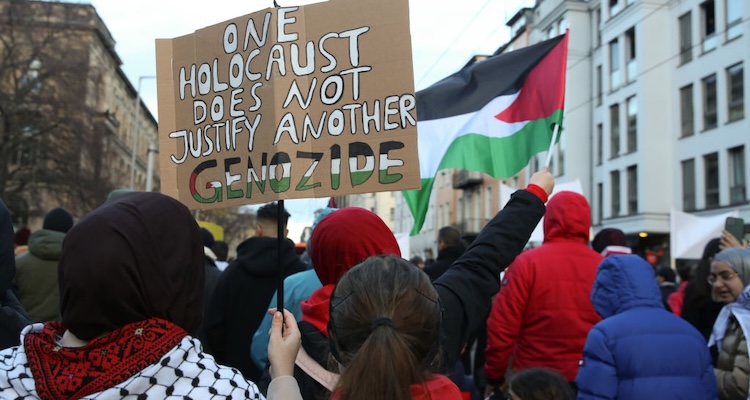
We cannot pass over this easily, as so many have done in the past two years. Genocide is the crime of crimes. None is worse. The term was first used by Polish-Jewish lawyer Raphael Lemkin in 1944 to describe what subsequently became known as the Holocaust or, in Hebrew, the Shoah. Mishra is fully aware of the etymological history of the term and recognizes what he sees as the “moral and symbolic capital” it has afforded Jews and Israel. He has had enough of that. As he argues, “Since the Shoah was coded as the greatest evil, incomparable and unprecedented, those describing Zionism as a genocidal ideology aim to defuse the symbolism of the Shoah and represent the destruction of Gaza as the true evil of our times.” Have we not reached the point, he asks, of needing to find “a replacement for the Shoah as a universal symbol of human and moral evil?” His answer, developed across his entire book, is that it is time to recognize that Western colonialism and white supremacism are the regnant evils of our era. In contrast to Primo Levi, who wrote in the preface to his final work, The Drowned and the Saved, that the Nazi slaughter of the Jews should be remembered not only as “the central event” of the 20th century but “the greatest crime in the history of humanity,” Mishra avers that “the most consequential event of the twentieth century might not be the First or Second World War, the Shoah, the Cold War, or, for that matter, the collapse of communism, but decolonization.” Since Israel is now widely viewed as “a cruel settler-colonialist and Jewish supremacist” state, it should no longer enjoy the protection afforded it by the memory of the Shoah. Such memory, Mishra insists, has been “perverted to enable mass murder.”
In fact, mass murder is what took place in southern Israel on October 7, 2023. So did the most brutal forms of sexual violence, including mass rapes; mutilations; beheadings; the burnings of whole families; and no end of other vicious atrocities that Hamas and its allies carried out on that day. It marked the single worst massacre of Jews since the Holocaust. Mishra steers clear of focusing any serious attention on the event. In effect, he erases it. It obviously is of no consequence to him. His mind is elsewhere, and he wants ours to be as well.
Where? In Gaza among the Arab population, where, he claims, an “orgy of bestial violence” on Israel’s part “challenges a fundamental assumption that human nature is intrinsically good [and] capable of empathy.” No one who has closely read Levi, Wiesel, and the various other writers Mishra cites would ever or could ever reasonably conclude that “human nature is intrinsically good.” It is not. The fact that it is not is one of the reasons Israel exists and must continue to exist.
The book’s dedication page is telling: On it, “two beacons” are singled out for praise. One is PalFest. The other is JVP, Jewish Voice for Peace, a declaredly anti-Israel and anti-Zionist group that openly stands for the eradication of Zionism and actively promotes the boycott, divestment, and sanctions campaign against Israel. In addition, JVP explicitly blames Israel for Hamas’s vicious assault on the country on October 7, 2023, stating that “the source of all this violence” was “Israeli apartheid and occupation—and United States complicity in that oppression.”
As W.H. Auden put it many years ago, it is bad for the character to engage with a bad book. And from start to finish, this is an unusually bad book. The characters of all literate people will be improved by refusing to engage with it.
Photo: Adam Berry/Getty Images
We want to hear your thoughts about this article. Click here to send a letter to the editor.