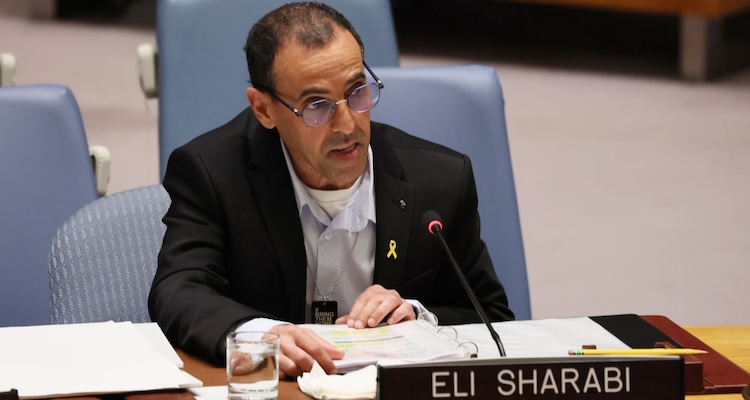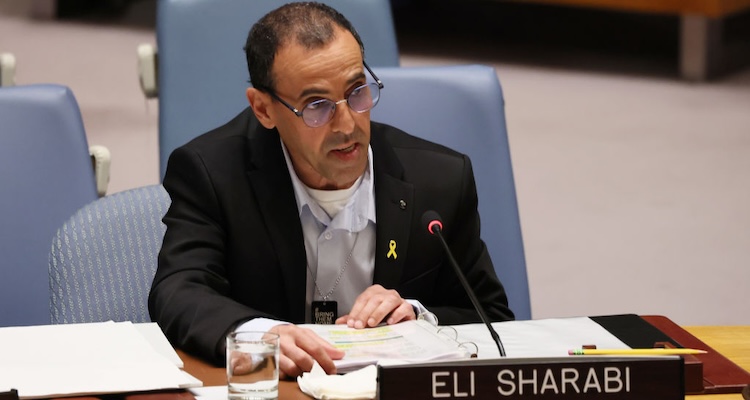
Less than a week after the conclusion of the Twelve-Day War, I found myself at the Azrieli shopping center in Tel Aviv, where an endless queue snaked around the entire mezzanine, filled with Israelis eager to have Eli Sharabi sign a copy of his newly released book about his captivity in Gaza.
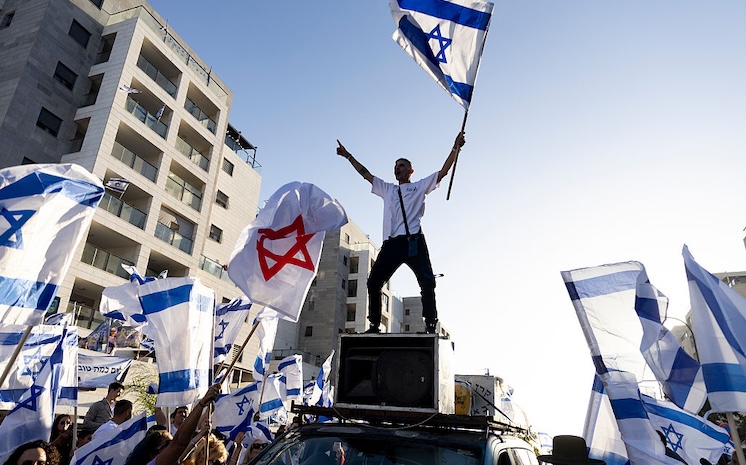
How fitting, I thought, that just steps from the shattered glass and storefronts wrecked by Iranian missiles days earlier, unafraid Israelis were proudly demonstrating our greatest superpower in homage to Sharabi’s unbelievable display of the same: resilience.
In Hostage, the fastest-selling book in Israeli history, Sharabi lays bare the unimaginable 491-day ordeal he suffered at the hands of Hamas, beginning on that fateful Simchat Torah in October when he was abducted by murderous terrorists from his safe room in Kibbutz Be’eri. Unbeknownst to him, his wife Lianne and teenage daughters Noiya and Yahel were executed shortly thereafter.
But despite the horrors Sharabi suffered, what emerges from his stirring account, as well as from his public appearances at the White House, the United Nations, and elsewhere, is a portrait of a man miraculously unbroken and unbowed by his torment. Sharabi’s remarkably dignified comportment offers an example of resilience for Jews around the world. We cannot possibly fathom the depths of his suffering, but we can pay forward his stellar example.
_____________
“This isn’t our first rodeo,” Sharabi recalls thinking the morning of October 7 when his family first took shelter. “We’ve been here so many times before.” But the family quickly realizes this is different, as terrorists swarm into Be’eri itself and, eventually, into the Sharabi home, where they seize Eli and separate him from Lianne and the girls, who he figured would be safe because of their British passports. “There is no more regular Eli,” he determines, as his Hamas captors dragged him into a truck. “From now, I’m Eli the survivor.”
Sharabi emerges from the short ride into Gaza, blindfolded and shackled, in a mosque, where the terrorists interrogate him and accuse him of being a soldier, refusing to believe that he was 51 years old. Along with a Thai kibbutz worker named Khun, he’s transferred to a private home populated by a middle-aged husband and wife and their three sons. Out of a “mix of survival instinct and a desire to stay in control and manage the situation,” he begins to feel close to the family and reminisces with the father about their respective grandparents’ childhoods in Jaffa. But he takes care to note that “this isn’t Stockholm Syndrome.” Why? “I see only pure evil in their eyes.”
On Day 50 of his captivity, he’s moved to a mosque, where he meets Almog Sarusi, a young Israeli who’d been abducted from the Nova music festival, with whom he compares notes about their experiences. When told to descend a shaft underneath the mosque into a tunnel deep underground, Sharabi hesitates. “Even when you have no control over yourself,” he recalls thinking, “you always have a choice.” Soon thereafter, they’re joined by five more young Nova hostages seized from a roadside shelter: Ori Danino, Hersh Goldberg-Polin, Eliya Cohen, Or Levy, and Alon Ohel (who happens to be my cousin). They discuss the heroism of Aner Shapira, who died after catching and throwing back seven grenades that terrorists tossed into the shelter. And it is there that Hersh shares his immortal words, courtesy of Holocaust survivor Viktor Frankl: “He who has a why can bear any how.”
Almog, Ori, and Hersh are taken elsewhere during the November 2023 cease-fire that resulted in the release of over 100 hostages, and Sharabi becomes something of a father figure to the others. He reflects that he’s “been practicing the art of self-sacrifice and living with people who need me for years” and that his professional experience provided “tools to navigate complex human dynamics and conflicts.” He prods Alon to share good memories instead of the trauma of the shelter and urges him to “stand your ground” in order to survive. And he encourages the others by reminding them, “When this nightmare is really over … then you’ll see me fall apart. Then you’ll see me cry. But until then, I’m on a mission to survive. So are you.”
But Sharabi does struggle, especially when his captors torment him by convincing him—falsely—that Lianne and the girls are still alive, even seen on television demonstrating for his release. He learns from Alon not only “how to say hard things gently” but also to visualize his wife and daughters in happier times. For the reader, knowing that they’d been slain, his recollections of joyous family occasions are heartbreaking.
As time wears on, conditions worsen. Sharabi and the others are moved around further amid Israeli air strikes and rescue efforts. They’re forced to record propaganda messages. They’re beaten mercilessly at their captors’ whims and subjected to psychological torture. Their already meager food stocks run low, and their health and hygiene deteriorate. But they persist in exercising with whatever they find “to keep our bodies and souls alive”; Sharabi ceaselessly reminds himself, “I want to breathe life, to walk free, to return to the open skies, to go back home, to work, to purpose.”
Days turn to weeks, weeks turn to months, and the grim one-year anniversary of the attack comes around (the hostages enjoy a surprising amount of exposure to the calendar and even the news). And in January 2025, new hope emerges of a cease-fire deal that may set them free, but this brings only more cruelty: They’re told that Sharabi, Or, and Eliya will be released—but not Alon. “You’re strong,” Sharabi tries to reassure Alon through tears. “You’ve got this. You’re capable. You’re getting out of here.” Their captors have to pry them apart.
That excruciating departure briefly yields to joy, as Sharabi reunites with Ohad Ben Ami, a close friend from Be’eri also slated for release, but the joy curdles when Ohad informs him of Hersh and Ori’s murder by their captors. The next day, Sharabi is told that his brother Yossi was abducted and killed in captivity. And then he learns at long last that Lianne, Noiya, and Yahel perished on October 7.
Even so, throughout the shameful Hamas parade in which he’s compelled to participate, he demonstrates incredible discipline. “None of this really matters,” he tells himself. “I have only one goal: to do whatever it takes, and give them whatever they want, to ensure a smooth release. To survive. To get home.”
And get home he does, emerging from the IDF helicopter proudly, defiantly wearing an Israeli flag. He immediately phones Alon’s parents to update them personally on their son’s status and praise his “inner strength” and “gentle, sensitive core wrapped in rough edges.” He has since relentlessly spoken out on behalf of Alon and the remaining hostages in forums around the world. At times, unfortunately, Sharabi’s advocacy has veered into the realm of the nakedly political, including criticizing Prime Minister Benjamin Netanyahu, such as when he told Israel’s Channel 12 that “if there was a different political makeup [of the Israeli government], we would’ve been freed a long time ago.” In fact, Sharabi’s captors themselves, not Israel, have repeatedly proven to be the stumbling block during the negotiations to end the conflict; had Israel acceded to their demands, Hamas would have tightened its grip on Gaza and freely rebuilt its arsenal of terror.
_____________
When I visited Be’eri back in December 2023, we still believed that Yossi Sharabi was alive. At a press conference outside an eviscerated building, the sickly smell of burning still lingering, Nina Sharabi, Yossi’s wife, pleaded passionately for his return. “One hundred and twenty-nine abductees still in Gaza,” she said, through tears, “and the whole country is a hostage of Hamas.”
As of this writing, 50 hostages, living and dead, including Yossi, remain in captivity, and Israel still feels as if it’s hostage to Hamas. But Eli is home, he’s survived, he’s prevailed, and in demonstrating resilience both in and out of Gaza, he has heroically imparted his superpower to Jews around the world.
Photo: Michael M. Santiago/Getty Images
We want to hear your thoughts about this article. Click here to send a letter to the editor.