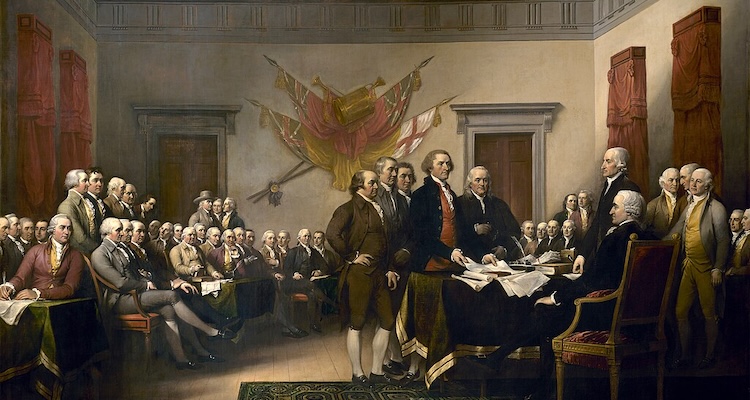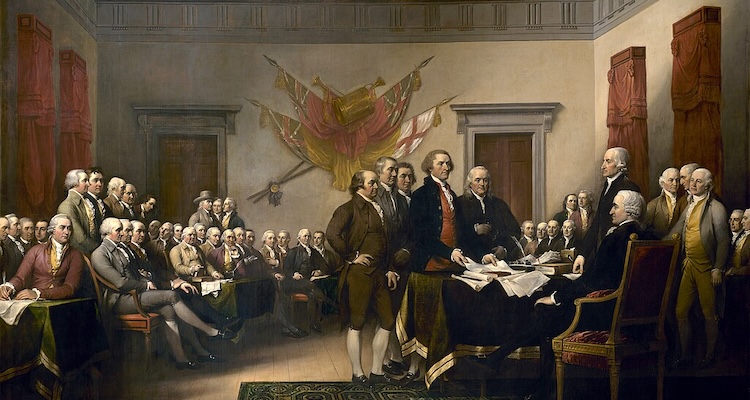
Next year’s 250th anniversary of the Declaration of Independence can’t come soon enough. Both Democrats and Republicans need remedial lessons in basic American principles, stat.
The increasingly secular Democratic Party has trouble understanding the basis of freedom—our God-given rights to life, liberty, and happiness. Meanwhile the nationalist-populist GOP flirts with a cramped definition of nationhood and ignores the universal ideals that inspired the Founders. Both sides miss the point.
Progressives promote an ever-expanding list of human rights without stopping to think why human beings have rights in the first place. And the “national conservatives” have no time for rights talk as they seek to police entry into a shrinking national community. The result is a politics unmoored from the philosophy of freedom and equality that gave birth to the Declaration and the Constitution and remains the source of American greatness.
Start with the Democrats. On September 3, the Senate Foreign Relations Committee heard testimony from Riley Barnes, President Trump’s nominee to be assistant secretary of state for the Bureau of Democracy, Human Rights, and Labor. Barnes delivered a harmless opening statement. He thanked the president and acknowledged his family. He quoted Secretary of State Marco Rubio, who had told State Department employees that “we are a nation founded on a powerful principle, and that powerful principle is that all men are created equal, because our rights come from God our Creator—not from our laws, not from our governments.”
Human rights matter, Barnes said, because “we are a nation of individuals, each made in the image of God and possessing an inherent dignity.” Barnes spoke of free speech, religious freedom, and uncoerced labor. He was polite. Succinct. Inoffensive.
Unless you are the junior senator from the Commonwealth of Virginia.
Tim Kaine was agog. “The notion that rights don’t come from laws and don’t come from the government, but come from the Creator—that’s what the Iranian government believes,” Kaine pronounced, in a jaw-dropping expression of senatorial stupidity.
Then Kaine added condescendingly, in case we missed it, that Iran is “a theocratic regime.” Though Kaine—Harvard Law, class of ’83—professes to be a “strong believer in natural rights,” he has no clue what they are. The Islamic Republic of Iran is grounded in a particular interpretation of sharia law, not the universal rights human beings possess by our natures.
The senator’s unfamiliarity with the Declaration of Independence is troubling. That he was very nearly the vice president of the United States is chilling. And that he represents Thomas Jefferson’s home state makes it all even worse.
The Declaration of Independence is clear: God is the source of human rights. The Declaration’s 56 signatories refer to “the laws of Nature and of Nature’s God.” They assert as self-evident the proposition that all men “are endowed by their Creator with certain unalienable Rights.” They appeal to the “Supreme Judge of the world.” They rely on the “protection of divine Providence.”
Does that make them sound like Ayatollah Khamenei to you?
The most disturbing aspect of Kaine’s outburst was his comment that rights come from government. Not in America, they don’t. The famous second paragraph of the Declaration of Independence lays out the following sequence: God creates man. Man has rights. Men form governments “to secure these rights.” And when a government “becomes destructive of these ends,” the “People” have the “right to alter or abolish it.”
Indeed, the first three words of the U.S. Constitution are “We, the People.” The United States is a republic where the people are sovereign. Not kings, not presidents, not parliaments, not judges, and, thank heavens, not Tim Kaine. The government’s job is to guarantee rights, to make and enforce laws, to decide cases. But here, the People rule.
Democrats and the left are too willing to cheapen and degrade citizenship by extending rights and entitlements, including the franchise, to noncitizens and illegal immigrants. Meanwhile, Republicans and the right are tempted to say that some citizens are more “American” than others. Both tendencies offend the American idea.
“National conservatives,” for example, look with suspicion on the American creed as set out in the Declaration of Independence and Lincoln’s Gettysburg Address. When JD Vance accepted the Republican vice-presidential nomination last July, he said he hopes to be buried with his wife Usha, the daughter of Indian immigrants, at a cemetery plot in Kentucky, “near my family’s ancestral home.”
At the time, his remarks struck me as odd. They sounded a funereal note during an otherwise jubilant week. Now I understand that Vance’s discussion of his ultimate demise had a purpose. It was meant to illustrate his belief that, “even though the ideas and the principles are great. . . [America] is a homeland. That is our homeland. People will not fight for abstractions, but they will fight for their home.”
As a matter of history, he’s wrong. Many people have fought for abstractions or ideals—abstractions like no taxation without representation, ideals like liberty. But more striking is Vance’s implication that Americans who can’t trace their heritage to 19th-century Kentucky somehow remain outside the national community until someone who does have such ancestry weds them or decides to “allow them [in] on our terms.”
That’s not how American citizenship works.
In June, Vance made a similar argument in a speech to the Claremont Institute, whose mission is “to restore the principles of the American founding.” The institute might try starting with the vice president. If an American is simply someone who agrees “with the creedal principles of America,” Vance said, that would include “millions, maybe billions, of foreigners,” while excluding “a lot of people the ADL would label domestic extremists, even though their own ancestors were here at the time of the Revolutionary War.”
Excuse me? Why the gratuitous reference to the Anti-Defamation League, a Jewish organization? And when did bloodlines trump lawfulness and reverence for the Constitution? There are more than a few American Jews whose ancestors lived in America during the Revolution. And certainly creedal principles mattered in
1776. The people who didn’t believe in them were called Tories. They became Canadian.
At the National Conservatism Conference in Washington, D.C., in early September, Senator Eric Schmitt of Missouri took up Vance’s line of thought. “We Americans,” he said, “are the sons and daughters of the Christian pilgrims that poured out from Europe’s shores to baptize a new world in their ancient faith.”
Stirring rhetoric, I suppose. But isn’t Schmitt leaving a whole bunch of people out? Like: the descendants of African slaves brought here involuntarily long before his German ancestors arrived in Missouri in the 1840s. And: the descendants of Jewish and Chinese and Japanese and Mexican immigrants. And: the naturalized citizens who’ve arrived since the 1970s and taken an oath to “defend the Constitution and the laws of the United States against all enemies, foreign and domestic.”
Ranking citizens by date of arrival has consequences. It creates a mirror-image identity politics as exclusive and unappetizing as the left-wing version. It empties civic nationalism of substance. It turns citizenship into Ancestry.com. It rejects all who believe that America represents something more than blood and soil—that it is the last best hope of earth.
Since Abraham Lincoln, Americans have read the Constitution through the lens of the Declaration—as a blueprint for the government of a national community that conceivably every person could join. Thus, after the Civil War and Reconstruction, citizenship became the criterion for belonging to the American People. The 14th Amendment, ratified in 1868, states that “all persons born or naturalized in the United States, and subject to the jurisdiction thereof, are citizens of the United States.” Their “privileges and immunities” cannot be abridged.
What a tragedy it would be if we spend the next year celebrating America’s birthday—only to forget what America means.
We want to hear your thoughts about this article. Click here to send a letter to the editor.