Intersectionality is in crisis. It is reeling from the Republican-led assault on left-wing radicalism, retreating to its campus redoubt. If it passes from our public discourse, its epitaph should read: “Often wrong, never in doubt.”
Evidence of intersectionality’s ongoing if incomplete demise accumulates by the day. EPA Administrator Lee Zeldin canceled a $50 million grant to the Climate Justice Alliance, which insisted that “the path to climate justice travels through a free Palestine.” On mass media wildly popular with young Americans—podcasts by “free thinkers” like Joe Rogan—intersectionality is a punch line. Mentions of intersectionality began to taper off in 2022, according to Google Books Ngram Viewer. Viral essays feature former social-justice warriors questioning, as one did, environmentalism that has “become less about conservation…and more about freeing Palestine.” Corporations are rolling back DEI programs and retiring ad campaigns designed as catnip for intersectional sensibilities. Ibram X. Kendi’s Center for Antiracist Research at Boston University—which “sought to examine bigotry in the United States from multidimensional, intersectional, and interdisciplinary perspectives”—fired most of its staff in late 2023 due to “public support having shifted and contributions waning.” It closed for good in January of this year.
Even left-wing outlets are getting wise to the emptiness of intersectional posturing. “Is Intersectionality Over?” asked British magazine the Lead. “The label ‘intersectional’…has now become a buzzword to signal a certain liberal politics,” laments the author. “Promoting an intersectional/diverse message is good for business.… But brands and companies very rarely make changes or take any action.”
That sense of betrayal is more profound when intersectional activist groups use the language of identity as part of an outright scam. One Black Lives Matter (BLM) leader appears to have stolen $10 million in donations; a co-founder used funds to buy a $6 million house, which she admitted to using for parties; yet another BLM local leader will serve time for defrauding donors out of nearly half a million dollars earmarked for “the movement.” The District of Columbia government recently painted over the BLM mural it had installed near the White House just a few years prior. The bad press has reasonably led the public to question whether the need for intersectional activism was so great if its flagship organization turned to corruption so thoroughly and so quickly.
Parts of the left now treat intersectionality as out of style. “While intersectional feminism is becoming mainstream through its incorporation into business and advertising, academics are increasingly critiquing the idea because of its reliance on identity,” notes the Lead. “Cultural studies scholars now reject the idea of an inherent identity that each of us [is] born with.” The progressive concept-treadmill rolls on—perhaps aware that intersectionality doesn’t sell quite like it once did.
But intersectionality is most clearly on the ropes within the Democratic Party. After a convention mocked for comical paeans to race and gender, former Transportation Secretary Pete Buttigieg vented that Democrats had become obsessed with “combinations of identities.” Michigan Senator Elissa Slotkin grumbled that “identity politics needs to go the way of the dodo” and was rewarded with the rebuttal to President Trump’s State of the Union address. California Governor Gavin Newsom rode a political tailwind and reversed his support for transgender athletes’ participation in women’s sports, calling it “deeply unfair.” Voters are rejecting intersectionality’s champions at the ballot box. Cori Bush and Jamaal Bowman are out, while the gay, black, Hispanic yet anti-woke Ritchie Torres won in a landslide. Torres calls intersectionality a “simplistic, distorting lens” for analyzing the world. His political star continues to rise.
Triumphalism is premature, though. During its brief, wondrous heyday as a progressive shibboleth, intersectionality exerted enormous power over American life. Intersectional ideas fueled BLM, the Women’s March, and gender ideology, all of which blended into one “omnicause.” It is on the decline, but the underlying ideas that ignited it in the first place may persist. Ensuring that intersectionality dies and stays dead requires understanding those ideas and developing the vocabulary to explain why the movement that intersectionality spawned inevitably fails.
_____________
For critics and champions alike, intersectionality is now shorthand for the idea that all oppression is connected and that “justice is indivisible.” But that principle predates intersectionality and is generally credited to Communist militant Angela Davis. Davis, now an emeritus professor in California, was a central figure of the anti-American left in the second half of the 20th century. She became a progressive darling by ranting about capitalism, patriarchy, and racism in the West (and providing guns to Black Panthers) while doing Soviet PR. Her view that all those -isms were part of one overarching system that needed to be overthrown for “justice” became an article of faith for critical theorists like Kimberlé Crenshaw.
Crenshaw, a law professor at Columbia and UCLA who suggested that there was a firm theoretical basis for Davis’s axiom, is revered among academics as the matriarch of intersectional theory. She coined the term in an article in 1989 and dilated on it throughout the ’90s in a series of essays on the “intersection” between “marginalized identities” such as race and sex. For her efforts, she was rewarded over the course of the decades that followed with an embarrassment of riches: a Lifetime Service award from the Association of American Law Schools; funding for her think tank, including $5.2 million from George Soros’s Open Society Foundation in 2021 and nearly $10 million annually in public support; an academic center at Columbia Law School; TED Talks; and celebrity status among activists, academics, and leftist elites.
Rather than rooting the need for leftist politics in anti-American fervor, as Davis had, or in equality, as the civil-rights movement had, Crenshaw gave pseudoscientific validity to leftism fueled by granular identity categories. In her 1989 article, Crenshaw argued that individuals experience oppression as greater than the sum of its parts. Black women, Crenshaw’s prime example, experience discrimination more profound than a mere combination of racism and sexism, and of a distinct character.
Crenshaw thus buttressed Davis’s activist principle. Rather than fighting racism or sexism as distinct forces with distinct histories, a bigger-picture approach to identity politics was necessary to clear discrimination from every nook and cranny and effect “indivisible justice.” All “marginalized” identities would band together to fight their corresponding “dominant” identities, as mapped on an “axis of oppression.” Each identity would assimilate into a coalition of the oppressed, a popular front attempting to overthrow the “system of oppression” of which racism and sexism are mere symptoms.
Critical race theory (CRT), purporting to explain why the civil-rights era failed to yield equality of outcomes, found footholds in elite universities throughout the 1990s. Crenshaw’s framework, central to CRT because it could explain civil rights’ shortcomings, began to appear in legal journals and course syllabi. Women’s studies departments began to offer courses on the confluence of race and gender. Campus offices dedicated to “multicultural affairs” popped up, while Princeton channeled the Davis-to-Crenshaw development by renaming its “Third World Center” the “Center for Equality and Cultural Understanding.” Citation patterns show that, by the early 2000s, Crenshaw’s papers were among the most referenced academic works. Intersectionality had been accepted as an analytical tool before it burst onto the scene in mid-2010s activism.
The Oxford English Dictionary added “intersectionality” in 2015, but the term entered the popular lexicon during the 2017 Women’s March protesting Donald Trump’s election. Organizer Linda Sarsour—who would later step down for tolerating rampant anti-Semitism—clarified that the march was about feminism, police surveillance, and, of course, the need to boycott Israel. During the 2018 #MeToo reckoning, the Oscars featured a taped segment touting Hollywood’s revitalized progressivism. “We work together to make sure that the next 90 years empower these limitless possibilities of equality, diversity, inclusion, intersectionality,” actress Ashley Judd pontificated. Examinations of the concept attempted to provide explanations to every American demographic, popping up in publications from USA Today to Teen Vogue. Senator Kirsten Gillibrand, hardly the most progressive Democrat in Congress, pronounced a typical message on Twitter in 2018: “Our future is: Female [and] Intersectional.” That doesn’t really mean anything, except as a sign of fan service. Democrats were supposed to talk about intersectional identity. Backed by sophisticated theory, intersectional activism was for the smart set.
Crenshaw’s theory and Davis’s activist dimension are now inseparable. George Washington University’s Intersectionality Research Institute describes its eponymous “critical theoretical framework” as “the concept that all oppression is linked and people are often disadvantaged by multiple sources of oppression: their race, class, gender identity, sexual orientation, and religion, just to name a few.” Then–Representative Bush infamously found abstract commonalities between social-justice causes: “The fight for Black lives and the fight for Palestinian liberation are interconnected. We oppose our money going to fund militarized policing, occupation, and systems of violent oppression and trauma.” More broadly, as one prominent activist outfit in Seattle put it, “intersectional organizing” means recognizing that “common enemies, Western imperialism, capitalism, white supremacy, patriarchy, they all work together.”
Activist intersectionality made progressive politics a team sport. But it led to two nasty habits. It suggested that anyone who wanted to be part of the movement would be subjected to regular purity testing, as in the exhortation that “if your feminism isn’t intersectional,” meaning focused on more than just sexism, “you’re not a feminist.” Ensuring that anyone who agreed with one element of contemporary progressivism agreed with every element affirmed the intersectional principle but made leftism less a political movement and more an inquisitorial mob.
It also led to rampant conspiracy theorizing. By suggesting that the interconnected nature of oppression can be observed in the real world, intersectional activists encouraged a literal interpretation of the interconnectedness of all oppression. And if the various “common enemies” serve one overarching apparatus of oppression, someone or something must be behind it all. In addition to the usual left-wing “enemies”—whites, capitalists, imperialists—vulgar intersectionality tempted its devotees to find one group that could embody all sources of oppression at once. And who could be more white, capitalist, and imperialist than the Jews and the Jewish state?
While Davis’s pro-Soviet left had long invoked conspiracy theories about Israel and its role in supposed Western imperialism, intersectional hatred of Israel took off in the early 2000s. Israel was becoming capitalist and rich, both intersectional no-nos. The violence of the second intifada evoked decolonial efforts like Algerians’ guerrilla warfare against the French, helping solidify the view that Israelis were white Europeans oppressing non-white, Third World Arabs. With no room for nuance in intersectional analysis, the now-familiar terms crystallized: Israel was the oppressor, Palestinians the oppressed. Students would learn that Palestinian liberation is intertwined with other social-justice movements. Gender theorist Judith Butler argued in 2006 that “understanding Hamas, Hezbollah as social movements that are progressive, that are on the Left, that are part of a global Left, is extremely important.” Intersectional thinking fundamentally reframed the way young Americans would analyze the Middle East, positioning Israel not as a nation with its own distinct history, but as part of a global power-relations matrix. And not in a good way.
Anti-Israel fervor still grips groups flying the intersectional flag. (The expression is apt; the Pride Flag, which once represented sexual orientations, has been replaced by the “Progress Pride” Flag, adding symbols of gender and racial identities.) Theories abound in activist fever swamps positing that police brutality in the United States is being directed by the Jews. “The NYPD is in effect a branch of the IDF,” according to a University of Chicago professor of sociology. In Atlanta, protests against a police-training facility in early 2024 descended into half-baked intersectional explanations of how Israel was to blame. “The cops being trained by the IDF is a connection that can’t be overlooked,” said one activist. “The show of force we saw,” when Georgia law enforcement dispersed protesters with rubber bullets, “shows that all our struggles are connected.”
The intersectional left’s response to the October 7 attack brought this grand conspiracy theory into the public eye, mounting an active defense for Jew-hating rapists and murderers. BLM’s Chicago chapter celebrating the image of a Hamas paraglider may have been bad marketing, but BLM was supposed to support Hamas. BLM and Hamas work to overthrow the same “systems.”
Some silences spoke just as loudly. The National Organization for Women, once focused on women’s rights but that now counts among its “core issues” “Racial Justice” and “LGBTQIA+ Rights,” did not issue a statement about Gazans raping Israeli women until six weeks after the attacks. When it finally did, it titled its statement “NOW Condemns the Use of Rape as a Weapon of War” and did not mention the specific incident it was condemning.
Self-proclaimed “Queers for Palestine” have drowned out other rainbow-coalition groups in defending Hamas, whose “heteronormativity” is the stuff of macabre legend. What appeared at first to be cowardice was soon understood as calculated. The intersectional project required not alienating Hamas supporters, lest that complicate intersectionality’s inviolable principle of indivisible justice.
Intersectional politics turned out to be not just untenable—holding together ostensible anti-rape activists and Hamas apologists—but liable to come to morally abhorrent conclusions justified by conspiratorial thinking. More profoundly, intersectional actors’ overwhelmingly siding with Hamas raises the possibility that intersectional theory—which was supposed to fight for the righteous against their oppressors—is at fault. That theory will not die unless we identify it, kill it, and bury it for good.
_____________
Crenshaw’s intersectional theory is more like physiognomy than physics. It is a useless pseudoscientific justification for radical politics that should have petered out in its infancy because it fails the most basic test: It does not correspond to the real world. But we must not mischaracterize it. Doing so only gives opportunists an opening to say that we have rejected merely a false version of intersectionality. They could say that real intersectionality—and the activism it would lead to—has never been tried.
Let us return to Crenshaw, who has remained the theory’s foremost authority. She has repeatedly argued that the oppression of any given subgroup cannot be fully understood by looking at each source of that oppression individually. As she articulated in her 1989 article, “Because the intersectional experience is greater than the sum of racism and sexism,” the two most popular axes of oppression, “any analysis that does not take intersectionality into account cannot sufficiently address the particular manner in which Black women are subordinated.” Analyzing litigation from the mid-20th century, in which courts were receptive to claims of racism and sexism but were reluctant to label black women “a special class to be protected from discrimination,” Crenshaw argued that antidiscrimination law should incorporate additional categories formed by intersectional identities.
Crenshaw’s point thus far is logical as far as it goes. But it goes off track.
Black women can experience discrimination in ways that are both similar to and different from those experienced by white women and Black men. Black women sometimes experience discrimination in ways similar to white women’s experiences; sometimes they share very similar experiences with Black men. Yet often they experience double-discrimination—the combined effects of practices which discriminate on the basis of race, and on the basis of sex. And sometimes, they experience discrimination as Black women—not the sum of race and sex discrimination, but as Black women.
Note first what Crenshaw does not consider possible: That sometimes black women, among other “marginalized” individuals, do not experience discrimination at all. She has adopted the critical-theory axiom that discrimination is omnipresent, if shape-shifting.
Note second how she uses severity and quality interchangeably. Sometimes intersectional discrimination is “greater than the sum” of its component parts, or “double-discrimination” working arithmetically to make it more severe than one form of oppression acting alone. Crenshaw invites readers to consider an analogy: All disadvantaged people are in a basement, stacked upon each other according to the number of identities working against them. “The heads of all those disadvantaged by a singular factor brush up against the ceiling,” while “those above the ceiling admit from the basement only those who can say that ‘but for’ the ceiling, they too would be in the upper room.” An escape into non-oppressive territory “is generally available only to those who—due to the singularity of their burden and their otherwise privileged position relative to those below—are in th[at] position.” This mode of thinking suggests that society organizes itself by quantitative intersectional hierarchy; the more marginalized categories in your identity, the more marginalized you are.
But sometimes intersectional discrimination is merely different in kind from single-dimensional discrimination. Discrimination against black women can occur in a “particular manner” or “as Black women—not the sum of race and sex discrimination.” The basement analogy would fail under this paradigm, which is more concerned with the quality of each identity-combination and the kinds of discrimination each invites. Crenshaw has elaborated on this in responding to critics who find oppression-stacking unproductive. “Intersectionality is about capturing dynamics and converging patterns of advantage and disadvantage,” Crenshaw told one interviewer in 2021. “Those are going to change from context to context.…There are millions of different ways that power converges.”
This observation manages to be both undeniably true and completely unfalsifiable. Of course certain stereotypes, such as an angry black woman, draw upon multiple discriminatory elements. Yet if these “dynamics” vary “from context to context,” they resist systematic study. They cannot be integrated into social science because they are always given an escape hatch: “There are millions of different ways that power converges.” But whatever happens to marginalized groups is presumptively a function of those “convergences,” or shape-shifting oppression. This amounts to assuming one’s own conclusion. Operating from within this theory, we cannot deduce or prove that systems of oppression explain the phenomena we observe; we can only take it as a given. That’s not scholarship. That’s a cult.
In its most defensible qualitative form, though, intersectionality is not wrong—just banal. Imagine that the world is indeed organized according to the dubious principles of the Intersectional Axis of Oppression, with groups considered “normal” oppressing “deviant” ones. By intersectionality’s own logic, each person contains a theoretically infinite number of “deviant” identities. It’s normal, for instance, to be right-handed, diurnal, and bipedal. It’s deviant to be left-handed, nocturnal, and unipedal. And intersectional analysis holds that experience is shaped by the qualitative nature of the discrimination suffered as a result. We can only conclude that every person has a highly subjective, ever-changing, uni-que experience of the world, which no one else can fully understand. That’s called individualism.
Taken to its logical conclusion, then, intersectionality should lead us to treat each person not as a collection of identities but as a person, unique in ways that cannot be captured with reference to their identity-markers. Accordingly, we should not try to expand antidiscrimination law to include more granular categories or groups that experience unique brands of discrimination. We should change the focus of antidiscrimination law altogether to shift away from focusing on groups and toward individuals: Did this person receive unfair treatment on account of things that were not morally relevant, germane to his job, or some other neutral standard of expected behavior? Since that is not really antidiscrimination law so much as protection against arbitrary and capricious behavior, this standard would ultimately lead away from anti-discrimination law altogether.
_____________
Needless to say, defensible but banal did not catch on. The quantitative version of the theory remains much more popular. Public figures routinely incant the formulation that people suffer in accordance with their number of marginalized identities. Efforts to unwind supposed effects of intersectional marginalization often result in unctuous rewritten histories. Consider DNC Vice Chair David Hogg paying tribute to a fake intersectional task force on gun control, “the founders of the gun violence prevention movement started centuries ago by almost entirely black, brown and indigenous lgbtq women and non binary people that never got on the news or in most history books.”
Perhaps this version of intersectionality devolves into parody because it is empirically wrong. Reality does not reflect the hypothesis that oppression operates according to intersectional principles. Black women, the paragon of intersectional oppression, do better than black men on a range of outcomes. Black men are more likely than black women to go to prison, abuse drugs, and live in poverty. Their educational outcomes are significantly worse and life expectancy shorter. These are precisely the outcomes that critical theorists point to as proof that certain groups are systemically oppressed. Yet they refute the quantitative intersectional hypothesis.
Part of the problem with intersectional analysis is that it imports critical theory’s incorrect premises, which are belied by facts such as Nigerian Americans and Indian Americans doing better than white Americans in most measurable ways. Intersectionality only compounds the critical theorists’ errors by failing to show that when you put “oppressed” identities together, outcomes get worse. The key intersectional “observation” is just an unfounded assertion.
Yet intersectional theory continues to assume that traditional axes of oppression—white over black, male over female—are still operative. It has no mechanism for adjusting its understanding of the world because it is not rooted in the world. It is no more useful to understanding the world than the rules governing characters in a board game are. It is made up out of whole cloth, resistant to correction, and systematically unable to account for persistent facts that undermine its most basic premises.
Intersectional theory fails as a theory, which is why it failed as a political movement. Crenshaw hoped that “through an awareness of intersectionality, we can better acknowledge and ground the differences among us and negotiate the means by which these differences will find expression in constructing group politics.” Instead, her ideas did just the opposite. They turned Americans against one another and directed adherents toward a circular calculation of who they were fighting for. Rather than identifying and benefiting people that need help in reality, intersectionality simply asserted that it knew who those groups of people were in the abstract.
A theory of everything that explains nothing, intersectionality represented the worst of the academic and activist left. Its time of death has not yet been recorded. Let’s hope it comes soon. When that happens, intersectionality should be remembered as we remember Amalek, the nation whose evil intersectional activists tried to justify, and who in doing so invited their own demise: Remembered, but blotted out.
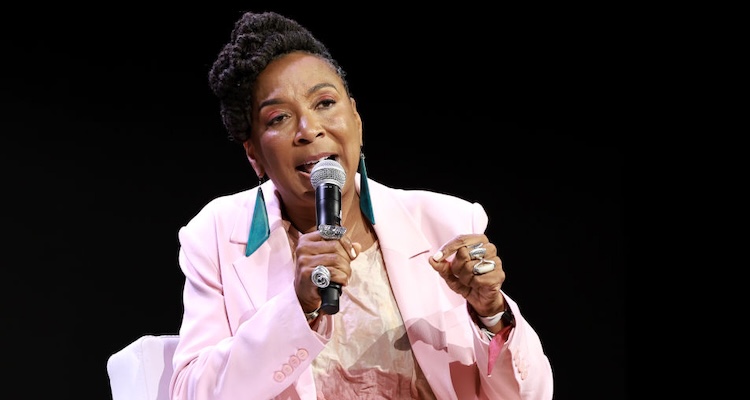
Photo by Arturo Holmes/Getty Images for ESSENCE
We want to hear your thoughts about this article. Click here to send a letter to the editor.