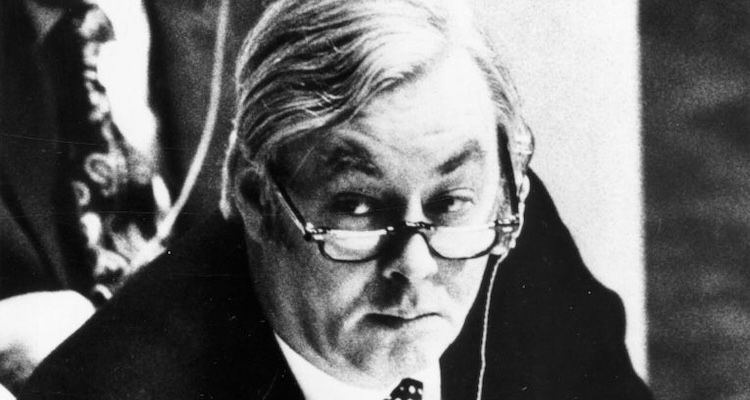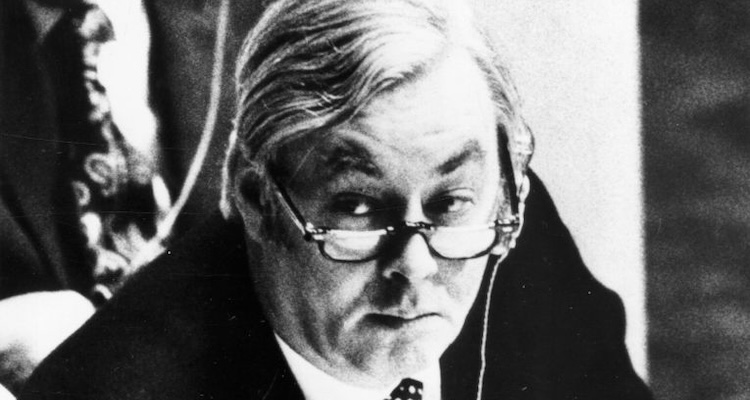
Fifty years ago, on November 10, 1975, the United Nations passed General Assembly Resolution 3379. Daniel Patrick Moynihan, then the U.S. ambassador to the United Nations, rose to his feet and delivered one of the most famous speeches in American history. “The United States,” he thundered, “does not acknowledge, it will not abide by, it will never acquiesce in this infamous act.”
Moynihan made “one point, and one point only.” Zionism “is not and cannot be ‘a form of racism,’” he said, quoting the resolution’s most important clause. It cannot be, Moynihan said, because the Jews are not a race. Judaism accepts religious converts, who join the Jewish people. Judaism thus combines peoplehood and faith. That makes Zionism one of the most permeable, least biologically based forms of nationalism—because it is defined not necessarily “by birth” but by “belief.”
Moynihan recognized that Resolution 3379 was anti-Semitic, not “just” anti-Zionist. He also understood that the resolution was an attempt to demean America by demeaning its ally. He repudiated what he would later call this “Big Red Lie” as an assault on democracy and decency. And he warned that this libel would enter the international bloodstream. With this lie now UN-certified, Moynihan warned that, in future conflicts, “whether Israel was responsible, Israel surely would be blamed: openly by some, privately by most. Israel would be regretted.”
His prophecy has been fulfilled. Zionism-is-racism is the foundation stone of anti-Semitic anti-Zionism. On the 50th anniversary of the Moynihan speech, we should pay tribute to his vision, his understanding, and the significance of his warning—because it demonstrates how evil can flourish over time. The UN actually repealed the resolution in 1991, but the damage had already been done. As progressives in the West embraced intersectionality and the oppressor-oppressed binary, Israel became their object lesson.
For his part, Moynihan said he backed Israel “for reasons that had almost nothing to do with it.” He was actually defending America and liberalism—smelling the anti-Americanism and illiberalism shaping anti-Zionism. A lifelong liberal Democrat, he blasted self-hating leftists who denounced America, and he also rejected starchy conservatives who were demanding he act “diplomatically.”
“What is this word ‘toning down’; when you are faced with an out-right lie about the United States and we go in and say this is not true. Now, how do you tone that down? Do you say it is only half untrue?” he asked. “What kind of people are we? What kind of people do they think we are?” In 1976, he would attain a U.S. Senate seat by insisting that “this is a society worth defending,” using a phrase coined by his aide, Suzanne Weaver Garment.
Looking abroad, he wondered: What’s wrong with “the accusers”? With its perverse Soviet-orchestrated distortions of language, history, and reality, Resolution 3379 “reeked of the totalitarian mind, stank of the totalitarian state.”
It was and is the Great Inversion—and Perversion. Despite being mass-murdered by Nazi racists, Jews became racists. Despite resisting Ottoman, and then British, colonialism controlling their indigenous homeland, Zionists then became settler-colonialists. Despite there being many dark-skinned Israelis and light-skinned Palestinians, Israelis became “white oppressors,” racializing this nationalist clash. And despite enduring history’s largest genocide, Jews were and are accused of “genocide.”
Clearly, much anti-Zionism reflects blind hatred, transcending the complicated dilemmas every country faces. In his 1968 classic White Over Black: American Attitudes toward the Negro, 1550–1812, the historian Winthrop Jordan analyzed the “process of debasement” that created a “we” against a “they” in early America, which turned the “Negro” into a slave. Similarly, the Zionism-is-racism charge demonized Israel, Zionism, and the Jews in its determination to make the Jewish state a pariah.
Over a half century beginning with the Moynihan speech, Soviet atheists and anti-Christian Islamists diabolically concocted a charge that both updated and masked classic Christian anti-Semitic tropes. Pre-modern Europe deemed Jews the ultimate villains; Zionism-is-racism cast Israel, the collective Jew, as committing today’s ultimate crime. The medieval Church called Jews “Christ killers”; Zionism-is-racism accused Israel, the collective Jew, of slaying innocent Palestinians. And just as old-fashioned demagogues rallied the masses against the individual Jew, Zionism-is-racism united a fragmented developing world and political left against Israel, the collective Jew.
Three weeks before the General Assembly vote in 1975, the Social Humanitarian and Cultural Committee of the United Nations (also known as the “Third Committee”) approved this Soviet and Arab resolution singling out one form of nationalism, Jewish nationalism, in that forum of nationalisms, as “racism.” The Palestine Liberation Organization’s deputy representative, Hasan Abdel Rahman, compared Zionism to “Nazism in the sense that it was trying to exterminate the Palestinian people.”
Leonard Garment, America’s representative to the UN Human Rights Commission, sought “the most provocative” word to respond to the charge. He wanted to convey that “it’s something dirty… a piece of pornography.” That’s why he denounced this “obscene act,” saying it placed “the work of the United Nations in jeopardy.”
The UN was devaluing the currency of human rights. This “terrible lie…will have terrible consequences,” Moynihan warned. When the language of human rights is “perverted,” if “we destroy the words that were given to us by past centuries, we will not have words to replace them.”
Still, in branding Zionism “racist” while accusing Israel of practicing apartheid like the despised South African regime, Soviet and Arab propagandists hit an ideological gusher. They linked Zionism to the two “perfect racisms”: Nazi racism and Apartheid racism. “It was these two ideas—the Israelis as Nazis and the Israelis as white imperialists—which were brought together with such brazen neatness in the identification of Zionism with racism,” Norman Podhoretz would write in Commentary.
Israel became “the fashionable enemy,” the historian Bernard Lewis would note. The charge resonated with the times while deviating from the truth. After colonialism largely collapsed and America’s civil rights movement mostly succeeded by the beginning of the 1970s, Moynihan explained, “racism was the one offense international society universally condemned.”
Over 70 percent of Americans applauded Moynihan’s counterattack; the UN’s reputation in America still hasn’t recovered. On the new hit show Saturday Night (it became Saturday Night Live in 1977), the comedian Chevy Chase reported: “The United Nations General Assembly proclaimed Zionism to be racism. The black entertainer Sammy Davis Jr., who recently converted to Judaism, said, ‘What a breakthrough, I can finally hate myself.’”
Even the prominent anti-Zionist Noam Chomsky repudiated Resolution 3379’s “profound hypocrisy, given the nature of the states that backed it (including the Arab states).” Chomsky also objected to “referring to Zionism as such rather than the policies of the State of Israel.”
In 1975, only 30 years from Auschwitz, the floodwalls that the West had erected against Jew-hatred were breached. The UN, founded as World War II ended to prevent another world war, another Holocaust, another Jew-hating frenzy, now targeted the Jews.
Few then believed that these critics were “only” anti-Zionist in coloration. Most recognized that Judaism and Zionism were intertwined, while noticing the Jew-hating glee of the Communist and Arab nations in attacking the Jewish state. The Wall Street Journal feared that the resolution would “restore respectability to the dormant irrational hatred of the Jewish people.”
With the bully’s instinctive genius, the haters understood what would hurt Israel’s reputation most—and what the world would swallow easily. They showed how to foist broadly-agreed-upon aversions—to racism, to genocide—onto the Jews. Many black Americans were alarmed to see the justifiable abhorrence of racism, that biologically based hatred, hijacked and redirected against Jews. The civil rights activist Bayard Rustin predicted that the term “racism” would become an all-purpose, meaningless epithet “in international discussions,” like SOB “in personal relations.”
The Zionism-is-racism charge had everything to do with the Soviet and Palestinian mindsets. Communist propagandists enjoyed manipulating words to trigger “Pavlovian” responses, the Princeton Kremlinologist Robert Tucker observed; their “ultimate weapon of political control would be the dictionary.” Terms like “racism,” “colonialism,” and “imperialism” came straight from the Communist playbook. They obscured the reality in the Middle East, which was a clash of two emerging nationalisms after two imperial powers collapsed: the Ottoman Empire, then Great Britain.
While popularizing the Palestinian cause through terrorist brutality, the PLO’s Yasir Arafat and his allies launched an ideological war, too. The Columbia University academic Edward Said warned Arafat that if the conflict remained local, they’d lose. They needed to exploit the global mass media’s herd mentality, he advised. Join “the universal political struggle against colonialism and imperialism,” with the Palestinians as freedom fighters paralleling “Vietnam, Algeria, Cuba, and black Africa.”
Israel’s post–Six-Day War territorial expansion helped Said frame Israel as “an occupying power,” not “simply a Jewish state,” in a 1979 manifesto titled The Question of Palestine. Alleging racial discrimination as the key motive was a means of transforming the “Zionist settler in Palestine… from an implacably silent master into an analogue of white settlers in Africa.” That charge gained traction in a post-Sixties universe of civil rights, anti-imperialism, anti-colonialism, and Western self-abnegation.
Elie Wiesel, the most famous Holocaust survivor, decoded anti-Semitism’s methodology. “To prepare ‘solutions’ to the ‘Jewish problem,’ the first step was to divorce the Jew from mankind,” he wrote in his 1978 book, A Jew Today. Calling Israel “racist” reignited the process of ostracizing, demonizing, then dehumanizing, which in the 1940s had caused the Holocaust. Wiesel dismissed the claim that “this is not about Jews, this is about Zionists,” writing: “They try to divide us, to pit us against the other after having pitted us against the world.” Instead, Jewish history teaches that “whenever one Jewish community is threatened, all others are in danger.”
Riding the anti-racism movement’s momentum, the Israel-bashers made an important rhetorical shift. “Racial discrimination is a practice, racism is a doctrine,” Moynihan noted. Countries can change discriminatory policies, but racist ideologies had to be destroyed—along with any country founded on that evil. This sweeping essentialist charge had exterminationist implications. Leveling the “more serious” racism charge shifted from targeting what Israel did to what Zionism was. This shift from the transactional to the ontological—Israel’s identity—paved the way for today’s genocide charge and the attempt to make Israel a pariah.
Robin Shepherd, a British journalist, remembers campaigns to ban Jewish student societies in London universities in the late 1980s and early 1990s, using the “justification” that “Zionism was racism.” He recalls: “It was a charge that would put anyone with even mildly pro-Israeli leanings right on the back foot. It was a verbal jab to the chin. It was a way of telling you to conform to the anti-Israel orthodoxy or be vilified.”
Having found Zionism existentially guilty, opponents easily added other essentialist indictments, culminating in today’s rhetoric libeling Zionism as “settler-colonialism” and Israel as an “oppressor.” Anti-Zionism has flourished for many reasons. Still, the Zionism-is-racism charge was today’s original sin. Outlasting the Soviet Union’s collapse, the claim keeps the Jewish state on permanent probation—the only state whose legitimacy is contingent on its good behavior.
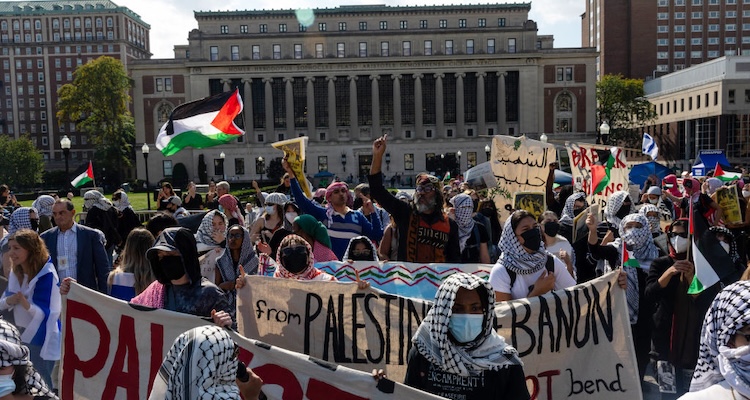
This totalitarian anti-Zionism helped Western elites cast Palestinians as noble, oppressed, disenfranchised people of color and Israelis as ignoble, oppressive, racist whites. It helped progressives ignore the Palestinian national movement’s violence, Islamism, sexism, and homophobia. The Red-Green alliance united leftists with Islamists, and Moynihan’s “Big Red Lie” became the “Big Red-Green Lie” that refuses to die.
_____________
Fifty years later, and despite the resolution’s repeal nearly 34 years ago, many believe that the Israel-bashers have won, since the Zionism-is-racism libel is trending worldwide.
Yet anti-Zionism keeps failing as Zionism and Israel thrive. In 1975, Israel’s Prime Minister Yitzhak Rabin used the enmity to unite his people. “Zionism, Judaism, the State of Israel, and the Jewish people are one,” he said, locating the pull to the Land of Israel and the longing to return to Zion at Judaism’s core. Israeli cities rechristened “United Nations Street”—so named in November 1947—as “Zionism Street.” Thousands of schoolchildren protested, with Golda Meir explaining Zionism to 10,000 high school pupils in Tel Aviv. Students distributed half a million buttons proclaiming: “I AM A ZIONIST.”
Similarly, decades later, on the worst day in modern Israeli history, Zionism was vindicated. On October 7, the Israeli government failed. The IDF failed. But Zionism succeeded. Zionism never promised a state on “a silver platter”—a warning by Israel’s first president, Chaim Weizmann. If Zionism began as a national survival strategy for the Jewish people, it worked that day as a call to immediate and vital action. The thousands of Israelis who mobilized and repelled the jihadi marauders represented a living, breathing, dynamic Zionism no libels can touch. By giving the Jews an ideology and a methodology, Zionism motivated Israelis to fight and ensured that they were sufficiently well trained and well armed to save Israel.
Simultaneously, October 7 unleashed waves of Zionist activism worldwide. Within weeks, Diaspora Jews contributed a billion dollars. Missions kept visiting Israel, bringing helmets and Kevlar vests, socks, and home-baked cookies. Washington, D.C., hosted the largest Jewish protest in American history, with 290,000 marchers and another 250,000 joining via livestream.
The fighting in Israel, the volunteering and donating throughout the Jewish world, reflected the Zionist ethos of self-defense. But something more spiritual happened, too. Even Theodor Herzl understood that Zionism would not just revive the Jewish body but the Jewish soul as well. “Zionism,” he said, “is a return to Jewishness even before there is a return to the Jewish land.”
As Jew-hatred surged, Jewish leaders described “the surge” in communal engagement and identity. From Hillels to synagogues to day schools, rates of participation and passion peaked.
In Israel, the patriotism—and the mourning— triggered a profound Zionist revival. Hundreds of stickers immortalizing fallen soldiers’ defining slogans decorate Israel’s public spaces with medleys of Zionist ideas and sensibilities. Some are Zionist classics, including Am Yisrael Chai (the Jewish people live) or Ain Li Eretz Acharet (I have no other homeland). Some are more personal but deeply Zionist, including “We chose to make aliyah to this land, we won’t let anyone hurt it.”
Most reflect a gritty, resilient generation of New Jews living the Zionist dream. Many urge their survivors to maintain Israelis’ characteristic love of life: “be happy,” “be good.” Evoking the traditional phrase ve-samachata be’chagecha (delight in your holidays), one sticker reads: ve-samachata be’chayecha (delight in your life). Others are feistier, explaining, “Soldiers don’t love what they do, they learn to love what they must do,” insisting that it “doesn’t matter what happens, you’ll get over it.” Crossbreeding optimism and fortitude, that well-known Israeli phrase yehiyeh beseder assures: It’ll be all right.
This Zionist revival rests on three pillars:
- First, although Jew-haters don’t make the Jew—the Jew makes the Jew—the Jews can’t make Jew-haters disappear without fighting back. Ra-ther than being defensive, one must champion genuine liberalism. Social Justice Zionism or Liberal Zionism should seek to rescue “social justice” and “liberalism” from the illiberal liberals. True social justice begins with rejecting all bigotry, articulating an egalitarian liberalism recognizing everyone’s inherent rights and dignity, without romanticizing those deemed “oppressed” and demonizing the supposed “oppressors.”
- Second, Responsibility Zionism expresses the Zionist commitment to Jewish self-determination. Caring Zionists must assess what Israel and the Jewish people need to flourish, internally. Responsibility Zionism is rebuilding Israel’s south after the Hamas attack—and the oft-neglected north, wounded by decades of Hezbollah fire from Lebanon. It’s trying to make Israel’s politics and society worthy of the soldiers, the reservists, the volunteers, and their families. And it’s tree planting, not firefighting; being proactive, not just reactive.
- Finally, Identity Zionism builds from the “I” to the “us.” In an age of alienation, of what Émile Durkheim the sociologist called anomie, in a throwaway society where many feel disposable and can easily cancel others, Zionism emphasizes history, identity, continuity, community—roots and ties. Zionism offers a Jewish counterculture improving on the outside world while cultivating a broad, unifying, welcoming peoplehood platform for the Jewish world. Secular Jews can find meaning without God, and religious Jews can build a broader sense of belonging.
Fifty years ago, Moynihan’s colleague at the UN, Israeli Ambassador Chaim Herzog, called Zionism “nothing more—and nothing less—than the Jewish people’s sense of origin and destination in the land, linked eternally with its name.” He went on: “It is also the instrument whereby the Jewish nation seeks an authentic fulfilment of itself.” He stood in the UN on that November day, representing “a strong and flourishing people which has survived” all the haters before “and which will survive this shameful exhibition.” Herzog then ripped up the resolution.
Zionists worldwide will continue seeking authentic fulfillment for their people and themselves. And they should challenge everyone to transcend today’s deep-rooted anti-Zionist mania, disdaining it, in Herzog’s words, as just another “passing episode in a rich and an event-filled history.”
Photo: Keystone/Getty Images
We want to hear your thoughts about this article. Click here to send a letter to the editor.