With the new academic year just underway, universities have been lining up to settle their differences with agencies of the federal government. They face a range of serious charges, many stemming from troubled campus climates negatively affecting Jews. Universities that have achieved settlements to date include Columbia, UCLA, and Brown, all of which are promising institutional reforms and paying large sums of money to clear their names of harassment, intimidation, and other incriminating activities. They have agreed to these deals largely to restore sizable federal research grants, without which major university departments and programs would be seriously set back.
Addressing campus anti-Semitism also figures in. Columbia has agreed to pay $221 million over three years—$200 million to the federal government and $21 million to the Equal Employment Opportunity Commission (EEOC) to resolve charges of civil rights violations against Jews. Columbia will also review its Middle East Studies program and make it more “comprehensive and balanced.” And it will appoint new faculty to its Institute for Israel and Jewish Studies.
Brown settled in July and got off relatively lightly, agreeing to pay $50 million over a decade to workforce-development organizations and not to the federal government. Additionally, Brown committed to renewing its connections with Israeli academics and will encourage applications from students in Jewish day schools. Working with the federal government, Brown agreed to hire an outside organization to determine if anti-Jewish hostility figures in to the campus climate.
In an initial anti-Semitism lawsuit settlement with private attorneys, UCLA will pay $6 million to three Jewish students and a Jewish professor, all of whom charged the university with violating their civil rights during campus encampment protests. That’s small change compared with the $1 billion fine UCLA is facing from the federal government.
Harvard has so far held out, but it and others are likely to make deals before long. As of this writing, Harvard is considering settling for $500 million. Among other issues, Harvard faces charges about the marginalization and maltreatment of Jews. A report on campus anti-Semitism that the university itself issued in April found that Jewish students had “faced bias, suspicion, intimidation, alienation, shunning, contempt, and sometimes effective exclusion from various curricular and co-curricular parts of the University and its community—clear examples of antisemitism and anti-Israeli bias.”
Similar acts of anti-Jewish hostility were facts of life at numerous other universities. According to findings of the United States Department of Justice, Jewish students at George Washington University were often ridiculed, intimidated, and tormented. On August 12, 2025, Harmeet Dhillon, assistant attorney general of the Civil Rights Division, issued a letter to GW’s president stating clearly that harassment there had been “severe” and “pervasive.” Jewish students were subjected to Nazi salutes and told “they should have been burned in the Holocaust.” Some were “slapped, physically restrained, and had coins thrown at them.” At one point, some of them were blockaded in a study room and could not leave for fear of further assault.
The list of such hateful activity at George Washington University and other academic institutions goes on.
_____________
How serious are these charges? Mahmoud Khalil, a major organizer of Columbia’s encampment protests and the subject of a suspended deportation effort by the State Department, has declared that anti-Semitism at his university is nothing more than “manufactured hysteria.” This stands in sharp contrast to the words of Columbia’s own acting president, Claire Shipman, who has recognized that “Jewish students and faculty have experienced painful, unacceptable incidents, and that reform was and is needed.” She further acknowledged “the very serious and painful challenges our institution has faced with anti-Semitism” and has promised efforts to address it.
Progressive anti-Semitic activity at American colleges and universities dates back decades. It eased in more recent years before erupting dramatically following Hamas’s horrific attack on Israel on October 7, 2023. Within one day of the torture, rape, slaughter, burnings, beheadings, and abduction of hundreds of Israeli Jews, protests broke out on campuses across America. In a sinister turn, they were not directed against Hamas, the perpetrator of these vicious crimes, but against Israel, whose citizens were brutally victimized by them. Within hours of the Hamas pogrom, 34 student groups at Harvard issued a letter on October 7, 2023, declaring Israel “entirely responsible for all unfolding violence…. The apartheid regime is the only one to blame.” Similar denunciations of Israeli “war crimes” and even “genocide” were issued by groups at other universities, well before Israeli soldiers had even entered Gaza.
The crude anti-Israel rhetoric repeated itself across the country. In part, this was owing to a “Day of Resistance” tool kit, or handbook, which Students for Justice in Palestine (SJP), a major organizer of the campus protest movements, circulated widely within one day of the Hamas attacks. The tool kit celebrated Hamas’s October 7 invasion of southern Israel, justified the massacre as an act of “resistance,” and encouraged campus activists to begin demonstrations immediately on behalf of Palestinians and against Israel. The tool kit also included graphics and multiple hashtags and instructed campus affiliates on what to say and what to do.
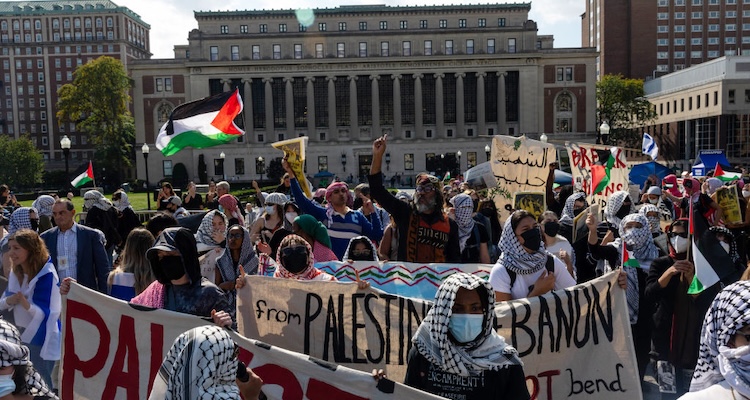
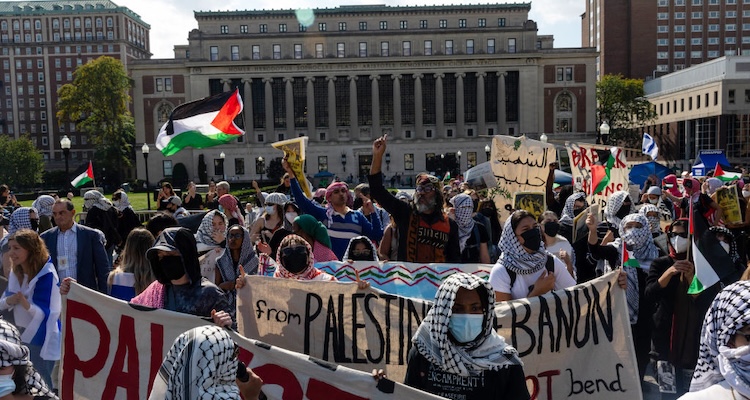
It worked. The protests became especially strident with the erection of “Gaza Solidarity” encampments, the first of which went up at Columbia on April 17, 2024. In no time at all, there were 150 or more of these at American colleges and universities. Accompanying them were passionate calls for a global intifada and other bloodthirsty slogans, including “Death to Israel,” “Death to America,” and “Death to the Jews.”
At their most radical, calls to boycott and divest from everything Israeli were an attack on the basic idea of the university itself, which exists to house and foster open study and discussion. They also attacked America. An offshoot of SJP at Columbia posted the following in September 2024: “Divestment is not an incrementalist goal. True divestment involves nothing short of the total collapse of the university structure and American empire itself…. To divest is to undermine and eradicate America as we know it.”
The erection of the “Gaza Solidarity” encampments in the spring of 2024 launched what Cary Nelson, a professor at the University of Illinois and an anti-Semitism expert, calls “the most rapid politicization of higher education in our lifetimes.” One result is that a significant number of Jewish college students—60 to 70 percent at many universities—feel that they are being harassed, are no longer as welcome as they had been before, are being shunned, or are even in danger. On top of that, as Nelson reports in his new book Mindless: What Happened to Universities?, “a troubling 10 percent of college students would allow calls for the genocide of Jews and 13 percent said that Jews deserved any physical attacks they suffered.” Some Jewish faculty members, and especially those who identify as Zionists, now feel marginalized, vulnerable to the exclusionary pressures of cancel culture, and sometimes are given to practicing one form or another of self-censorship. With the growing prominence of “anti-Zionism” as a regnant political credo within certain academic disciplines—especially Middle Eastern Studies, Gender Studies, and Ethnic Studies—the threats are aimed not only at Jewish faculty, students, and staff, but at the very idea of free expression. To partisans of anti-Zionism, anti-colonialism, anti-Americanism, and other objectionable “isms” on the “progressive” hit list, advocacy trumps scholarship.
This campus discord has long been in the making. The Boycott, Divestment, and Sanctions movement (BDS) dates back some 20 years, well before the “Gaza Solidarity” movement, and has energetically disseminated its primary goals: incrementally, “anti-normalization” with everything connected to Israel; ultimately, the elimination of the Jewish state. Omar Barghouti, a co-founder of BDS, is on record favoring “euthanasia” for Israel. He has stated, “Definitely, most definitely, we oppose a Jewish state in any part of Palestine. No Palestinian—rational Palestinian, not a sellout Palestinian—will ever accept a Jewish state in Palestine.” He and other supporters of BDS believe Israel never should have been created and are doing what they can to bring about its demise. This sentiment was voiced time and again in the 2024 campus protest movements but long predates it.
Are such sentiments anti-Semitic? Pro-Palestinian groups insist they are not and have argued that their encampments at Columbia, UCLA, Harvard, and elsewhere were merely anti-Zionist. Theoretically, anti-Zionism and anti-Semitism are not identical, but as they play out in real life, especially since October 7, an alignment between the two is now evident. They are the twin faces of a common hatred. Like anti-Semitism, anti-Zionism is a passion, a fiercely hostile one. Most Jews know that. When they are faced with slogans such as “We don’t want no Zionists here,” they quickly realize the people being shunned and excluded are they themselves. When they hear “Kill all Zionists” and “Zionists to the gas,” they know the people being cursed and threatened do not all live in Tel Aviv but in the American places they call home.
As for those who do live in Tel Aviv, Jerusalem, and other Israeli towns and cities, they now are some 47 percent of world Jewry. Given that fact, there will be no Jewish future worthy of the name without the continued existence of the State of Israel. Those who want to see it eradicated, like the most committed anti-Zionist BDS stalwarts, are not, as they see themselves, on “the right side of history,” but more closely aligned with those in Germany in the 1930s.
What will the 2025–2026 academic year bring for Jewish students, faculty, and staff?
The reforms promised thus far by Columbia and others may be a well-intended first start, but to address questions of anti-Semitic discrimination on college campuses successfully, they will have to go well beyond the technical demands of legal settlements and restore some moral clarity to how universities must function. Indoctrination is not education, but it has won a prominent place within certain academic disciplines. One result is endless vilification of Israel as a racist, colonialist, apartheid, and even Nazi state. The gleeful repetition of such slurs may fall within the parameters of free speech, but they manifest a malign disorder of both intellectual and moral functioning. Far from helping students learn to think clearly, political advocacy of this sort only gets them caught up in ritualistic sloganeering. Shouting “From the river to the sea” and “Free, Free Palestine” may feel virtuous, but it will accomplish nothing. To think otherwise is delusional. As I tell my students, when the political shouts start up, the mind shuts down. And when one begins to think in slogans, one stops thinking altogether. Nothing is more antithetical to teaching and learning at their best. For the latter to flourish, universities will need to go well beyond payouts of large sums of money to the federal government and begin to fix what is broken closer to home. In this respect, a revivification of the humanities is vital. When properly pursued, they do, in fact, humanize, but they can never do this if they are misused to dehumanize the Jews or anyone else.
Photo: Alex Kent/Getty Images
We want to hear your thoughts about this article. Click here to send a letter to the editor.