When I first moved to Los Angeles, I met a guy who was working on a hidden-camera show. Those shows had been a staple of television since its earliest days, and the flagship of the genre, Candid Camera, ran in one form or another for years. Everybody knows the basic setup: The producers devise an on-screen prank to play on an unsuspecting mark, and the fun unfolds as an ordinary person tries to navigate an unusual situation. The best Candid Camera setups were harmless psychology experiments. “We catch people in the act of being themselves,” said the host of Candid Camera, Allen Funt, each week as he introduced the show. He and his team made certain that the pranks were sharp and unexpected enough to get big laughs but lighthearted and wholesome enough that no one suffered emotional damage or jumped out of the window in televised mortification.
It was a big hit. Funt created and hosted Candid Camera for most of its three decades on the air (the show premiered in 1948). When he was too old to continue, his son Peter Funt took over the family business and hosted a version in the 1990s. Like the majority of hits that come out of Hollywood, the success of Candid Camera was mostly about timing. It began in 1947 as a radio show called Candid Microphone, but by the following year television was the place to be, so the show transitioned to the screen, and its unforgettable tagline—“Smile! You’re on Candid Camera!”—made its way into the national lexicon. I’m pretty sure “Sigh audibly! You’re on Candid Microphone!” would not have had the same impact.
Like any successful television product, Candid Camera inspired knockoffs and copycats for decades, the later versions being MTV’s Punk’d and Comedy Central’s Impractical Jokers. The guy I met a few weeks after moving to Los Angeles in 1988 had a job on one of the many variations. At the time, I was an unemployed film student driving a battered 10-year-old Subaru, so a working television professional seemed impossibly glamorous. But the day I met him, he was in a deep depression.
That day, they had tried to film a pretty basic setup. It was a kid-centered prank in which they had a very old person walk through some kind of water feature and emerge on the other side as a much younger person, all to the delight and amazement (they hoped) of a child who didn’t realize that this was all a trick and that the participants were paid actors hired for the day.
In the very first take, this guy told me, the segment fell apart. The adorable five-year-old watched an elderly lady hobble into the water feature and then emerge as a reenergized 20-year-old. He clapped and cheered in amazement and then said, in a heartbreakingly innocent voice, “Can you bring my grandma back?” And they all stared at their shoes while he kept asking, more and more insistently, for them to bring his beloved grandmother back from the grave. Eventually he broke down in sobs, his mother was called onto the set, and they all tried to explain to him that this was all just pretend, that it was a trick, that his grandmother was dead and going to stay that way. His mother carried him off while he was still wailing, still demanding to know why they tricked him like that.
Done correctly, in other words, Candid Camera can be a fun, joyful investigation into human nature. Done incorrectly, it ends in trauma and tears.
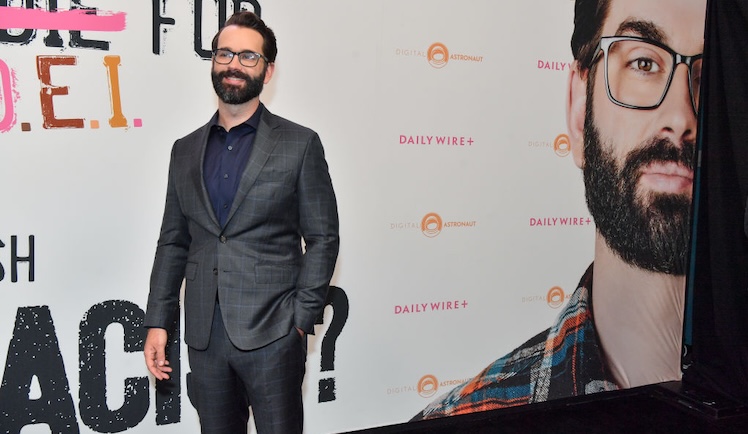
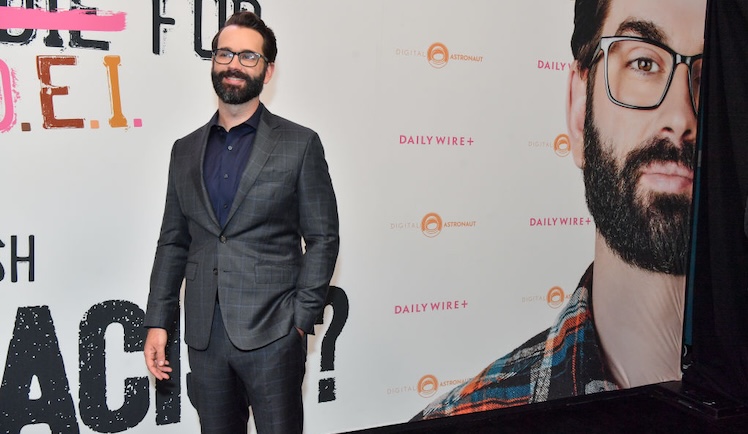
I thought about that moment while watching Am I Racist?, the gleeful and hilarious documentary produced by and starring Matt Walsh, the conservative writer, podcaster, and commentator at the Daily Wire. The movie is a 100-minute journey through the inner maze of the diversity, equity, and inclusion movement, complete with ambush interviews, bad wigs, and Allen Funt’s foundational show-business insight that you can never go broke showing people in “the act of being themselves.”
Unfortunately for many of the people in this utterly joyful, deliciously nasty documentary, the “themselves” they are in the act of being turn out to be meretricious nonsense-spouting, race-huckstering nutjobs, and Walsh does a masterful job of letting them unspool the crazy and wrap it around their own necks while he stares placidly at them and speaks in a carefully modulated monotone. The effect is spectacular. It is the funniest—and truest—movie you will see this year.
Am I Racist? is filled with many terrific moments, but the one that made me remember that sad little boy who lost his nana happens when Walsh, in a truly awful hairpiece, interviews Robin DiAngelo, the author of White Fragility, and convinces her to hand his black producer $30 as “reparations.” DiAngelo is so thoroughly humiliated by the segment that I found myself wanting to call her mother to the set to take her away. Even as you’re laughing, it seems a little unfair.
Except: For years, the left has delighted in using these same tactics against their enemies. In Bowling for Columbine, Michael Moore’s 2002 documentary exploring gun violence in America, one of the film’s most memorable and tense moments is his interview with movie star Charlton Heston, who was an outspoken advocate of gun rights and the president of the NRA. He was also suffering from Alzheimer’s, which becomes clear as the interview goes on and grows increasingly uncomfortable to watch.
Or how about the 2006 film Borat: Cultural Learnings of America for Make Benefit Glorious Nation of Kazakhstan? In that film, the main character, Borat Sagdiyev (played by Sacha Baron Cohen), stays as a guest in the home of a group of evangelical Christians and peppers them with increasingly weird, inappropriate questions rooted in his character’s bigotry and prejudice. His hosts respond with patience and attempts to share their faith with him, but it’s clear that the movie is trying to make them appear foolish.
Am I Racist? is the same kind of ambush filmmaking, but to that I say: It’s about time. And the villains of Matt Walsh’s movie are a far cry from gracious Southern Christians or movie stars in mental decline. Matt Walsh’s marks are smug, influential media darlings. They had it coming.
But as we say in show business when someone talks about the cultural significance of a project, “Yeah, yeah, yeah. But how’d it do?” Here’s your answer: Am I Racist is the first broadly appealing hit from Ben Shapiro and Jeremy Boering’s Daily Wire Studios and has a sky-high Rotten Tomatoes score. It has reaped about $11 million at the box office against a $3 million budget, and it has proved that not only does Daily Wire Studios know how to make a successful theatrical comedy—something that not every studio can claim in 2024—but that audiences want a comedy that makes fun of the corrosive, over-the-top race culture that we’ve all been suffering under for the past decade or so. Matt Walsh made a hit movie, and he didn’t even need to write a script. He just followed Allen Funt’s lead and let his subjects be themselves, and it turns out that they are hilarious.
Photo by Jason Davis/Getty Images for DailyWire+
We want to hear your thoughts about this article. Click here to send a letter to the editor.