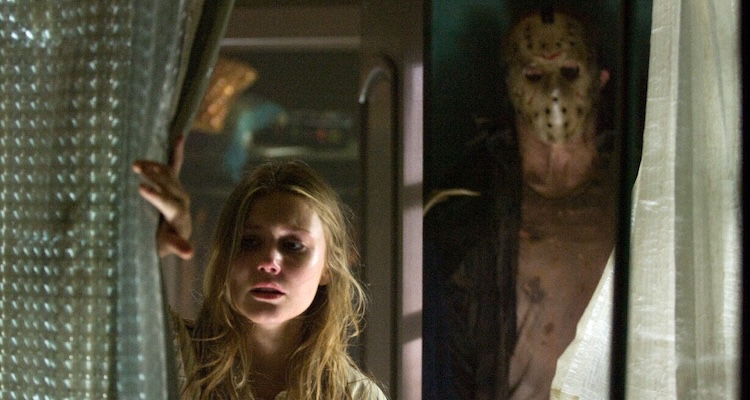
In every classic slasher psycho-killer movie there’s the same moment. It occurs at the end, when the promiscuous teens who have been racing around the old barn trying desperately to avoid the chain saw finally get the killer.
Usually it’s the girl in the third-tightest T-shirt (the girls in the first two have already been dispatched, in order of tightness) who hits him with a rock, or a pole, or stabs him with a pitchfork, something like that—it’s been a long time since I actually watched one. The scene always plays out the same way: In the background, the psycho-slasher is down, pitchfork sticking out of his chest. In the foreground, the girl in the third-tightest T-shirt and her slightly vacant boyfriend embrace in exhausted relief. Whew, they say, Glad that’s over. Glad that crazy guy is dead. One hundred percent dead and gone, that’s for sure. Why, there’s no way he couldn’t be dead and we’re so sure of that we’re just going to start making out and not even bother turning around to confirm that he is, in fact, dead.
And in the background, of course, the psycho killer silently rises.
They call it, I’m told, the third-act boo, the jolt of terror at the end that gives the audience a little last-minute squeal (and often sets up the sequel at the same time). There are lots of effective boos—the one where the victim closes the medicine chest in the bathroom is my favorite, revealing the killer in the mirror standing right behind her! There’s also the one where the baddie was in the back seat of the car the whole time!
I have a friend who works on an action-adventure television series, and he says the hardest thing about writing an effective boo is that it works only if the audience has come to a moment when it feels safe. The viewers need to think that everything is fine and the danger is over, he told me, and getting to that point takes a deft hand with story craft. “They’ve got to be thinking, Everything’s okay, everything’s okay, crisis over, back to normal,” he said. “And then, suddenly, What’s that noise?”
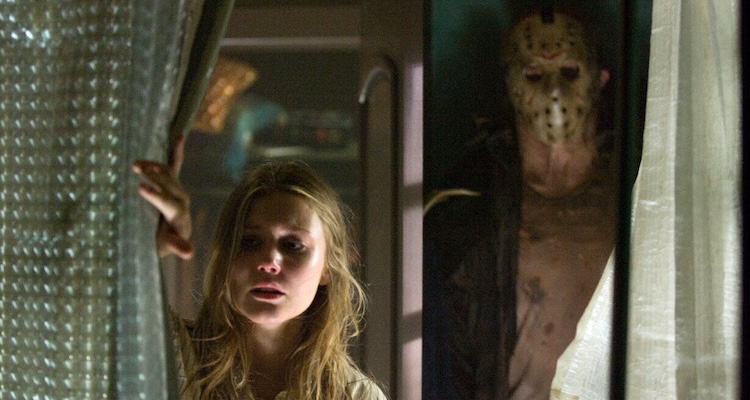
Third-act boos are an off-screen phenomenon too. If you’re in show business, the past years have felt like one long slasher picture. It all started with the internet and its collection of video sites that siphoned audiences away from traditional television. That’s when the spooky music started playing in the underscore. And then a few years later the killer (well, killers) appeared. The streaming services chased movie studios and television networks through the lake house, wielding axes and chain saws like an army of Jasons from the Friday the 13th series, killing all the promiscuous teenagers. In my (admittedly) tortured analogy, the “promiscuous teenagers” would be the traditional studio and network executives, but the group of victims also includes writers with fat studio deals, star-driven production companies, and traditional broadcasters.
Just when it seemed like some kind of new business model was emerging—a mix of subscription-based
platforms, advertising-supported television, and theatrical releases—a worldwide pandemic shut down all of the movie theaters. The cash-money machines that have been the engine of prosperity for show business for over a century stopped delivering cash, at which point a new group of deranged psychotics went on the rampage.
These were the share- and bondholders who had been bankrolling the disruptive changes in show business for the previous decade, and now they wanted their money. So Hollywood began to shrink: fewer projects, smaller budgets, a contracting business. And before any of that was digested by the industry, the writers and actors decided to go on a six-month strike. In other words: Boo!
At this point in the picture, the lake house is piled so high with corpses—executives, overall deals, movies cancelled in mid-development or post-production, floundering streaming services, legacy broadcasters—that you can barely hear the exhausted and terrified panting of the few bloodied survivors.
What Hollywood is searching for, in box office revenues and television subscription numbers, is a sign that things are stabilizing. As each project gets released into the world, the results are parsed and dissected for a concrete nugget of information that might lead to some kind of safety. We’re all looking for signs that this terrible slasher movie is over and we can go back to making romantic comedies and adult dramas. But the third-act boos keep coming.
So when the final installment of Tom Cruise’s mega-smash Mission: Impossible series opened with a strong weekend box office and generally positive audience response, it must have felt like everything was going to be okay to Paramount Studios—itself exhausted and bleeding from a yearlong takeover wrangle. The movie made nearly $600 million worldwide, which sounds awfully good until you remember it cost about $400 million to make. Even the bankable moviemaking genius of Tom Cruise couldn’t escape the third-act boo.
And when the re-envisioned Marvel superhero movie The Fantastic Four: First Steps opened this summer to one of the strongest weekend box office takes in recent memory, it wasn’t just the employees of Marvel Studios and its parent company Disney that celebrated. All of show business set aside its usual bitter jealousies and rejoiced: The Summer Blockbuster is back! The next weekend, though, the movie tanked. Attendance dropped 66 percent. Boo!
About the only unalloyed bright spot is the performance of the latest installment of the DC franchise, Superman, which hit the $500 million mark early in its run, despite some headwinds in the international market. Superman is like the teenage girl in the third-tightest T-shirt: safe, for now. But that just makes the entertainment business more jittery and anxious for signs. The foundational economic rule of Hollywood is Find something that works and run it into the ground. Hard to do when nothing is working with any consistency. Hard to do when the layoffs are continuing, when streaming services are being sold or shut down, when no one in the business knows exactly what success looks like.
The trick to writing a really good third-act boo, like my friend said, is to make sure that the audience thinks it’s over and the psychopath is truly dead. Everyone has to feel becalmed to really get that jolt of surprise and terror when it turns out that the killer has been behind the shower curtain the entire time. But what if, like Hollywood in the summer of 2025, everyone is still nervous and fearful and terrified? What if we’re not at the point in the movie where anyone feels a shred of safety? What do you call that?
You call that, my friend told me, a second-act boo. Or, worse, a first-act boo. Which means that the slasher movie that Hollywood is living through—box office deflation, audiences vanishing, layoffs coming, industry contraction—is not even close to over. There are a lot of boos left.
Film still from Friday the 13th (2009), © Warner Bros. Pictures. All rights reserved.
We want to hear your thoughts about this article. Click here to send a letter to the editor.