I have an actor friend who once tried to explain to his future father-in-law how show business works. It was a fraught conversation. He was trying to explain the process of television-series development, casting calls, and network screen tests to a man who had spent his entire adult life working at a small-town bank. He wrapped up his mini-seminar by saying, “And that’s how the business works,” after which there was a long silence.
“That’s how it works?” His future father-in-law asked, eyes narrowing in concern. “It sounds to me like you play the lottery for a living.”
Normal people, when they think about the entertainment industry, think mostly about fame and stardom, which seem like remote and very long-odds possibilities. As a wise Dionne Warwick sings in “Do You Know the Way to San Jose,” people come to Los Angeles with a big dream—“In a week or two, they’ll make you a star / Weeks turn into years, how quick they pass / And all the stars that never were / Are parking cars and pumping gas.”
The truth is, though, that stars and bold-faced names are a little like ants: If you see one, you know there’s a vast colony of support ants—lawyer ants, agent ants, studio-executive ants—somewhere just out of sight, working away. A lot of the stars-that-never-were don’t end up in sad dead-end jobs. Many of them become casting directors and talent managers. Some of them are even writers and directors. I had an attorney once who, as an actress, was cut from the pilot episode of the sitcom The Facts of Life. She left the business, went to law school, and came back as a prominent (and ruthless) entertainment lawyer. Hollywood is a place where there’s always plenty to do—if you don’t insist on becoming a movie star—and everybody knows how much we love a comeback story.
My actor friend got the message, too. After he got married, he tried to keep his acting career going. But when the first child arrived, he realized (with some help, I’m sure, from his father-in-law) that this acting business didn’t make any sense. So he pivoted to public relations, which turned into marketing, which became executive vice president of marketing and promotion for a large television network. He no longer had to fear the disapproval of his small-town banker father-in-law because pretty soon he was a successful executive with a house in the Pacific Palisades. Until this past Tuesday, when his house—and the rest of the neighborhood—was destroyed in what is (and as I write this, the Pacific Palisades fire is still very much an is and not a was) the most destructive blaze in American history. He and his family are fine, I learned when I texted him early the next morning. They managed to decamp to a hotel in Long Beach. But their home is gone.
It wasn’t immediately apparent, when the news first started to break, that the fire was going to be quite so disastrous. I moved from Los Angeles to New York several years ago, so I tend to get my local LA news from Facebook and Instagram. But as the pictures started to emerge, I watched the streaming broadcast from KTLA Channel 5 and made a list of everyone I knew who lived in the Palisades—friends, colleagues, business frenemies—and texted each one to ask whether they were safe. It was a huge list—I’ve been in the entertainment business for 35 years —and I was struck by how many in my show-business circle live there. Lived, I should say. Most of my career, it turns out, was in the fire zone.
Which makes sense if you’ve ever been to the Pacific Palisades. It’s true that it’s a very rich area, but it also feels like a very normal, very down-to-earth small town. There are hardware stores and delis that have been there for decades, along with the kind of boutiques you’d find in any upscale suburb in America: a place for high-end sporting goods, a gifty kind of bookstore, a place to buy expensive candles. The local public high school was top-notch, and it even had a thriving Episcopal church. They’ve all been burned to the ground.
There were movie stars in the Palisades, whom you’d see in the grocery stores and Peet’s Coffee, both now destroyed. But the place was mostly the support village for the entertainment business. It’s where you lived if you were one of the thousands of people who worked in show business but wasn’t famous. If you were meeting a talent manager for lunch but neither of you wanted to make it a big deal, you met in the Palisades. If you were in the checkout line at the Gelson’s supermarket on Sunset—gone now—you might, as I did years ago, bump into a network executive and find out that your show is about to be cancelled. The Palisades was the central nervous system for show business. It’s anyone’s guess where that will be now that the Palisades is a pile of ashes and embers.
There’s an old story about an agent and a studio executive meeting for lunch. The studio executive arrives early and is waiting at the bar, watching the news. There’s been a terrible plane crash somewhere—an enormous tragedy with 300 passengers lost. And when the agent arrives and hears the news, he says, Oh man, that’s awful. So was there anybody on the plane?
What the agent wanted to know, of course, was whether there was anybody connected to the entertainment industry on the plane, anybody that he and his studio-executive colleague were reliant on in some way. If you’ve ever been in a car or plane with someone famous, it’s hard not to think that if something goes horribly wrong, the headlines will read: “Famous Actor Lost in Tragedy.” Or, in the very best case: “Famous Actor, Others, Lost in Tragedy.” What made the Pacific Palisades such a lovely place to live, such a normal place to raise a family, was how easily the “Famous” and the “Others” mixed together. In show business, of course, you can often—like my erstwhile attorney—go from one to the other. But you never had to leave the Pacific Palisades to do it.
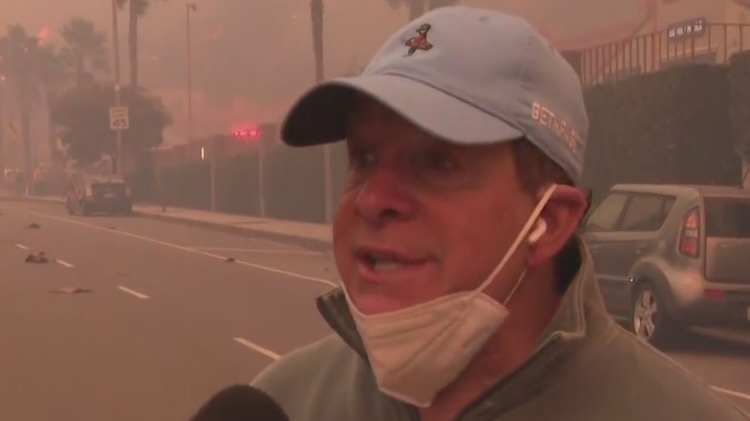
During a live on-the-scene broadcast on KTLA, a young reporter was interviewing a local resident about the problem of abandoned cars along Palisades Drive. During the frantic evacuation, many people just left their vehicle in the street and headed to safety on foot. The result was that some streets were blocked and emergency vehicles couldn’t get through. “Leave the keys in the car,” the local resident urged his neighbors, in a straight-to-camera plea.
“Thank you for talking to us live, sir,” the reporter said. “What’s your name?”
“My name is Steve Guttenberg,” said Steve Guttenberg, the actor and star of such 1980s classics as Three Men and a Baby and the Police Academy series. He was, of course, instantly recognizable to every single viewer of KTLA’s live broadcast over the age of, say, 45, but to the younger reporter he was just another Palisades resident doing his best under extremely dangerous conditions. Just another working person in the entertainment industry who was watching his village go up in flames and, I hope, already planning its comeback.
Photo: Screenshot by KTLA 5
We want to hear your thoughts about this article. Click here to send a letter to the editor.