In his Decline and Fall of the Roman Empire, Edward Gibbon posed one of the great counterfactual questions in history. If the French had failed to defeat an invading Muslim army at the Battle of Poitiers in 732, would all of Western Europe have succumbed to Islam? “Perhaps,” ventured Gibbon, “the interpretation of the Koran would now be taught in the schools of Oxford, and her pulpits might demonstrate to a circumcised people the sanctity and truth of the revelation of Mohammed.”
As Gibbon understood, power is the decisive force in history, the ultima ratio. Without it, there can be no durable order among nations and precious little justice. This truth implies no moral judgment. It was not the superior virtue of the French that repelled the Islamic invaders at Poitiers. It was their superior power. The intrinsic relationship between power and nationhood is not well understood in the West today. Two popular fictions have recently gained currency that are distorting perceptions about the ethics of military force and the very nature of civilization along with it. The first is the notion that war and conquest are Western inventions; the second is that such methods and ambitions are morally indefensible. Taken as a pair, these ideas suggest a gross stain on the West for its long practice of organized violence and imperial might at the expense of indigenous peoples.
These ideas are encapsulated by an ideology that has become ubiquitous in many elite quarters of Western opinion. Settler colonialism is a complex cultural-political argument characterized by European settlers discovering an area that they consider terra nullius (nobody’s land) and, driven by an insatiable hunger for expansion, laying waste to indigenous peoples and cultures. As Adam Kirsch elaborates in his bracing new book On Settler Colonialism, this intellectual fad came to prominence after the October 7 massacre of Israelis by Hamas, but it has been an influential concept in the academy for decades. It has been a familiar refrain among professional activists for nearly as long. And it amounts to a new countermyth of American history.
A poet and literary critic, Kirsch has written a succinct and subtle study of this subversive ideology. His inquiry begins with an acknowledgment that “settler colonialism” is not a self-conscious movement. Even referring to it as an ideology runs the risk of sowing confusion by naming a political idea for what it opposes. But this charged concept aims to shape our sense of reality with a specific interpretation of politics and history, and Kirsch pays it the compliment of taking it seriously.
On Settler Colonialism explores how this boutique term became ever-present in our political dialogue. The dispossession and in some cases the mass slaughter of indigenous peoples by European settlers is hardly a secret; on the contrary, it’s an old story and a rather straightforward one. But the novelty of the ideology tethered to this anchor, Kirsch shows, inheres in its “political theory of original sin” according to which “the violence involved in a nation’s founding continues to define every aspect of its life, even after centuries.”
Immersed in the literature of settler colonialism, Kirsch summons the work of its leading proponents including the Australian scholar Patrick Wolfe, who argued decades ago that “invasion is a structure, not an event.” The passage of time can never turn these invaders or their descendants into authentic inhabitants.
From the perspective of settler colonialism, history is a morality tale that has little to impart beyond indigenous innocence, European depravity, and immutable guilt. Kirsch spells out the syllogism that has grown up with this masochistic impulse: “If settlement is a genocidal invasion, and invasion is an ongoing structure, not a completed event, then everything (and perhaps everyone) that sustains a settler colonial society is also genocidal.” In other words, settler colonialism licenses the most extreme criticism and denunciation of Western culture, making it the latest symptom of the penitential condition of the West.
Although Kirsch does not draw the analogy, the totalizing vision and internally inconsistent views of settler colonialism carry strong echoes of the woke revolution that casts the United States as congenitally and irredeemably racist. In its zealous but partial scapegoating, it too requires the frequent elision of inconvenient facts. The more you investigate this ideology, the less it looks like a political persuasion and the more it takes on the qualities of religious belief. (A similar observation was made about the dogmatism of the great “awokening” a few years back.) This is part of what accounts for the difficulty in jousting with its advocates; it is almost impossible to argue a believer out of his faith.
But if settler colonialism is a sin, where is redemption to be found? In both the academic and the popular literature on the subject, the notion of redemption is entirely obscured. Based on the enormity of the colonial project and what is portrayed as its noxious legacy, the “settler colonialism” theory feeds a demand that cannot possibly be satisfied even in principle since it is committed to the destruction of the settler state tout court. The only happy outcome would seem to be for America never to have existed in the first place. Which political party would like to adopt that plank in its platform?
According to this doctrine, the confession of sin is critical. Hence the profusion of “land acknowledgments” whereby statements are read out on public occasions—as happened at this year’s Democratic National Convention—or displayed in permanent signage indicating the Native American peoples that once inhabited a particular site. Kirsch does not conceal his scorn for this. “If the struggle against American settler colonialism were a real political struggle,” he writes, “land acknowledgments would be contemptibly hypocritical, since the institutions that make them clearly have no intention of actually vacating the land they blame themselves for occupying.”
As this passage suggests, On Settler Colonialism is unashamedly and splendidly bellicose. After its judicious analysis of the phenomenon’s roots, it wastes no time getting to the heart of the matter. Settler colonialism castigates a wide array of Western institutions and public policies, but this is merely a function of its burning hostility for the American system and all its works. The depiction of the United States and Israel—as ever, the two principal targets of the bien-pensant left—as settler colonial societies could not be more radical, “a way of arguing that they are permanently illegitimate, because they were created against the will of the people previously living there—Native Americans and Palestinian Arabs.”
_____________
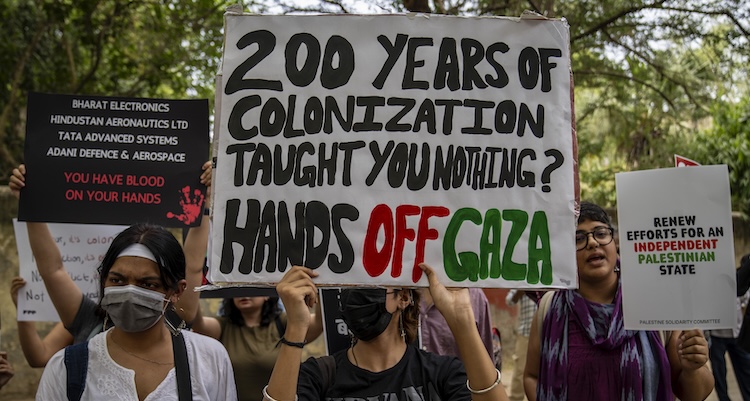
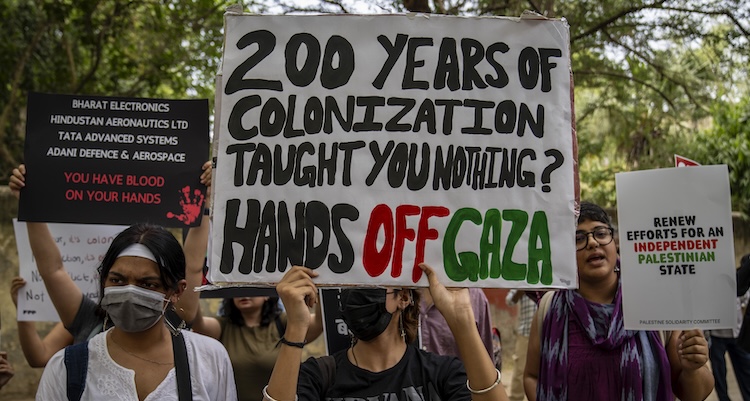
The spur for Kirsch’s book is the carnage that befell Israel last October and the hideous global response it engendered. Just as shocking as the jihadist attack that indiscriminately killed some 1,200 Israelis was the way it revealed and catalyzed the spread of the toxin of anti-Semitism across Western society. Kirsch cites a poll conducted after the attack that found young Americans split over the conflict between Israel and the theocratic death cult that is Hamas. Among those ages 18–24, nearly two-thirds of respondents agreed that Hamas’s genocidal onslaught “can be justified by the grievances of the Palestinians.” No wonder campus protesters chanted “We don’t want no two states, we want ’48,” demanding the abolition of Israel.
Kirsch notes that the massacre of Jews in Israel—instantly transmitted around the world via bodycam footage taken by Hamas fighters—had the effect of reversing “the usual terms” of the Israeli–Palestinian conflict. For two decades, the pattern of the conflict saw Hamas casually rocket Israeli towns near the Gaza border with little effect while Israel retaliated with lethal artillery barrages and air strikes. The asymmetry of firepower combined with a similar asymmetry in the protection of civilians left Israel largely unscathed while Palestinians bore the brunt of the Israeli response. These uneven death tolls provoked fierce criticism of Israel around the world. One might have expected, then, that a gruesome and intimate butchery of many hundreds of Israeli civilians would elicit widespread horror and condemnation. In fact, just the opposite happened. The most murderous attack against Jews since the Holocaust inspired “a larger and louder pro-Palestinian response than any previous conflict.”
How to explain this wretched state of affairs? Kirsch admits that some of the indignation toward Israel flows from traditional humanitarian concerns in response to Israel’s retaliatory invasion of Gaza, which resulted in a great many civilian casualties. But in truth, this was an afterthought. The protests against Israel erupted more or less concomitantly with the news of Jewish bloodshed, well before any Israeli military response. Over the years, it had been common to witness excitement and enthusiasm over Hamas’s exploits in Palestinian culture, or even in the political slums of Cairo and Damascus; what made this time different, Kirsch observes, is that now “it was coming from Ivy League campuses, the Democratic Socialists of America, and Black Lives Matter.”
And the forces of jihad returned the compliment to the boutique left, adopting the language of an academic seminar. Three months after its barbaric attack in the Gaza Envelope, Hamas published a memorandum in defense of the war it initiated. “The events of October 7 must be put in their broader context,” it said. That broader context, Hamas explained, is “all cases of struggle against colonialism.” Formerly committed to shedding Jewish blood on explicitly theological grounds, Hamas now fine-tuned its position to opposing Zionism as a “colonial project,” an “illegal entity.”
But the insistence that Israel is part of the same historical process that brought European settlers to various lands wrenched from indigenous peoples belies the historical record. Modern Zionist settlement in what is now Israel took off in the 1880s when Palestine was a province of the Ottoman Empire. Jewish emigration continued after World War I when the land was ruled by the British under a mandate from the League of Nations. Eventually, the Jewish state was established in a manner that displaced Arab inhabitants of Palestine but did not erase them.
Notwithstanding the post-1967 settlements on the West Bank, the State of Israel remains a speck on the regional map surrounded by a vast swath of Arab countries stretching from Morocco to Iraq. Some empire. And since 1948, the Arab population of historic Palestine has swelled from about 1.3 million to about 7.5 million. Some genocide.
Anyone with a tinge of sympathy for Zionism ought to recoil from an ideology that is a fount of historical falsehood and monstrous fantasy at the expense of the Jews. But Kirsch wisely instructs readers how the settler-colonial prism also provides low returns for Palestinians. In short, the rise of this framework generates terrible confusion about that insoluble conflict. By fashioning a radical argument against Israel’s entire existence, the settler-colonial paradigm obviates any legitimate discussion of land swaps and proposed national borders. Given the durable imbalance of power, the implications for Palestinians of remaining locked in rejectionism will be grim. Hence the beginning of wisdom for advocates of Palestinian interests is to recognize that Israel, with no “mother country” to speak of, is staying put.
Ultimately, it is not only the concept of colonialism that people fail to grasp in the modern age but the concept of war. In a century of recurrent conflict between Jews and Arabs, it is long past time for Palestinians to adjust to the reality of Jewish sovereignty. Without that, their aspirations for a better life will remain bound up in an impossible, anti-historical scheme. On Settler Colonialism is a lucid and humane warning against precisely that fate.
Photo: AP Photo/Altaf Qadri
We want to hear your thoughts about this article. Click here to send a letter to the editor.