For more than a decade, the tradition of liberalism has taken a beating from both ends of the political spectrum. Some of the blows have been inflicted by a right that has outgrown its fidelity to democratic values and constitutional procedures. Others have come from a left that has jettisoned civic nationalism in favor of a peculiar obsession with group identity. Separately and together, these tendencies have bred a Manichean worldview among vast swathes of the American public. Bemoaning the ascendancy of illiberalism is a cottage industry, and the bemoaners are too often absolutist in their own right, insisting that tribalism infects their political and ideological rivals while disputing that any such tribalism grips their own side. Scarcely anyone stands apart from the mob and takes the full measure of the grotesque beast in our midst.
A welcome exception to this dreary pattern is Thomas Chatterton Williams, a staff writer at the Atlantic and a visiting professor at Bard College. His new book, Summer of Our Discontent, is an earnest and sensitive treatise about the season in 2020 that kicked off our era of social upheaval and political radicalism.
Williams begins with the converging crises of the Covid-19 pandemic and the death of George Floyd. These “generation-defining twin calamities” inaugurated a season of “rebellion and reckoning” centering on the theme that “malignant racial sickness” was coursing through the American bloodstream. This was not new. “Academics and activists have made postmodern, identity-inflected arguments for decades now,” Williams reminds us. The summer of 2020 was therefore “the climax of this story, not its beginning nor its culmination.”
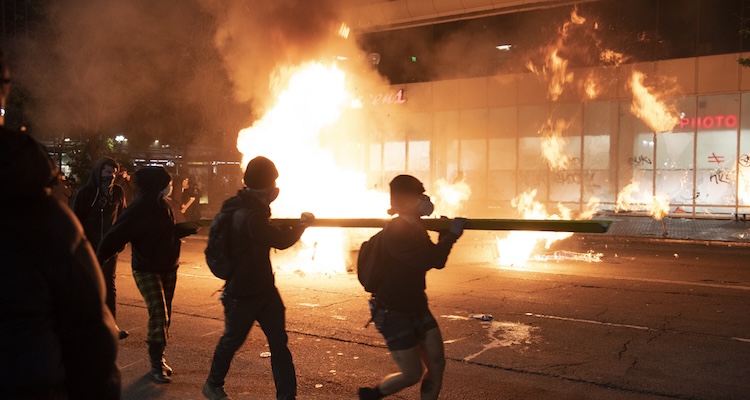
A large cartridge of Williams’s ink is expended on the social and political turbulence unleashed by George Floyd’s death. The video footage of Floyd expiring on Minneapolis pavement as police officers attempted to detain him (after he had used counterfeit currency) had the effect of a torrential rain over a parched desert. What ensued was a full-blown moral panic outwardly driven by “the visual quintessence of a centuries-long and cancerous history,” but that quickly came to be a mirror of fashionable identity politics and a zeal to blacklist anyone who did not accept the premises of the panic.
The social-justice movement reached its zenith as sprawling protests across America—and, thanks to social media, around the globe—agitated for a redress of grievances around issues of systemic poverty and racism, crime and punishment, and police violence. Prominent civic institutions, private firms, and government agencies got in on the action, taking up the Black Lives Matter agenda with gusto. These were, Williams notes, the largest manifestations against racism “in the history of humanity.”
Alas, the palpable white guilt and yearning for moral innocence on display during “The Great Awokening” were less animated by black uplift than by a desire for recognition of their own virtue. Soon this quasi-religious movement—Williams dubs it “the cult of anti-racism”—threw its weight behind utopian schemes to alter American society root and branch. Judicious calls for police reform were rapidly overwhelmed by strident demands to defund or abolish the police. Within a fortnight of Floyd’s death, the Minneapolis city council pledged to “dismantle” their police department, which promptly sparked a crime wave and a 50 percent surge in homicides. City residents eventually responded by terminating the initiative.
The pandemic stasis that cast its net across the country in the spring of 2020 primed large numbers of Americans to rebel against the established order. It combined, Williams observes, with a palpable sense of “race pessimism” and “a kind of mass learned helplessness” among younger generations, particularly the Millennial left. He explores how this bleak dispensation arose precisely as poverty rates had begun to plummet for black people and other historically disadvantaged minority communities. The author’s explanation for this weird dichotomy lies in the frustrations and failures of the Obama administration, which played a decisive role in the “blooming discontent” that manifested in the annus horribilis of 2020.
To buttress this conclusion, Williams cites the writing of Alexis de Tocqueville about the French Revolution and the singular character of American democracy. In fractured and stratified societies, Tocqueville observed, “no inequality is so great as to offend the eye” whereas “the slightest dissimilarity is odious in the midst of general uniformity.” In the Obama years, better material conditions alongside extravagant expectations led to dissension. Since “unfulfilled, rising expectations create unstable political situations,” Williams argues that disappointed hopes energized the Jacobins of our time and catalyzed the pivot from post-racialism in 2008 to its polar opposite within a few short years.
The Obama ascendancy had been supposed to mark the “immediate transcendence, in theory and practice, of racial identity (and therefore of racism and its twisted legacies),” Williams muses. He then invites some doubt about this seductive reverie: “In retrospect, such a hyperinflated vision would pop when it brushed too many times against reality’s jagged grain. But was that preordained?”
_____________
Williams’s answer is that a genuine opportunity for racial harmony was squandered by Obama’s blunders and Republicans’ refusal to show the first black president adequate “generosity.” Although both factors were certainly at work, Obama’s presidency was never likely to usher in a post-racial paradise because Obama’s success was the result of social change rather than the cause of it. His election owed not chiefly to his (inchoate) political philosophy or (then-undemonstrated) public virtue but rather to the thin reed of his identity.
In small but significant measure, Obama’s meteoric rise was a function of what Shelby Steele called Americans’ “race fatigue” and the concomitant desire to see a black citizen voted into the nation’s highest office. This did not bode well for the post-racial project that sought to do away with categories such as “black” and “white” altogether. Given that it was not merely the content of his character but also the color of his skin that had elevated Obama to begin with, it was improbable that such a conventional and opaque figure would definitively move the country beyond the primacy of race. Obama was “bound,” as Steele concluded at the time, “by the same racial configuration that he has exploited.”
But it was Obama’s successor that exposed the simmering discontent on the left and inflamed the national psyche. The specter of Donald Trump, Williams argues, “allowed what most Americans would consider niche extremism and identitarian solipsism to find fresh and far more receptive hearings.” In the shadow of the populist turn in Republican politics, America’s media institutions began to view themselves “as mandated not simply to bring forth news of the world and to inform their readers—nor even simply to argue for a position and then work to persuade them—but rather to instruct their followers on the indisputable Truth of what was moral, above all what was ‘racist,’ and what would heretofore be considered impermissible.”
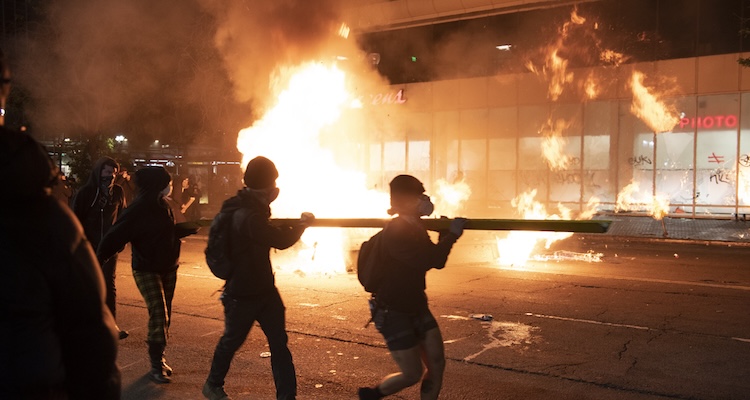
One incident at the New York Times Company encapsulates the whole. After the Minneapolis protests had descended into spasms of national rioting and looting, the New York Times published a guest op-ed by Senator Tom Cotton under the headline “Send In the Troops.” In short order, a group of Times employees rebuked the editors who had commissioned and published the senator’s article. Within days, editors were forced to resign, and the Times issued a bizarre apology for having the audacity to air a popular and tough-minded argument to its readers. Williams concludes from this episode that journalism’s marquee institution “capitulated in the face of coordinated mobs of junior staffers” and abdicated its responsibility to be a forum (in the words of Times pioneer Adolph Ochs in 1896) “for the consideration of all questions of public importance, and to that end to invite intelligent discussion from all shades of opinion.”
Williams is alarmed by the glaring failure of institutions involved in the acquisition and transmission of knowledge—the academy, the press, and the government—to withstand the onslaught of a flagrantly illiberal mob. “Key institutions have a primary obligation to prevent themselves from being hijacked or undermined internally. Failing to perform this most basic function adeptly is … a breach of stewardship and professionalism.” He advocates for revived institutions forging a path between the “ill-conceived identity politics of the left” and the “spiteful populism of the right.” His proposal to escape both these traps is admirably straightforward. Any realistic scheme to achieve more resilient multiracial societies entails “consciously de-emphasizing zero-sum tribal oppositions and keeping faith with the objective democratic values of the liberal society that can be extended ever more universally to safeguard all human dignity.”
Summer of Our Discontent urges readers to “resist the mutually assured destruction of identitarianism.” True to form, the New York Times itself published a review by Yale Law professor Justin Driver condemning Williams on ideological grounds—because he supposedly “fixates on mere blemishes dotting the house to his left and too often neglects the unmistakable stench of decay emanating from the house to his right.” This response is simply more proof of the truths Williams is telling and how unwilling the stewards of our elite institutions are to hear them.
Photo: Daniel Arauz / Flickr
We want to hear your thoughts about this article. Click here to send a letter to the editor.