R
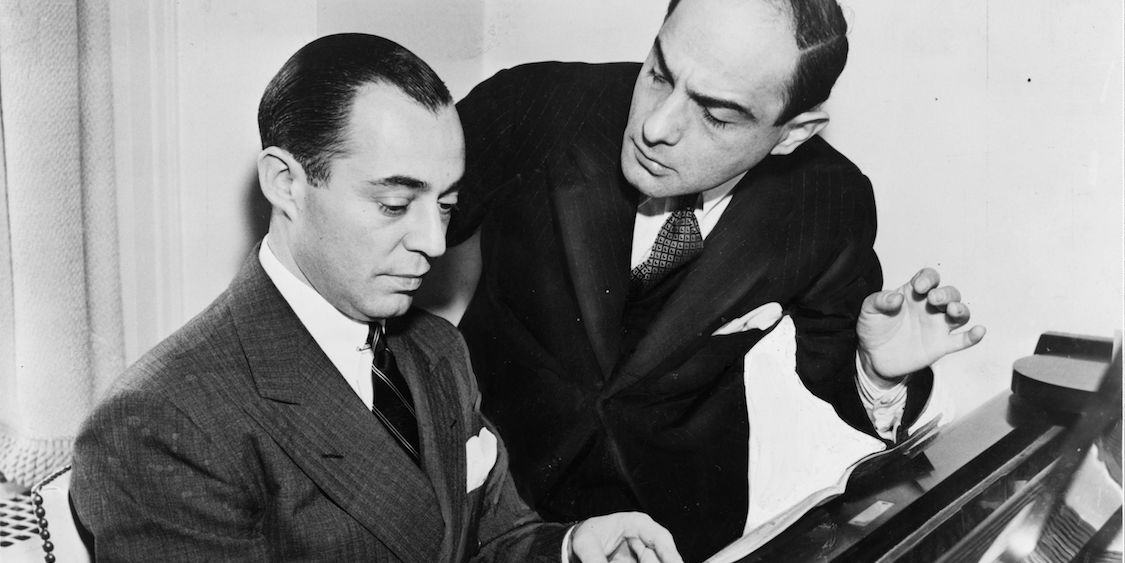
odgers and Hart or Rodgers and Hammerstein? Most connoisseurs of American popular song define themselves, consciously or not, by their preference for one Broadway songwriting team over the other. Yet Lorenz Hart and Oscar Hammerstein II each wrote the lyrics to dozens of songs that are still sung to this day, and the music that Richard Rodgers composed for them is identical in quality and similar in style. The two men’s underlying sensibilities, to be sure, could not have been less alike: Unlike the fundamentally optimistic Hammerstein, Hart wrote clever lyrics that were by turns jaded about sex and tinged with despair. But he also gave us ballads as unabashedly romantic as anything that Hammerstein ever wrote.
The real difference in the latter-day reputations of Rodgers’s principal collaborators is that while he and Hart wrote nearly 30 musicals together, none of them has held the stage. Only two of their shows, On Your Toes (1936) and Pal Joey (1940), have ever been successfully revived—one time apiece—on Broadway. Conversely, five of the nine stage musicals written by Rodgers and Hammerstein continue to be mounted around the world and produced on Broadway every few seasons. Compared with Oklahoma!, Carousel, South Pacific, The King and I, and The Sound of Music, the shows of Rodgers and Hart are mere footnotes to the history of musical comedy.
Not so, however, their 800-odd songs. “The Lady Is a Tramp,” “My Funny Valentine,” “Spring Is Here,” “Where or When”: These songs, and many others like them, remain ubiquitous and beloved. Why have they outlived the musicals for which they were created—and what manner of man was capable of writing lyrics for them that were so widely varied in emotional tone?
B
orn in New York City in 1895, Lorenz Milton Hart (always called “Larry”) grew up in Harlem at a time when it was still a predominantly Jewish neighborhood. His father, an unscrupulous real-estate operator, made more than enough money to spoil his two children, who became obsessed with theater as a result of the Yiddish-language stage performances to which their parents took them. Teddy Hart, in fact, grew up to be a Broadway comedian who would star in The Boys from Syracuse, the 1938 Rodgers-Hart-George Abbott reworking of Shakespeare’s Comedy of Errors.
Larry, Teddy’s older brother, was no less stagestruck and was seriously interested in Shakespeare from boyhood onward. But American playwrights had little to offer the serious-minded theatergoer at the turn of the 20th century, so he embraced the Broadway musical, which had just started to take shape as a unique genre. Uninterested in the flowery Central European operettas that then dominated the American musical-comedy stage, Hart looked for inspiration to W.S. Gilbert’s immaculately crafted lyrics and the small-scale musicals of Jerome Kern, P.G. Wodehouse, and Guy Bolton. Richard Rodgers, seven years Hart’s junior, was equally impressed by the Kern-Wodehouse-Bolton shows, recalling in 1975 that they “tried to deal in a humorous way with modern, everyday characters,” and the two men launched a writing partnership of their own shortly after they met in 1919.
The most widely remarked aspect of Hart’s style was and is its humor. The wittiest lyricist of the golden age of American popular song, he emulated Gilbert’s virtuosic use of rhyme for comic purposes, deftly translating it into the American vulgate: “When love congeals / It soon reveals / The faint aroma of performing seals, / The double-crossing of a pair of heels.” He was also a master of the twin arts of compression and surprise, and much of his humor lies in the economical way in which he makes his dramatic points. In “Bewitched, Bothered and Bewildered,” for example, he suggests in just 12 well-chosen words (all but one a monosyllable) that the singer’s attraction to her loutish partner is purely sexual: “He’s a laugh, but I love it / Because the laugh’s on me.”
Unlike Gilbert, Hart could be slipshod about fitting his words to Rodgers’s tunes, enough so that Stephen Sondheim called him “the laziest of the pre-eminent lyricists.”1 He was also inclined to cram too many rhymes into his lyrics, which can sound cluttered and self-conscious as a result. But Hart could also write plainly and directly about love, and whenever he did so, his straightforwardness was an ideal verbal complement to Rodgers’s broad, sweeping melodies.
All this notwithstanding, the most distinctive quality of his work is its deep-dyed disillusion, which not infrequently comes across as harsh cynicism: “Caring too much is such / A juvenile fancy. / Learning to trust is just / For children in school.” Just as often, though, it manifests itself in the melancholy romanticism of “Glad to Be Unhappy” (“Unrequited love’s a bore, / And I’ve got it pretty bad”) or the hopeless despair of “This Funny World” (“If you’re beaten, conceal it! / There’s no pity for you”). In all these modes, Hart stands out from every other songwriter of the ’20s and ’30s, and the fact that his saddest lyrics were invariably set to major-key tunes by Rodgers makes the contrast still more striking.
Why did Hart write such bleak lyrics? Because he took a bleak view of his own life. Rodgers’s account of their first meeting hints at one of the sources of his partner’s dissatisfaction, which was that he believed himself to be physically unattractive:
The total man was hardly more than five feet tall. He wore frayed carpet slippers, a pair of tuxedo trousers, an undershirt and a nondescript jacket. His hair was unbrushed, and he obviously hadn’t had a shave for a couple of days. . . . Feature for feature he had a handsome face, but it was set in a head that was a bit too large for his body and gave him a slightly gnomelike appearance.
Dark and balding, Hart was so painfully self-conscious about his height that he wore elevator shoes. He was also homosexual, and there is no evidence that he ever formed a lasting romantic relationship with anyone.2 Hart was discreet about his sexuality, making it impossible to speak with assurance about his interior life. Still, everyone who knew him agreed that (in the words of Alan Jay Lerner) “the joy of his professional success became drowned in the lost misery of his handicapped life,” and that he drank to increasingly perilous excess for that reason. But there was another compelling reason for Hart’s chronic disappointment: He found it all but impossible to write for Broadway in the theatrically serious way to which he had aspired from the start of his career.
Hart believed deeply in the potential of the musical as a dramatic art form, going so far as to assure Alec Wilder that “all his lyrics were concerned with character delineation and plot.” He also believed in the storytelling power of dance, so much so that he and Rodgers worked with George Balanchine, the greatest choreographer of the 20th century, on four shows, On Your Toes, Babes in Arms (1937), I Married an Angel (1938), and The Boys from Syracuse (1938). But with the sole exception of Pal Joey, the books of their musicals were not nearly so distinguished as their scores. Unable to write his own books, Hart elected instead to collaborate with journeymen like Herbert Fields on weightlessly silly “original” stories, and he knew that he was disserving his potential by doing so.
In this respect, of course, Hart was no different from anyone else writing for Broadway in the ’20s and ’30s. Only Show Boat (1927) and Porgy and Bess (1935) had aspired to do more than provide light entertainment to tired businessmen and their wives. But he longed in vain to aim higher, and Hollywood failed to offer him a more challenging alternative, though two of the first movies for which he and Rodgers wrote songs did more than hint at the untapped promise of the new medium: Love Me Tonight (1932, directed by Rouben Mamoulian) and Hallelujah, I’m a Bum (1933, directed by Lewis Milestone) are film musicals whose staging and scores were strikingly innovative. Alas, the creative decisions in Hollywood were made by producers, not writers, and Rodgers and Hart never again worked on films of like quality, nor were the watered-down screen versions of their stage shows at all satisfactory.
Then came Pal Joey (1940), written in collaboration with John O’Hara, who had suggested to Rodgers that his popular New Yorker stories might be turned into a musical. The result was an edgy urban fable about a heartless nightclub hoofer (played by Gene Kelly on Broadway) who catches the eye of a man-hungry socialite who is prepared to stake him to a club of his own in return for his services in bed. O’Hara put Joey Evans’s sleazy world on the stage so vividly that even his stage directions are memorable: “A cheap night club, on the South Side of Chicago. Not cheap in the whorehouse way, but strictly a neighborhood joint.”
But it was only because of the redeeming presence of such beautiful ballads as “Bewitched, Bothered and Bewildered” and “I Could Write a Book” that Broadway audiences were willing to stomach the plot of Pal Joey, which even now can come across as joltingly hard-boiled. And while the show ran for 374 performances, Brooks Atkinson’s priggish New York Times review devastated Hart: “If it is possible to make an entertaining musical comedy out of an odious story, Pal Joey is it . . . . Although [it] is expertly done, can you draw sweet water from a foul well?” Atkinson was the most perceptive of all the major newspaper critics, and his inability to appreciate the show’s originality dealt a fatal blow to its lyricist’s shaky self-confidence.
Hart had long since become a full-fledged alcoholic, but his drinking had not yet started to affect the quality of his work. After Pal Joey, though, he went off the rails, and he did so just as Rodgers became interested in writing a musical based on a 1930 play, Lynn Riggs’s Green Grow the Lilacs, whose subject matter, life in the Oklahoma Territory at the turn of the 20th century, was unsympathetic to Hart. Not only was Rodgers determined to proceed with the project, but he was tired of putting up with Hart’s drunkenness, so he decided to do the show with Oscar Hammerstein, who had already suggested to Rodgers that it was time for him to write a musical with “a book of ‘substance.’” Hart told his partner to go ahead without him. “I don’t know how you put up with me all these years,” he added. “The best thing would be for you to forget about me.”
The success in 1943 of what came to be known as Oklahoma! was the beginning of the end for Hart. Hoping against hope that work would give his old friend a reason to live, Rodgers asked him to help revise one of their earlier shows, a 1927 musical version of Mark Twain’s A Connecticut Yankee in King Arthur’s Court. But it was too late: The revival opened in November of 1943, and Hart was hospitalized the next morning, dying four days later. His last words were “What have I lived for?”
I
t is all too easy to understand Hart’s despair. In 1943, it was all but unheard of for musicals to be revived, whether on Broadway or anywhere else, and the notion of the “standard” song did not yet exist: The American music industry was totally oriented toward promoting new songs from new shows and films. When Hart died, there was thus no reason for him to suppose that he would be remembered by anyone who had not seen the original Broadway productions of his musicals. In addition, he was well aware that Rodgers was relieved to be rid of him. Reminiscing during rehearsals for No Strings, a 1962 show for which he wrote his own lyrics, Rodgers spoke of Hart with cruel callousness: “You can’t imagine how wonderful it feels to have written this score and not have to search all over the globe for that little fag.”
The 1952 Broadway revival of Pal Joey proved to be unexpectedly successful—it ran for 540 performances, 166 more than the original production—and Atkinson acknowledged no less unexpectedly in his New York Times review that he had failed to properly appreciate the show 12 years earlier:
There was a minority, including this column, that was not enchanted. But no one is likely now to be impervious to the tight organization of the production, the terseness of the writing, the liveliness and versatility of the score, and the easy perfection of the lyrics.
By then, though, it was clear that the musicals of Rodgers and Hammerstein, Pal Joey excepted, were far better constructed than anything else that Rodgers and Hart had written, and Pal Joey itself gradually faded from sight. The unsuccessful 2008 Broadway revival made use of a completely (and ineptly) rewritten book by Richard Greenberg, and while On Your Toes was revived with commercial success in 1983, its popularity was substantially due to the show’s choreography and dancing.
On the other hand, the songs of Rodgers and Hart finally came into their own in the ’50s, when pop and jazz singers like Frank Sinatra, Ella Fitzgerald, and Peggy Lee started to perform and record them regularly. These performances, especially Sinatra’s, were chiefly responsible for establishing pre-rock American popular song as a recognized genre whose sophistication set it apart from other, more plebeian styles of pop music. The tribute to Hart and his composing partner that Cole Porter had penned in 1939 became a byword: “It’s smooth, it’s smart. / It’s Rodgers, it’s Hart!” As much as postwar theatergoers delighted in the wholesome musicals of Rodgers and Hammerstein, no one ever called them smooth or smart.
Unlikely as it would have seemed at the time of his death three-quarters of a century ago, Hart’s lyrics are even more widely admired today than they were in his lifetime. Uprooted from their flimsy theatrical contexts, they have turned out to be uncommonly hardy. If anything, their dark disillusion speaks even more powerfully to postmodern listeners than it did to those who first heard them in the ’20s and ’30s, and for those who know the double-edged feeling that Hart described when he wrote in “Glad to Be Unhappy” that “for someone you adore, / It’s a pleasure to be sad,” no other popular songs are quite so poignant.
1 A notorious example of Hart’s careless prosody is the opening line of “There’s a Small Hotel,” in which he accents the first two words of the song’s title, throwing away “small hotel.”
2 On one of the rare occasions that Hart is known to have spoken to Rodgers (or anyone else) about his sex life, he hinted that he favored cash-and-carry encounters with the lower-class men who are known in the gay world as “rough trade.”