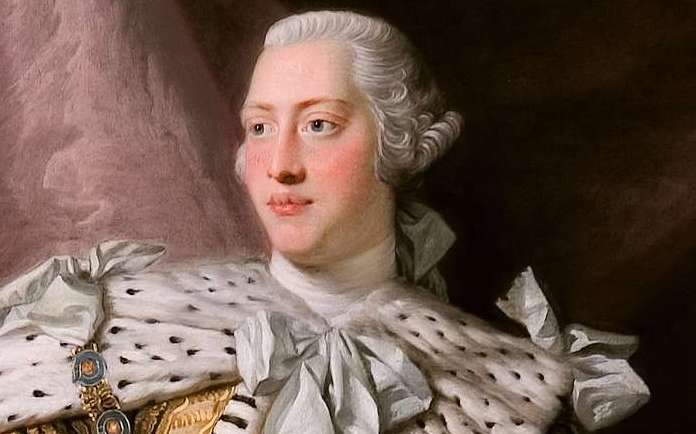
Most Americans know only two things about King George III: that he was the British tyrant Thomas Jefferson denounced in the Declaration of Independence and that he went mad. He did indeed go mad, more than once in fact. But as Andrew Roberts shows in his magisterial new book, The Last King of America, George III was certainly no tyrant. In fact, he was constitutionally scrupulous to a fault and, unlike most monarchs of his age, lived according to the principle that duty always comes first.
It is a measure of how seriously King George III took his job that even before he came to the throne, when the 21-year-old fell in love with Lady Sarah Lennox, the exquisitely beautiful daughter of the Duke of Richmond, he gave her up. Told by his tutor, and later prime minister, Lord Bute, that marrying a subject was just not possible, George accepted Bute’s advice. “The interest of my country shall ever be my first care, my own inclinations shall ever submit to it,” George wrote to Bute. “I am born for the happiness or misery of a great country, and consequently must often act contrary to my own passions.” As Roberts notes, these words could serve as a leitmotif of his entire reign.
But Jefferson, for propaganda purposes, needed a bogeyman he could blame for the rupture with the mother country—and the king, the living symbol of British power and authority, was the obvious choice. And blame him Jefferson certainly did. The middle section of the Declaration consists of no fewer than 28 charges against the king, almost all of which, as Roberts shows, were nonsense.
Roberts writes that the 17th charge (that he had imposed taxes without the colonists’ consent) and the 22nd (that Parliament had been given the power to legislate for the colonies) “justified the whole rebellion on their own.”
“The other twenty-six,” Roberts writes, “were a mixture of political propaganda, hypocrisy, hyperbole, and ex post facto rationalization, tacked on to the first two paragraphs of superb prose which will justly live as long as democracy and self-government still matter in the world.”
It is Roberts’s self-appointed task here to set the record straight on George III and to give us an honest portrait, free of Jefferson’s libels. The book is, to put it mildly, a revelation.
The Hanoverian dynasty had come to the British throne in 1714 with the death of Queen Anne, the last of the Stuart monarchs. The Act of Settlement of 1701 had barred Catholics from the throne. The elector of Hanover, a state in what is today northwest Germany, was, as Anne’s second cousin, the nearest Protestant heir.
George I was 54 when he came to the throne. He never learned to speak English, and he spent much of his time in his German possessions. George II (who reigned from 1727 to 1760) learned English as a child, but spoke it with an accent. He also visited Hanover, where he had grown up, often. George III, however, had been born in England, spoke English as a native tongue (he also spoke German), and never even visited Hanover. Indeed, he rarely ventured away from the Home Counties (the area around London) and never left England. As he famously said at the start of his reign, “born and educated in this country, I glory in the name of Briton.”
Devout, conscientious, and hard-working, he drank little and ate moderately. He was far more involved with the day-to-day running of the government than later British monarchs. (He would be the last sovereign to appoint a prime minister who did not command a majority in the House of Commons and who dealt personally with the other members of the cabinet, not just with the prime minister.) He amassed a voluminous correspondence with ministers and others, often noting the time as well as the date. Not a few were written late at night.
Unlike the other Hanoverians, George III had a loving relationship with his father, Frederick, Prince of Wales, who did not live long enough to become king. This is why George III came to the throne at the age of just 22. He would have the longest reign in British history up to his time (it has been surpassed only by his granddaughter Queen Victoria, and the present queen).
The other four Hanoverian kings of Great Britain (among them George III’s two sons, George IV and William IV) were famously promiscuous. William IV had fathered no fewer than 10 illegitimate children before he married Princess Adelaide of Saxe-Meiningen and settled down. (The former prime minister David Cameron is a descendant of William IV through one of his bastards.)
But George III was utterly faithful to his wife, Queen Charlotte. It had been purely an arranged marriage, and they had met for the first time only a few hours before they were married. But it turned out to be a genuine love match, and she would give him no fewer than 15 children, the largest royal brood in British history.
And while many of the Hanoverians, especially George IV, were extravagant and often deeply in debt, George III was careful with money. That doesn’t mean he was miserly. Believing that royalty required grandeur, he spent large sums on both Windsor Castle and Buckingham House (it became a palace only after Queen Victoria made it her official London residence). He collected widely in art, including over 50 Canalettos, and paintings by Vermeer, Rembrandt, Titian, Rubens, and Van Dyck, as well as drawings and 50,000 maps. Almost half the Royal Collection, the greatest collection of art in private hands in the world, was amassed by George III.
He also avidly collected books, almost 80,000, over the course of his life. They are now housed, as a special collection, in the British Library. The collection cost, it is estimated, £120,000. That was a huge sum in the 18th century. But the present-day value of the collection is simply beyond counting.
Unlike some book collectors, George III was a reader as well. He is often credited with saying to Edward Gibbon, on receiving a copy of the last volume of The Decline and Fall of the Roman Empire, “Scribble, scribble, scribble, ay, Mr. Gibbon?” But in fact, that was said by his younger brother, the Duke of Cumberland. George III actually read the Decline and Fall.
He was also keenly interested in science. He built the King’s Observatory in Richmond-upon-Thames so that he could observe the transit of Venus in 1769. He also funded the construction of the world’s largest telescope for the use of William Herschel, who had discovered the planet Uranus in 1781. His vast collection of scientific and mathematical instruments is now on view in the Science Museum in London.
Although given to self-righteousness, George III was never petty. He fought hard to retain the American colonies, but when their independence was established, he received the first minister from the United States, John Adams, with complete courtesy. While being painted by the American-born artist Benjamin West, he asked West what General Washington intended to do with the arrival of peace. West said that Washington planned to retire to Mt. Vernon. “If he does that,” said the astonished king, “he will be the greatest man in the world.” In 1805, he bought a copy of Chief Justice John Marshall’s five-volume biography of Washington.
And what of his madness? The “King’s Malady” has puzzled historians ever since the king’s reign. For one thing, it was intermittent. Episodes occurred in 1764–65 (a mild case, previously unnoticed by historians), 1788–89, 1801, 1804, and 1810–20. The final bout ended only with the king’s death, after an achingly sad last decade, for it was accompanied by both blindness and then deafness. Roberts notes that even though he could no longer hear the music, the king continued to play the harpsichord (which had once belonged to Handel).
The Prince of Wales, later George IV, had to be appointed regent to act in the king’s name. Roberts makes clear his utter contempt for George IV, who possessed none of his father’s many virtues and had innumerable vices that the king despised.
From the mid-1960s, the King’s Malady has often been ascribed to porphyria, a blood disease. Roberts demolishes that theory in an appendix, pointing out, for instance, that none of the king’s innumerable descendants have suffered from that genetic disease. He believes, and he makes a strong case, that the king suffered from what is today called a bipolar disorder, acute manic psychosis. The king often had to be kept in a straitjacket to prevent injury to himself and others. He would sometimes talk incessantly, once for 24 hours straight, until his voice gave out.
In the late 18th century, of course, knowledge of mental illness was practically nonexistent, and the king was subjected to treatments that were not only worthless but often painful and debilitating as well. Perhaps the saddest aspect of the King’s Malady was that when the Malady struck, the king, unlike schizophrenics, was fully aware that he was going mad but was powerless to prevent it.
In this detailed but wonderfully readable biography, Andrew Roberts gives us the life of one of Britain’s most successful kings. To be sure, he lost America, but the British Empire greatly expanded during his reign, despite the loss of the American colonies. And the British economy, thanks to the Industrial Revolution, was far larger and richer. In no small part thanks to this decent, hardworking, dedicated sovereign, his reign laid the groundwork for what we might call the “British Century.”
We want to hear your thoughts about this article. Click here to send a letter to the editor.