It is a statement of the obvious that the most immediate threat to Israel comes from Islamist terror. And now, with self-described allies such as the UK, France, and Canada turning on Israel and joining more long-standing hostile nations such as Ireland, Norway, and Spain (largely to appease their Muslim voters), there is a renewed focus on how Western attitudes to the Jewish state may be changing.
But understandable as that may be, the concern over European attitudes may be a distraction from a larger long-term threat. I am talking about the concerted behavior of the so-called Global South, which is aimed at the elimination of Israel.
This is already clear in the way African, Asian, and Latin American states have exploited Israel’s war in Gaza to ramp up their decades-long delegitimization agenda. They do so by using their numerical stren-gth in global institutions to attempt to turn Israel into a villain state. This is expressed through various United Nations General Assembly votes, support for South Africa’s case against Israel at the International Court of Justice (ICJ), and the International Criminal Court (ICC) arrest warrants against Israeli Prime Minister Benjamin Netanyahu and former Israeli Defense Minister Yoav Gallant.
The southern hemisphere countries of the Global South are primarily in Africa, Asia, Latin America, and Oceania. Many of them have historically had similar economic and political characteristics—lower GDP and per capita incomes, higher poverty rates, and varying levels of political and economic influence compared with the Global North (Europe and North America). And, crucially in this context, a shared history of colonialism. When calculated by population, some 59 percent of the Global South has now led or backed international legal action against Israel.
The large-scale generational project here has been to coalesce the Global South against Israel as the present-day exemplar of neocolonialism, and therefore the exemplar of all that must be destroyed. So while Israel is fighting as the West’s proxy in the war against terror, it is simultaneously the proxy in another fight: the Global South’s usurpation of the West.
All of this is happening out in the open. Those who seek to utilize the Global South (also sometimes referred to as the Majority World) to destroy Israel are clear about their aim. A paper published last year by ODI Global—which describes itself as “an independent, global affairs think tank” and “a force for positive change”—asserts that “Gaza has opened a rare opportunity for the Global South to have its voice heard.” It goes on: “Rapid and broad support from various nations across different global regions has collectively empowered many formerly colonized countries to expose the Global North’s hypocrisy when it comes to accountability and international law. In this way, Majority World actors are shifting the narrative away from Western-centric framings of a ‘humanitarian crisis’ towards one based on the necessity for justice and solidarity.”
Anti-Israel NGOs and other organizations repeat the mantra. In February 2024, the so-called Islamic Human Rights Commission (an Iranian front group based in the UK) wrote, “What we now see is a resistance to colonialism, which we haven’t seen in decades. This is a meaningful point of changing the narrative from victimhood to liberation. It’s not an accident that many people from the Global South are supporting Palestine.”
According to the International Human Rights Council, in supporting Israel, then British Prime Minister Rishi Sunak and senior Conservative Suella Braverman—both of South Asian descent—had become “traitors to people of South Asian heritage in the UK, as well as much of the Global South, who oppose the slaughter in Gaza and are themselves victims of structural racism.” In November 2022, the Palestine Solidarity Campaign posted on social media, “Colonialism has pillaged and plundered the resources of the Global South. It continues to drive the crisis we face today.” The organization condemned the “exploitation of communities across the Global South.”
These themes are now commonplace among such groups, with the idea that the hegemonic West—including its Middle Eastern representative, Israel—is to blame for the world’s ills.
In March 2022, the Islamist group Cage International responded to Western calls for unity against Russia: “The idea that the international order is stronger than ever is not shared by those often on the receiving end of its coercive tactics.” In January, it said, “The record of the ICC and related bodies is tarnished by disproportionate prosecutions of prominent figures from the Global South while sparing leaders of hegemonic powers responsible for occupation, genocide, and abuses of human rights.”
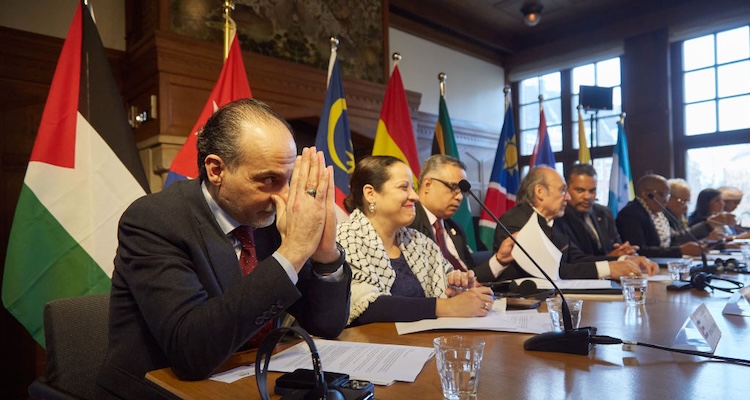
In January, representatives of nine Global South countries1 launched the Hague Group, “a coalition that will apply collective pressure on Israel over its gross violations of international law,” establishing a common platform to enforce “coordinated legal and diplomatic measures,” such as sanctions. While the Gaza war was the immediate driver of the initiative, it was based on more general issues with Israel itself, such as its “blocking of the creation of a Palestinian state.” Varsha Gandikota-Nellutla of Progressive International, one of the nongovernmental organizations behind the Hague Group, called it “a group for collective action” and went on: “Collective action at the national level, collective action at the international level, and collective action at the multilateral level. The Hague Group aims to build a bulwark to defend international law.” The intention is to add other countries. According to a report in the left-wing magazine Jacobin: “They expect to make inroads among the vast majority of Global South nations that voted in favor of the United Nations General Assembly resolutions condemning Israel’s occupation of Palestinian land in the West Bank and its latest war in Gaza.”
Hague Group members have already suspended diplomatic relations with Israel. South Africa was the lead plaintiff in the December 2023 ICJ case. In June 2024, Colombia imposed an embargo on coal exports to Israel—a significant decision, given that they were worth more than $300 million in 2023.
At the UN, the Security Council resolution that passed in March 2024 demanding “an immediate ceasefire” in Gaza was brought by the nonpermanent members, led by Algeria and composed almost entirely of Global South nations, including Ecuador, Guyana, Mozambique, Sierra Leone, and South Korea.
_____________
Rima Hassan, the French-Palestinian founder of Action Palestine France and a member of the European Parliament, observed in a recent interview, “States in the Global South are reappropriating international instruments that were originally conceived by the West. Nobody should be above the law. That has to be the case even for the West’s ally and protégé, Israel.”
The foundation of this strategy is the view of Israel as a “settler-colonial state,” a label increasingly in vogue. The Palestinians are seen as the latest victims in the long history of Western colonialism, for whom historic victims in the Global South have a natural sympathy: Their fight is the same. Indeed, the foreign minister of Indonesia, the world’s fourth-most populous country and a U.S. ally, left the G-20 Foreign Ministers’ Meeting in Brazil so he could personally present Indonesia’s argument against Israel before the ICJ. For Indonesia, support for “Palestine” is an issue of decolonization, which Indonesia is mandated to oppose, according to its constitution. As the editor of the Palestine Chronicle has put it: “The reason that solidarity for Palestine remains strong is directly related to the shared past and present experiences between the long-oppressed Palestinians and peoples in the southern hemisphere whereas Israel, like Europe, represents the cruel colonizer with an insatiable appetite for resources and cheap labor.” He goes on to describe a key moment, the 1973 Yom Kippur War: “When African countries had to choose between Israel—a country born out of Western colonial designs—and the Arabs—who had suffered at the hands of Western colonialism, as much as Africa did—they naturally backed the Arabs. One after the other, African countries began severing their ties with Israel. Soon enough, no African state, other than Malawi, Lesotho and Swaziland, had official diplomatic relations with Israel.”
That is an accurate rendering of history. In 1975, the Organization of African Unity became the first international body to assert the calumny adopted later that year by UN General Assembly Resolution 3379 that “Zionism is a form of racism and racial discrimination.” In 2001, the notorious UN World Conference Against Racism, Racial Discrimination, Xenophobia, and Related Intolerances in Durban and the NGO Forum held alongside it became a major catalyst for subsequent delegitimization campaigns against Israel. The 1,500 nongovernmental organizations there, including the likes of Human Rights Watch and Amnesty International, did not merely silence Jewish and Israeli attendees; they were actively anti-Semitic in their rhetoric, with demands for the elimination of Israel. The NGO Final Declaration and Program of Action labelled Israel a “racist, apartheid state” guilty of “crimes against humanity” and told “the international community to impose a policy of complete and total isolation of Israel as an apartheid state.” Israel and the U.S. had already walked out of the official session when the draft UN Declaration and Programme of Action equated Zionism with racism.
Sixteen years later, in October 2017, the first Israel-Africa Summit was due to be held in Togo with more than 20 countries (although several, including South Africa, Morocco, Algeria, Tunisia, and Mauritania, had said they would boycott it). A campaign against the summit included the usual rhetoric and focused specifically on colonialism, making the argument that Israel was not just a settler-colonial state but was engaging in colonialism in Africa itself through its diamond trade. A month before the scheduled date, the summit was “postponed indefinitely.”
These Global South nations believe they are seeing a shift in the axis of power that has given them the means and opportunity to move decisively against the last colonial power, Israel. As the above ODI Global paper puts it, this shift
finally accounts for and raises the perspectives of those who were once so easily dismissed as “subalterns.”…With countries of the Global South becoming more vocal and less intimi-dated by a colonial system of global governance
that was designed without them, the narrative has begun to shift. Buoyed by wide-spread global public support, actions of solidarity from states across Asia, Africa and South America have challenged the balance of power in international affairs and exposed the West’s own contradictions.…[A] more unified Global South has exposed more than ever the emptiness of Western rhetoric. It has also demonstrated a new model for what is possible when untraditional actors take bold action to uphold the standards and integrity of international conventions.
In this sense, the Palestinian cause operates as a unifying force within the Global South, with shared perceptions of anti-colonialism driving solidarity with the Palestinians. This comes at a time when there has been a significant shift in wealth across the globe as the world’s geo-economic axis moves from the North Atlantic to the Asia-Pacific. This includes not only China but also India and other Asian nations as well as Latin American countries such as Brazil and Mexico. With new economic strength has come increased global influence, especially in multilateral forums and new organizations originating in the Global South.
It is important to note that, in some senses, the term “Global South” is misleading and dangerous, as it is a way of morally weaponizing anti-Western ideas by giving them a realpolitik cover. As a paper from the UK think tank Policy Exchange argued last year:
The ‘Global South’ community has no compelling basis in historical, economic or political reality, and so cannot explain or predict state behavior. This fact alone would be enough to undermine its utility as an analytical tool for policy but, even more alarmingly, the term also promulgates a worldview which makes Western countries reluctant to prioritize and pursue their global interests. China and Russia have seized on this opportunity, and now use the term’s popularity to undermine our international reputation and influence with sophisticated disinformation and diplomatic operations. By willingly and uncritically adopting the term the ‘Global South’ and its accompanying narrative, our policymakers play into our adversaries’ hands and damage our own interests.
Correct as this analysis may be, the Global South is certainly real in this context, as it is the framework on which so much of the threat to Israel is now built. So while we must keep the threat posed by Islamist terror at the forefront, we must also be aware of this: Israel’s unique burden is that as it fights on our behalf against one ideology, it is also fighting to preserve its own legitimacy against another.
1 Belize, Bolivia, Colombia, Cuba, Honduras, Malaysia, Namibia, Senegal, and South Africa
Photo: Pierre Crom/Getty Images
We want to hear your thoughts about this article. Click here to send a letter to the editor.