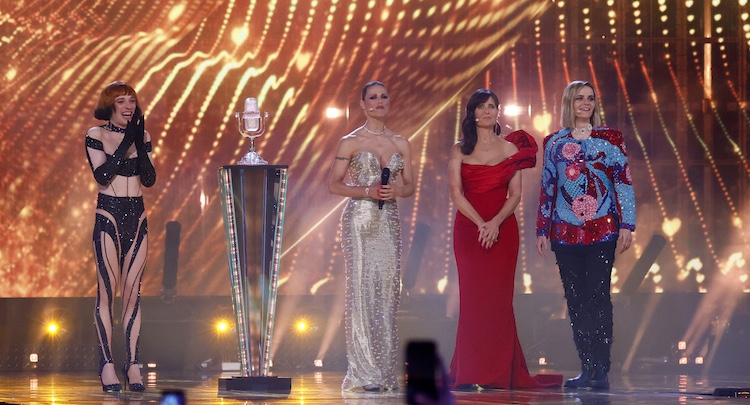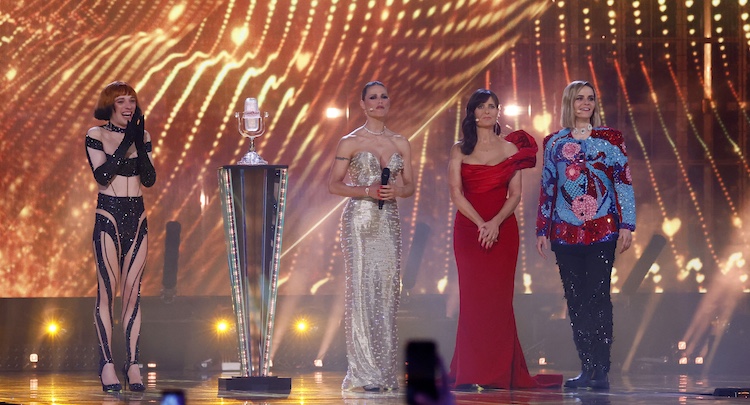
There’s a nonzero chance that the next Eurovision contest will look like that scene in Borat when Sacha Baron Cohen’s character gets a honky-tonk crowd to sing and clap along with the song “In My Country There Is Problem,” the chorus of which impels the listener to “throw the Jew down the well.”
Eurovision is, of course, hard to parody. The big difference between real Eurovision and, say, the Will Ferrell movie Eurovision is that the real one also involves people chasing Jews in the street. The parodies always miss that detail.
And now there’s another new detail: European countries that are opposed to having to sing alongside an Israeli Jew have adamantly refused to back down or to negotiate a compromise in good faith. (What would the compromise be, a half-Jewish Israeli contestant?)
And so there will be a vote on whether or not to throw the Jew under the bus.
The European Broadcasting Union, according to the New York Times, says the union has “never faced a divisive situation like this before.”
The Times itself uses the word “extraordinary” a couple of times, as in: “the European Broadcasting Union, which organizes the high-camp event, said in an email that it would host an extraordinary general meeting in early November at which member broadcasters will vote on Israeli participation.”
Eurovision’s slogan is “united by music.” And it was, for many years. But now there is a war in Gaza that the Israelis appear to be winning. And how could a contest that takes itself as seriously as Go-Jo the Australian Milkshake Man concentrate on its craft if there’s an Israeli Jew present? (As I explained here, opposition to Israelis is, for all intents and purposes, just opposition to Jewish Israelis.)
In each of the past two years, Israel’s participation inspired completely insane behavior. In 2024, Eden Golan had to wear a wig when going out in Malmo, Sweden, and mostly was kept in her hotel room when not rehearsing or performing, due to what the Times might call “extraordinary” security threats.
In the 2025 contest, Israel’s contestant was Yuval Raphael, a survivor of the Nova festival massacre on Oct. 7, 2023. Raphael won the public voting and only came in second overall because of the judges’ votes. It was a triumph—she had survived the Hamas attacks in a roadside bomb shelter into which terrorists repeatedly threw grenades, and she wasn’t a professional singer, yet here she was on the cusp of winning the most famous international song contest.
That triumph was more than the anti-Semites of the world could take, however. Several countries, Ireland and Spain among them, tried to challenge the legitimacy of the vote. Their challenge failed, of course, leaving them looking especially petty.
So Ireland and Spain changed tactics. This year, they believe they can beat Israel in the contest only if Israel is barred from participating. Ireland has a strong record in Eurovision contests, so it has reason to want to sideline the competition. Spain doesn’t like the fact that the contests’ public voting routinely shows that people actually like the Israeli performers and their music. “We are all aware that the contest carries significant political implications,” the head of the Spanish public broadcaster said. “The Israeli government is equally aware of this fact and leverages the event on the international stage.”
“Leverages the event on the international stage” is revealing phrasing. It’s not as if Israel gets more votes in the UN Security Council because it took second place in Eurovision. All that’s happening is that Jewish people are being integrated into wider society instead of being ostracized, and Spain doesn’t like that.
Further complicating matters is the location of this year’s contest: Austria. The Austrian government does not want to host a Judenfrei contest, for obvious reasons. History weighs heavily there.
As well it should. Global sports is experiencing a tidal wave of anti-Semitic exclusion and violence. The entertainment world seems to be trying to catch up. Cultural exclusion of the Jews is an old story and, unfortunately, a modern one, too.