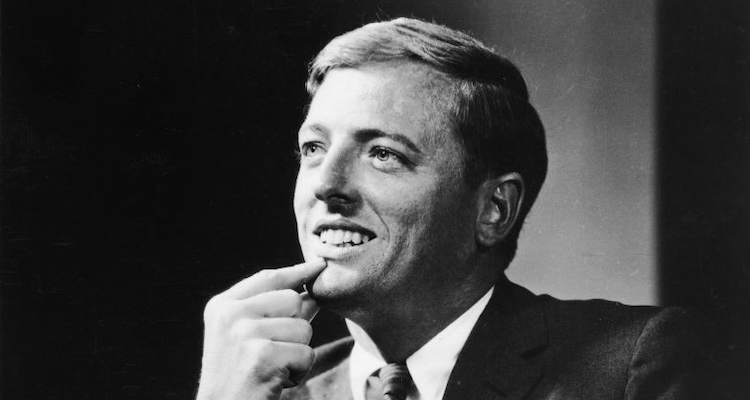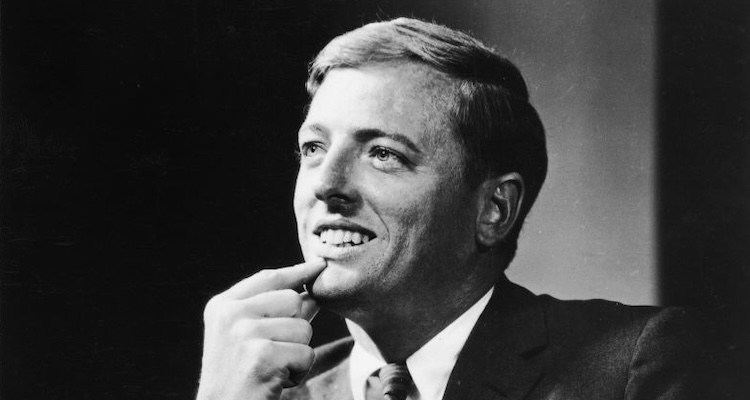
After Dwight Macdonald published in this magazine an attack on a newborn weekly called National Review in 1956, its founder and editor issued a riposte, also in this magazine. Macdonald, among the most respected literary critics of his time, was discombobulated at the younger man’s cheek; he was the one who got to fire broadsides, not the one who had to deal with cannonballs landing on his front porch. “You must be nuts,” he privately wrote William F. Buckley Jr. “Why, you damned whippersnapper, you impertinent pipsqueak, what the hell should I apologize to you for? I gave your magazine hell, and it deserved it.” Macdonald went on to call the Catholic Buckley a “dime-store pope” and “solemn little sectarian” before concluding, “and you used to be fun to argue with!”
Incorrect. Buckley was always fun to argue with, to read, to share a stage or television set with, to inhabit a planet with. He made the often-dry, sometimes arcane work of intellection a spectator sport. He made conservatism cool. When he debated his friend (sometimes dismissed as his ventriloquist’s dummy) Ronald Reagan about the Panama Canal in 1978—Reagan argued that we should keep it, Buckley said the time had come to step away—the soon-to-be presidential candidate said, during a rebuttal period, “Well, Bill, my first question is, why haven’t you already rushed across the room here to tell me that you’ve seen the light?” Laughs. Applause. Buckley paused for a moment to allow the audience to settle and said, “I am afraid if I came any closer to you, the force of my illumination would blind you.” Bigger laughs, louder applause. Bill Buckley could outshine Ronald Reagan.
“There’s nothing better or more amusing than a theatrical pomposity. It’s an art form,” Buckley explained to Morley Safer for a 1981 segment on 60 Minutes. “People who don’t have a sense of humor have a very hard time with National Review.” Buckley had recently used the magazine to boast, “We have a nation to run.” The Morley Safers of the world found this presumptuous and alarming. Or they pretended to.
Safer has an heir in Sam Tanenhaus, who, admirable as he is in many ways, does not come across as a man overly endowed with the gift of humor. His stolid, determined, authorized biography Buckley: The Life and the Revolution That Changed America exemplifies a mismatch between subject and author. So much of what Buckley did was performance, style, flash. Tanenhaus’s gloomy presence—unsmiling, brow furrowed, factually scrupulous, doggedly determined to nail every detail whether it’s relevant or not—clouds nearly every page of a book that could have been as warm and sunny as June.
Buckley (1925–2008) handpicked Tanenhaus, a longtime New York Times editor who ran the paper’s Sunday Book Review for years, mainly because of his commendable 1997 biography of the ex-Communist Whittaker Chambers, who as an editor and writer helped shape National Review in its early years after Buckley launched the magazine in 1955, at age 28. Tanenhaus evidently did not like Buckley as much as Buckley liked him, and for a predictable reason: The biographer’s politics are standard, dreary, New York Times liberalism. Among his (forgotten) books is a 2009 exercise in premature triumphalism, The Death of Conservatism.
_____________
In the main, Buckley is an intellectual biography written by an ideological antagonist. Tanenhaus, who is 69, doesn’t write with the shrillness or perpetual umbrage of younger liberal writers. He doesn’t, for instance, at any point tell us, “And this is how we got Donald Trump,” and for that alone he should be given some sort of honor—albeit with an asterisk given that Tanenhaus did exactly this in a June 1 Times op-ed. But he keeps zooming out from whatever preoccupied Buckley at any given moment to, for instance, tell us about the (first) America First movement and its anti-Semitic undertones, or the many sins of the Buckley-touted Senator Joseph McCarthy or the Jim Crow South, in each case to serve and broaden an indictment of his subject.
The mismatch should have been evident from the beginning: Buckley had a gift for liking nearly everyone he came across, even those of opposing persuasions. I met Buckley only once, at a party at his Upper East Side apartment in the early 2000s. He was charming, warm, and gracious, as virtually anyone who ever met him has said. Years after his death, I worked at National Review for five years, and the halls echoed with groans every time the name Tanenhaus was mentioned. Buckley had known any number of conservative writers with the chops to produce the most thorough treatment possible, so why did he give his time, his archives, and his blessing to a New York Times liberal? Tanenhaus doesn’t even seem interested enough in critical members of Buckley’s circle to have bothered talking to them. There are no quotations from Buckley’s chosen successors to edit National Review, John O’Sullivan and Rich Lowry. He interviewed Buckley’s only child, the Washington novelist Christopher, but quotes him only in passing about the palatial scene at his maternal grandparents’ home in Vancouver, B.C., where his mother, Pat Taylor, married Buckley in 1950.
It is hard to discern the intended audience for Tanenhaus’s book. Do Buckley’s detractors care enough about a man who has been dead for 17 years to wade through it? I’d think the only possible audience would be Buckley admirers, but Tanenhaus is determined to reduce their fondness.
Among his most startling sallies is his belief that his subject, who worked for Watergate burglary mastermind Howard Hunt during a brief stint in the CIA and was such a close friend that he was godfather to three of Hunt’s children, was an after-the-fact accomplice in Watergate—and should have been held criminally liable for not publicly disclosing what he knew after talking to Hunt. This strikes me as an overly expansive interpretation of what a biographer should do.
And why must Tanenhaus keep mentioning speculation (by others) that Buckley was gay when there is no evidence of this whatsoever? Tanenhaus tells us that Gore Vidal found his gaydar beeping during their famous dart-throwing contest on live television at the 1968 Democratic National Convention (Vidal called Buckley a “crypto-Nazi”; Buckley called Vidal “queer” and threatened to “sock [him] in the goddamn face”) and set out to prove that his enemy shared his same-sex proclivity. But, despite moving in the same social and journalistic circles, and being at the center of the gay world in entertainment and media, Vidal failed. If Buckley ever engaged in homosexual activity, why has no one ever stepped forward with a claim to being the other party in it? Why waste time on this dead end?
Tanenhaus does find much to admire, but Buckley’s most estimable qualities emerge as asides, while his missteps evoke grueling, forensic examination. The book hurries through its examples of Buckley’s generosity (many were those who received cash gifts they didn’t expect or seek but were extremely grateful to receive), his wit, and his matchless joie de vivre. What really motivates this biographer is a kind of prosecutorial zeal.
Like practically anyone who has ever worked at the Times, Tanenhaus is more interested in racial injustice than any other issue (economics, by contrast, barely even crosses his mind). And so he not only feels obligated to lambaste Buckley but sometimes interrupts himself to keep circling back to the matter even after his subject undergoes what appears to have been a sincere change of heart, calling for a black president as early as 1970. Tanenhaus also burrows into Buckley’s spectacularly unwise friendship with death row inmate Edgar “Eddie” Smith, a charming sociopath and quintessential prison lawyer who became pen pals with Buckley and whom the writer helped spring from prison. Buckley decided, based on nothing except the killer’s protestations, that Smith had not been guilty of the 1957 murder of a teen girl in New Jersey even when all of the evidence pointed to Smith, and he had in fact confessed. Five years after his 1971 release, praised again by Buckley and welcomed as a guest on the PBS interview show Firing Line, Smith attacked and nearly killed another girl. To his credit, Tanenhaus points out that there was then a strange vogue among intellectuals to befriend the worst people in prison; the Pulitzer Prize novelists William Styron and Norman Mailer each went to bat for convicts who, upon being sprung, went on to (again) commit horrific crimes.
There’s no sugarcoating Buckley’s 1950s record on civil rights. It was bad. In an unsigned 1957 National Review editorial that is still shocking today, Buckley wrote “Why the South Must Prevail” and didn’t dress up his argument in states-rights niceties; he simply said, in effect, that blacks were too dumb to be trusted with the vote. How much attention this matter deserves 70 years later should be up for debate; Tanenhaus considers it of supreme importance and goes off on a mini lesson about the civil rights era. He delves into the history of Camden, South Carolina, where Buckley’s oilman father kept a stately winter residence and where the senior Buckley also published a segregationist weekly newspaper. Again to his credit, Tanenhaus tracked down Edward Allen, a black son of Buckley Sr.’s yardman Walter Allen, who noted in 2016, “Everyone, Black and white, wanted to work for the Buckleys.”
Some scandals into which Tanenhaus enthusiastically delves didn’t even involve Bill. As a prank, three of his sisters, spirited Catholics like the rest of the family, sneaked into a neighbor’s (unlocked) Episcopal church in Sharon, Connecticut, in 1944 and “vandalized” it. This amounted to smearing some honey and oatmeal on cushions and mischievously leaving some mildly racy pictures from Esquire and the New Yorker hidden in hymnals. The Buckleys were friendly with the Cotter family, whose father was the pastor of the church. (His daughters would later achieve fame as the actresses Jayne and Audrey Meadows.) The prank was hardly an act of terror. Buckley wasn’t even in town at the time. Yet Tanenhaus expends several pages on the matter.
It’s because of these digressions that by the time we reach the halfway point of the book, we’re still in 1958. National Review was three years old, Buckley turned 32. The last 27 years of Buckley’s life, including the presidential victories of Ronald Reagan, which he helped engineer, and of George H. W. Bush, a friend for decades, not to mention the end of the Cold War, the Clinton scandals, 9/11, and the publication of his most wide-ranging memoir, Miles Gone By, are crammed into the final 42 pages.
But Buckley’s youthful involvement with the America First movement, which began when he was 14 and ended shortly after his 15th birthday in the devastation of Pearl Harbor, gets an entire 24-page chapter. It’s as if Tanenhaus did his research in chronological order, suspected he might have a 3,000-page opus on his hands, and sprinted through the second half of the life. So front-loaded is Tanenhaus’s research that we learn more about the habits of Buckley and his roommate Alistair Horne at the Millbrook boarding school—“Buckley smoked cigarettes (sixth-formers were allowed)—Horne tried out a corncob pipe”—than we do about the friendship between Buckley and the 41st president.
Tanenhaus is dismissive of much of Buckley’s writing, deploying the term “nonbooks” for the many volumes that collected ephemera or were padded out with appendices or were written in haste. He repeatedly knocks Buckley for being in such a hurry to give speeches, tape TV appearances, go skiing in Switzerland, and churn out more than a dozen spy novels (usually in about three months) that he never did complete the one career-defining manifesto, to be titled The Revolt Against the Masses (a title later borrowed by Fred Siegel for his 2015 book). His friend and skiing buddy John Kenneth Galbraith begged him, “Give it up. Come to the academy and write books. It is only books that count.” But a Professor Buckley would not have been Bill. The sprinter does not compete in marathons. Note that we are still talking about Buckley much more than we are about Galbraith, who predeceased him by two years. In a way, we are talking about Buckley every time we mention something published by National Review, which, you will pardon an alumnus for saying, remains one of the pillars of the conservative temple.
Even when mentioning triumphs, such as when Buckley was elected chairman, or editor, of the Yale Daily News, Tanenhaus feels obliged to add a dig: The vote turned out to be unanimous, which meant that it was simultaneously revealed that Buckley had voted for himself. If you find this tidbit less than disgraceful, you are perhaps not alone. Tanenhaus also tries to correct our preconceptions about Henry Wallace, FDR’s second vice president, the Progressive Party candidate for president in 1948, and a useful idiot for the international Communist cause. Tanenhaus seems miffed that Buckley, then at Yale, heatedly opposed the presidential aims of Wallace, who to the biographer was merely “the moment’s most attractive peace candidate.”
_____________
The book is weighty, but so is an anvil. It lacks grace, agility, charm. Every 10 pages or so, yet another of its subject’s fireworks display of high spirit pops up, and each time, Tanenhaus writes about it as if he’s reading the commodities report. After only two lessons, Yale student Buckley flew a two-seater Ercoupe monoplane from Boston to New Haven without radio assistance by following train tracks; his friends fretted that he had crashed. Later, he and his friend and soon-to-be brother-in-law Brent Bozell flipped the plane over and wrecked it on the front lawn of his sister Maureen’s school in Connecticut. Buckley walked away, just as he walked away from the many docks upon which he literally left his mark by sailing in so rapidly that he’d carve chunks out of them, earning himself the nickname, according to his son, of “Captain Crunch.”
Then there were the theatrical flourishes. “Buckley’s true metier as a writer and talker—eventually reaching levels approaching genius—was for intellectual comedy, an almost continual repartee,” writes Tanenhaus. Buckley’s wit-fueled 1965 run for mayor of New York on the Conservative ticket at first seemed like a stunt but nearly had the intended effect of denying the keys to City Hall to the liberal Republican John Lindsay, whom Buckley had deemed contemptible. Tanenhaus tells us (grudgingly) that Times editor Abe Rosenthal had to keep reassigning reporters to the Buckley beat as the candidate enchanted each of them in turn and their copy became starstruck. At one point, Buckley reached as high as 33 percent in a (nonscientific but large) poll, behind Lindsay’s 44. He would wind up with 13 percent.
Among the campaign highlights were Buckley’s innovative vocabulary (“What the hell does ‘emunctory’ mean?” Norman Mailer begged to know in a letter), his elegant debate put-downs, his promise to “demand a recount” should he win, and the unexpected appeal of his anti-elite, law-and-order politics to the presumed base of the Democratic Party—what would later be called the Silent Majority, the Archie Bunker battalions, or the MAGA vote. Liberal columnist and friend Murray Kempton wrote that Buckley “read his statement of principles in a tone for all the world that of an Edwardian resident commissioner reading aloud the 39 articles of the Anglican establishment to a conscript assemblage of Zulus.” Adds Tanenhaus: “His vocabulary might have been ornate, but his message was plain.” The city was starting to seem scary and unmanageable. Expecting to be approved by fellow discontented country-club eccentrics, Buckley was surprised to find, as his colleague Neal Freeman put it, his speeches attracting “corner-store owners, cops, schoolteachers, first-home owners, firemen, coping parents.”
Buckley’s first book, God and Man at Yale, similarly anticipated today’s cultural debate by charging his alma mater (in 1951!) with infecting its students with leftist dogma: “One of the most extraordinary incongruities of our time,” he wrote, was that the institution was churning out “atheistic socialists.” Conservative activism was an oxymoron before Buckley came along; as he also wrote in the book, “the so-called conservative, uncomfortably disdainful of controversy, seldom has the energy to fight his battles, while the radical, so often a member of the minority, exerts disproportionate influence because of his dedication to the cause.”
Tanenhaus cannot resist getting in a few gratuitous digs even up to the final page of his narrative: “Kempton wrote, ‘For William F. Buckley [had] genius at friendships of the kind that passes all understanding.’ And of the kind, he might have added, that at times defeated all reason, bringing him so often into the wrong company.” Understanding how Buckley struck so many as not just a great man but a noble spirit is as easy as glancing back at his Yale years, when via his newspaper editorials he was already a merry arsonist of received wisdom and yet was held in such awe that he was “almost a god-like figure,” in the words of the slightly younger Gaddis Smith, one of his successors as chairman of the Yale Daily News and later a revered history professor. Nearly two decades after Buckley left, a longtime advertising manager at the paper who worked with generations of gifted young men, Francis Donahue, was asked how Buckley rated in the long history of noted chairmen. “Were there others?” he replied, mischievously, allowing that Potter Stewart and Sargent Shriver might be ranked near Buckley. He added, “That doesn’t matter—being best chairman. More important, if I had my choice of all men—including the Pope—and could pick just one to be my brother, I’d take Bill. I never worked with a more considerate or fairer man.” The excellence of William F. Buckley Jr. was evident on the page, on the screen, and at the lectern, but most of all it was in the heart.
Photo: Pictorial Parade/Getty Images
We want to hear your thoughts about this article. Click here to send a letter to the editor.