For years, limiting the administrative state—the rabbit warren of bureaucratic offices and officials who regulate virtually every aspect of American life—has been a central pillar of conservative thought. One might have thought Donald Trump’s second term would be dedicated to this cause, to which all Republicans and conservatives have paid lip service over the past decade.
Not so fast. Since January 20, President Trump has issued a tidal wave of executive orders and other edicts, some attempting to reorganize the executive branch, others attempting to reorganize the global economy. He announced the creation of the Department of Government Efficiency and the termination of birthright citizenship. He declared that Venezuela is invading the United States, and he declared war on law firms and universities and members of his own first administration. He freed Capitol rioters from prison, calling their judicial trials and convictions a “grave national injustice,” and he sent hundreds of men to an El Salvador prison without the due process of law. He is leveraging his presidential powers to extract money and other concessions from private companies; he also is leveraging presidential powers to cut off federal payments to federal contractors, employees, and grant recipients. He is breathing new life into the archaic Alien Enemies Act; he is declaring the brand-new TikTok law a dead letter.
“I think we had a great 100 days,” he told NBC’s Kristen Welker on Meet the Press. “It was an absolutely unprecedented 100 days.”
If anything, that understates things. Even Franklin Delano Roosevelt’s landmark first 100 days, which set the tone for all new presidencies, mostly featured a series of legislative achievements. When FDR took to the airwaves to reflect on “the crowding events of the hundred days which had been devoted to the starting of the wheels of the New Deal,” he was extolling the legislature—“the historical special session of the Congress”—and not simply an avalanche of administrative power. President Trump’s first 100 days simply have no precedent.
All of this should unsettle conservative defenders of the rule of law and limited government. Eight years ago, Republicans rallied around the Trump administration’s slogan, “deconstruction of the administrative state.” This time around, Trump is deconstructing many, many things. But is the administrative state among them?
_____________
The modern administrative state’s enormous federal bureaucracy, with its regulatory and fiscal powers, was built one piece at a time over one and a half centuries.
To be sure, the executive branch’s departments and the government’s quasi-administrative entities, such as a central bank, were crucial elements of the American experiment in self-government from the very start. When Alexander Hamilton argued for an energetic, effective federal government in The Federalist, he emphasized that “the true test of a good government is its aptitude and tendency to produce a good administration.” The Washington administration exemplified this; the Lincoln administration did, too.
The foundation for an American “administrative state,” however, was laid later, with the establishment of an Interstate Commerce Commission to regulate railroads in 1887. The ICC and other early independent regulatory commissions were an attempt to reduce the power of courts, not the Congress. But as the Progressive Era at the turn of the 20th century gave way to the New Deal in the middle of the Great Depression, Congress transferred enormous power to executive agencies and independent commissions alike in ways that increasingly overshadowed Congress’s own constitutional role. Soon FDR would demand total control of even the independent agencies—that is, agencies for which Congress had legislated some protections against being fired by the president. That brazen effort to consolidate political power in the White House was rebuffed by the Supreme Court in Humphrey’s Executor v. U.S. (1935), a seminal case involving the Federal Trade Commission.
By 1946, after Washington’s radical expansion to end the Depression and win the Second World War, the administrative state had amassed so much power that Congress needed to reform the rest of government to provide stronger oversight. For the courts, the Administrative Procedure Act fixed procedures for agency action that would be policed by judicial review of such actions. And Congress sought to improve its own oversight capacity by empowering committees inside the House and Senate through the Legislative Reorganization Act. Both laws effectively conceded that administrative agencies were displacing Congress as the government’s main engine for policymaking.
And in the decades that followed, agency power became only more significant. Originally, controversies that came before agencies were resolved mostly on a case-by-case model. That proved unworkable in the vastly larger and vastly more complex postwar America, and so the agencies began to use wholesale rulemaking to provide a road map for businesses and governments alike. In so doing, this new regime made these administrative agencies our government’s legislators in chief. By the time the Obama administration rolled around, any lingering pretense of administrative self-restraint was overtaken by astonishing regulatory power grabs over energy markets, the internet, immigration policy, education, and more.
Over all those years, as the administrative state grew and changed, the response of American conservatives to it changed as well. At first, when the New Deal delegated enormous powers to the executive branch and independent agencies, conservative intellectuals defined themselves as the party of Congress, in books like James Burnham’s Congress and the American Tradition, released in 1959, and in the pages of National Review, which began publication in 1955.
After 1968, when the GOP became a presidential party again and governed from the White House for 20 of the next 24 years, conservatives began to see the virtues of presidential power—but as a means of restraining the regulators rather than empowering them further. In a series of articles in the late 1970s and early 1980s, a law professor named Antonin Scalia warned repeatedly against judicial micromanagement of regulatory policy, reminding readers that having an energetic executive might be the best and most politically accountable way to restrain activist agencies.
To that end, the Reagan-era conservative legal movement embraced not just constitutional originalism and statutory textualism, but also the “unitary executive” theory—FDR’s argument that since all regulatory agencies wielded executive power, they must be subject to the president’s power to fire agency leadership as a check on their authority. The Reagan administration also created new frameworks for White House regulatory management, with agencies having to submit their significant new regulations to the White House for cost-benefit analysis and other programmatic reviews. The Reagan administration promoted the president’s constitutional power, surely, but it also tied these powers to metrics and legal methodologies to constrain administrative power.
Eventually, conservatives turned from Congress and presidents to the courts. In the 2010s, the instincts of conservatives began to shift from old notions of judicial restraint toward new notions of judicial assertion of authority. At the same time, President Obama began wielding the “pen and phone” to make and unmake national policy either without Congress or in defiance of it. Together, these two developments inaugurated a new era of litigation over administrative power, which would continue through the Trump and Biden administrations.
In a long series of majority opinions (written mostly by Chief Justice Roberts), the Supreme Court reinforced the president’s power to fire agency heads, as well as the Constitution’s procedures for appointing officers. But it also rejected various Obama, Trump, and Biden agency policies because of procedural or substantive shortcomings. Furthermore, federal trial courts began to spring into action more quickly, seemingly meeting every big new presidential policy with an equally sweeping nationwide injunction to forestall the implementation of that policy. And as federal judges and federal (and state) executives issued competing edicts ever more quickly, even the Supreme Court began to accelerate its own role in the process of judicial review.
Most important, the Supreme Court eventually renounced long-standing judicial deference to the way agencies interpreted vaguely written statutes passed by Congress and signed into law by the president. And it took a much more skeptical view of agencies that were suddenly discerning enormous new regulatory powers in old laws. And many of the justices, especially Thomas, Gorsuch, and Kavanaugh, have considered whether courts should do more to limit Congress from effectively “delegating” legislative powers to agencies.
The Court’s decisions have sought to separate three different aspects of modern administration. First, on personnel, the Court has defended the president’s power to hire and fire officers, for the sake of energetic execution of the laws. Second, on policy, the Court has repeatedly made it harder, not easier, for presidents and agency heads to legislate sweeping new regulatory policies. And third, on process, the Court has resisted each administration’s efforts to short-cut procedural laws and short-change substantive ones.1
And then came Trump 2.
_____________
When President Trump appeared on Meet the Press to discuss the first 100 days of his second administration, he complain-ed about the federal judges who have issued temporary restraining orders (or “TROs”) and preliminary injunctions momentarily freezing many of his edicts. “We are being hit hard by judges,” he complained. “They’re trying to take away the power of the presidency.”
To be sure, some of the initial decisions encro-ached on presidential powers. When two members of the National Labor Relations Board sued President Trump to nullify his decision to remove them from power in the NLRB, a federal trial judge’s order purporting to undo their firing seemed a significant judicial overreach, particularly since the Supreme Court’s long-standing precedents do not prohibit their firing, and the Court’s most recent precedents seem to allow it. (As of this writing, the trial judge’s order has been stayed in the Supreme Court by Chief Justice Roberts, at least until the case can be fully litigated.)
Other cases affect presidential power, but in more complicated ways. The president’s constitutional powers have always been at their zenith on questions of diplomatic or military operations overseas. But when the Trump administration leveraged those powers to ship immigrants in wild haste to El Salvador’s notorious CECOT prison, the palpable threat to constitutional due process spurred Judge David Boasberg to direct the administration to turn the planes around—a high-handed judicial edict that was both jarring and ineffectual. Then again, Judge Boasberg found himself in that position only because President Trump’s deportation team seemed hell-bent on literally outrunning the law.
But most cases against Trump administration actions so far simply are not attacks on presidential power per se. Rather, they involve much more nuanced and specific questions about how to interpret federal laws the Congress enacted, or contracts that prior administrations had signed. In other words, they raise significant questions about not just the administration’s powers and responsibilities, but also Congress’s and the courts’ own powers and duties.
President Trump might try to reduce all lawsuits against his administration to unjustifiable encroachments on “the power of the presidency.” But in the weeks and months ahead, as the cases proceed beyond the initial fights over temporary restraining orders and preliminary injunctions, and as the substantive issues are fully litigated, they will begin to break down into a few categories. Some will be on jurisprudential terrain favorable to the president—and some surely will not.
The Trump administration may fare best in cases involving personnel—specifically, cases over his decisions to fire leaders of the NLRB or the Federal Trade Commission or other agencies where the leadership’s tenure is nominally protected by law. Ninety years ago, the Supreme Court’s decision in Humphrey’s Executor broadly affirmed Congress’s power to enact limited tenure protections for officials at agencies that wielded “quasi-legislative” or “quasi-judicial” powers but not executive power. In recent years, most notably in a case involving the Consumer Financial Protection Bureau, the Supreme Court has emphasized the limits of Humphrey’s rule, which cannot be extended to agencies that “wield substantial executive power.” The Court has even cast some doubt on the notion that the Federal Trade Commission, the very agency at issue in Humphrey’s Executor, can still qualify as a non-executive agency: “The Court’s conclusion that the FTC did not exercise executive power has not withstood the test of time.” Under that same reasoning, the NLRB’s own enforcement powers may make it an agency that “wield[s] substantial executive power,” meaning that the president has full constitutional power to fire the agency’s leadership at will.
Also in the category of personnel, the Trump administration may find similar success in litigation over its assertion of greater control over members of the civil service who have significant policymaking roles. Even setting aside the question of a president’s constitutional powers, the civil service laws now on the books explicitly afford presidents more leeway to manage positions with “policy-determining, policy-making or policy-advocating character.”
But when we move from personnel-management to policymaking, the legal terrain changes significantly. Many of President Trump’s policy enactments—not least of all his enormous and ever-changing tariffs—will face strong headwinds in the courts’ post-deference era. Just as the Biden administration’s attempts to waive student loans or impose the “Clean Power Plan” received significant scrutiny under the Court’s “Major Questions Doctrine,” so too will the president’s attempt to impose his own tariff policies under the guise of the International Emergency Economic Powers Act.
Finally, the Trump administration’s most ambi-tious initiatives may raise significant procedural questions, too. President Trump has set aggressive timelines for agencies to roll back previous administrations’ policies; an April 9 presidential memorandum even ordered agencies to consider skipping the Administrative Procedure Act’s notice-and-comment requirements when repealing regulations that, in the administration’s view, run afoul of recent Supreme Court decisions constraining administrative power.
It bears noting that this attempt to evade the APA’s notice-and-comment process is ironic. Trying to trigger the APA’s provision allowing an agency to skip notice-and-comment when it has “good cause,” the administration sees certain recent Supreme Court decisions as justifying a deregulatory E-ZPass. But the entire point of those decisions—indeed, the entire thrust of the Supreme Court’s last decade—has been to be skeptical of ambitious administrations’ grand designs.
Furthermore, it was this kind of argument that failed in the Supreme Court during the first Trump administration. When President Trump’s Department of Homeland Security attempted to repeal President Obama’s immigration nonenforcement policy in 2017, the agency attempted to boil the matter down to a blunt conclusion that President Obama’s original for-mulation of the policy was unlawful. But in a 2020 case, the Court rejected the agency’s narrow view of the required administrative process. Even if the administration had rightly concluded that the Obama policy was unlawful, the Court ruled, actually implementing that conclusion would entail “important policy choices” that needed to be aired out through the notice-and-comment process. The same logic may apply to the Trump administration’s new plan for avoiding the notice-and-comment process: Simply declaring Biden- and Obama-era policies illegal doesn’t necessarily nullify the legal process for writing or repealing regulations.
The point is not that the Trump administration will lose many or most of the regulatory cases so far. The point is that the administration’s own enormous ambitions, its constant framing of policies in terms of President Trump’s policy preferences more than Congress’s laws, and its unconstrained creativity in trying to shortchange the administrative process are already raising the very same kinds of judicial skepticism that eventually swamped the Biden administration.
_____________
In its zeal to repeal Obama- and Biden-era policies, the Trump administration is also breaking sharply with conservative notions of how to constrain the administrative state. Never mind the early conservatives’ focus on Congress, for which President Trump has no particular patience; or the modern conservatives’ focus on judges, for which he has no particular respect. Even the Trump administration’s focus on executive power stands in stark contrast to his predecessors.
When President Reagan and his Republican successors reasserted presidential control over agencies, their administrations erected frameworks and doctrines to constrain administrative power. For example, they insisted on imposing cost-benefit analyses and other procedural requirements for new major rules to make sure those rules were not damaging to the good working order of those being regulated by them. And they sought textualist support from the Constitution and from the histories of the passage of pieces of legislation to anchor an agency’s policies in the actual words of Congress’s laws.
President Trump, by contrast, is asserting presidential control in order to expand administrative power. In his second administration, he boasted to the Atlantic, “I run the country and the world.” To that end, he is not imposing procedural rigor on his agencies. Rather, he is directing them to avoid procedure whenever possible. He is not constraining administrative power; he is turbocharging it. And the tactics that his administration employs may prove useful for future administrations that want to expand the administrative state even further.
He is waging a war on “the deep state.” But four months into his administration, it is increasingly clear that the deep state and the administrative state are two very different things. President Trump is keen to reduce the former but expand the latter.
1 See my article “The Supreme Court vs. the Administrative State,” in the September 2024 issue of COMMENTARY.
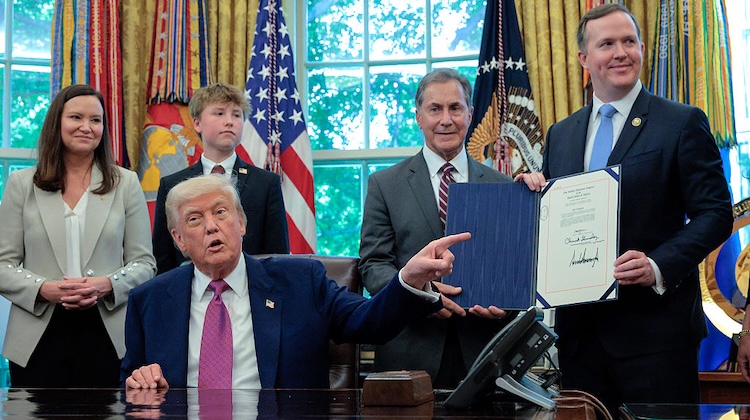
Photo: Chip Somodevilla/Getty Images
We want to hear your thoughts about this article. Click here to send a letter to the editor.