In his foreword to the catalogue of a recent exhibition at New York’s Jewish Museum, The Book of Esther in the Age of Rembrandt, museum director James S. Snyder seeks to evoke his institution’s tradition of exploring the works of Western artists, like Rembrandt, who specialize in Hebrew biblical subjects and of world cultures that engage with Jewish ideas. These are topics on which any reasonable person would expect a Jewish museum to focus, especially the one located in the American city with the largest and most culturally engaged Jewish population.
So it is profoundly telling that the three exhibitions Snyder cites as examples of the museum’s specialization in these themes—The Jews in the Age of Rembrandt; Gardens and Ghettos: The Art of Jewish Life in Italy; and Convivencia: Jews, Muslims, and Christians in Medieval Spain—were all presented more than three decades ago, in 1982, 1989, and 1992 respectively. That one has to go back to the year Bill Clinton was elected president to cite an exhibition demonstrating the Jewish Museum’s serious engagement with the intersection of Jewish and world culture is a sad testament to how dramatically impoverished the Jewish Museum had become in the 21st century.
This impoverishment—which is to say, a deliberate and shocking dearth of Jewish content—fell to astonishing lows during the tenure of Claudia Gould. She led the museum between 2011 and 2023, and during that time, one was hard-pressed to find anything resonantly Jewish in the museum’s special exhibitions. This was a conscious choice. Founded in 1904, the Jewish Museum (known in institutional circles as the JM) has vacillated for more than a century between being a Jewish museum and being a Jew-ish museum. In its mode as a Jew-ish museum, it has tried to echo the lofty, non-culturally specific artistic standards of its famous neighbors, the Guggenheim and The Met, and denied its founding purpose. Gould wanted to run a Fifth Avenue museum, not a museum dedicated to the rich cultural, artistic, and historical legacies of the Jewish people.
And so it was, and is, something to celebrate that the JM conceived and mounted an exhibition from March to August this year that placed at its core a distinctly Jewish text, which carries through to the wonderful catalogue that will immortalize it. The Book of Esther in the Age of Rembrandt does nothing less than bring to life—through visual, theatrical, political, ceremonial, and domestic culture—the central and monumental role this text had in the life and consciousness of the Jewish and non-Jewish communities of 17th-century Holland. This story is read aloud every year in synagogues across the world on the joyous Jewish holiday of Purim and is very specific to the Jewish experience. The exhibition documents the surprising emergence of Esther as a cultural superstar in the 17th-century Netherlands, Holland’s economic and artistic Golden Age.
_____________
Esther’s courageous actions exposing and undermining Haman’s genocidal plot against the Jews of Persia, thereby liberating her people, were seen by the Dutch as a divinely ordained prefiguration of their own vanquishing of Spanish rule and the establishment of Netherlandish independence.
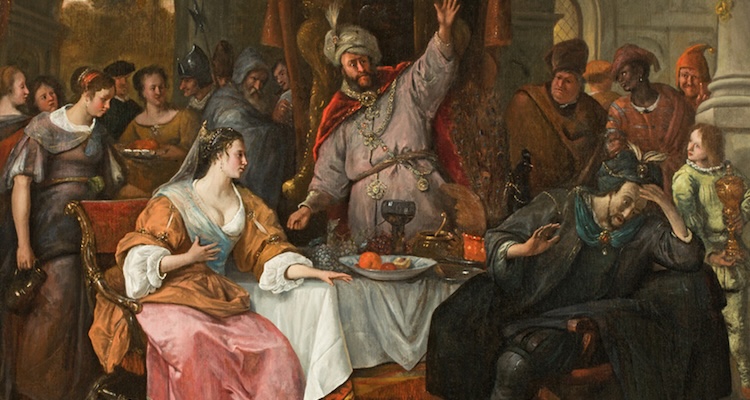
The exhibition and catalogue richly attest to the Dutch’s Esther Syndrome. Paintings, prints, tapestries, pieces of furniture, coins, and silverware are among the materials on display emblazoned with scenes from the Book of Esther. They run the gamut from public and performative—stage sets for theatrical productions about the story, as well as portraits of contemporary Dutch presented as its characters—to intimate and domestic objects (engravings on brackets of book locks and lids of snuffboxes). The character of the scenes culled by artists from the Book of Esther ranges from demonstrative and dramatic (“The Triumph of Mordecai” or “Esther Accusing Haman”) to quiet and contemplative (“Esther and Mordecai,” “Esther Reading the Royal Decree,” or “Esther at Her Toilet”). They suggest how profoundly the Dutch identified with all aspects of the story of the Jews’ rescue from annihilation by the hidden Jewish heroine who married the King of Persia and used her elevated position to save her threatened people. Rembrandt and his contemporaries drew on the text’s dramatic reversals of fate to amplify the extraordinary nature of the Dutch subjugation of the Spanish crown, their former subjugators. They used the heroic character and virtuous behavior of its Jewish protagonists to reflect on the righteousness of their own cause.
Through it all, it was Esther who was the focus of Dutch interest—a focus that reflects the strikingly human-centered nature of the source material, especially within the context of the Hebrew Bible. As Abigail Rapoport, curator of Judaica at the Jewish Museum and co-curator of the show, points out in the first of her two catalogue essays, “The Book of Esther is one of the few biblical stories in which God does not play an active role; instead, the story hinges on human actions. The absence of God’s name in the story centers the efforts of its characters and particularly highlights the heroic actions of Esther and [her uncle] Mordecai.” Indeed, the book does not mention God at all.
In her essay “Locating Esther: The Queen of Persia as a Dutch Heroine,” co-curator Michele L. Frederick of the North Carolina Museum of Art in Raleigh (which organized the exhibition with the JM) demonstrates that there was an iconographic foundation for the political resonance of the Purim story. Esther came to be associated with the Maid of Holland, an allegorical figure that symbolized the emerging young nation. Three striking portraits by the Dutch artist Gerrit van Honthorst, which were hung side-by-side-by-side in the exhibition, bring home this point. They represent three women—Elizabeth Stuart, her daughter Princess Elizabeth, and Amalia van Solms. Though none of them was born Dutch, all three achieved high political positions and had significant impact in the Netherlands. Van Honthorst depicts the women in the guise of Queen Esther, with two of them—Elizabeth Stuart and Amalia van Solms—crowned and holding the scepter of Ahasuerus, Persia’s king and Esther’s husband. A “distinctly female model of being and doing in a world at war,” Esther as the Maid of Holland personified for the Dutch freedom from political oppression as well as the championing of their Protestant ideals.
Larry Silver’s essay on “Esther in the Century of Rembrandt” sets the work of Rembrandt, Rembrandt’s teacher Pieter Lastman, and Rembrandt’s colleagues, students, and followers against the backdrop of the poetry and plays of the day, showing how richly intertwined the story of Esther was in Dutch culture. Though the Book of Esther describes a world that is “fundamentally secular,” as Robert Alter has characterized it, the Dutch recognized in the story the role of a benevolent, divine will that guides the virtuous actions of its Jewish characters. A popular drama about the Purim heroine by Johannes Serwouters was published in 1659 under the title Hester, or the Deliverance of the Jews. In his prologue, the Dutch playwright characterizes the “story of the Hebrew Esther” as showing us how under God the “Jewish race” was preserved and how “great wonders were carried out by great and mighty persons.” In examining paintings and prints of such subjects as “The Triumph of Mordecai” and “The Meal of Esther,” Silver reveals how the Dutch felt that they were like the Jews of Persia, fighting for religious as well as political independence. Through edicts and laws, Catholic Spain had viciously suppressed the practice of Protestantism in the Netherlands. Scenes from the Book of Esther celebrated and echoed a path toward attaining devotional freedom in the face of a domineering monarchy and an alien religious culture.
Silver suggests that the Eastern setting and ancient provenance of the biblical scenes attracted Rembrandt and his circle because they allowed the artists “to indulge their keen orientalist fantasy for exotic Middle Eastern costumes.” The exhibition featured and the catalogue handsomely reproduces numerous examples of paintings teeming with
characters outfitted as if by the costume designer of a flamboyantly produced Purim spiel—the traditional comic enactment of the story by Jewish communities. Dutch artists directly and indirectly based their works on stagings of the Book of Esther, which were popular in 17th-century Amsterdam. Rapoport’s essay on “Theatrical Connections” highlights the parodic character of these performances, which appealed to Jewish and non-Jewish audiences alike. More than a few of the paintings are marked by stilted gestures, exotic costumes, and proscenium-like spaces framed by curtains and draperies, revealing how strongly they were influenced by contemporary theatrical models.
Though the exhibition and catalogue do not aim to set the Dutch adaptation of the Book of Esther in a broader art-historical context, it is worth noting that Holland was not the only place to find value in evoking the story. The scene of Esther appearing before Ahasuerus to invite him to a meal, where she eventually reveals the plot against her people, was especially popular in the art of the Renaissance and Baroque eras beyond the Netherlands. She was commonly used by Christians and the Church as a prefiguration of the Virgin Mary. In the hands of artists commissioned by Catholic patrons—in Italy, for instance—such symbolism often produced heavy-handed works that used Esther to allude to Christianity’s ultimate triumph over Judaism and Paganism.
But the subjects favored by Dutch artists, such as “Esther Reading the Royal Decree” or “Esther at Her Toilet” (which envisions Esther’s sartorial preparations for her unbidden appearance before the king), are dedicated to the heroine herself and her own story. They project her bravery and determination to undo—metaphorically, undress—the plot against her people. These quiet paintings were among the artistic highlights of the exhibition—including a showstopper by Rembrandt of A Jewish Heroine from the Hebrew Bible (loaned to the show by the National Gallery of Canada in Ottawa), which was given a place of honor in its own mini-gallery at the Jewish Museum and is convincingly argued in the catalogue as representing the figure of Esther.
_____________
But the true glory of the exhibition and its catalogue is how they bring the art of Rembrandt and his contemporaries into the same setting as Jewish ceremonial art produced in the Netherlands for Purim and its related communal events, including scrolls, textiles, silver plates, and donation cups. The Purim story is told in one of Judaism’s five separate scrolls, Megillat Esther. Among the Esther scrolls featured in the show and illustrated in the catalogue is a remarkable group by the talented and inventive printmaker Salom Italia. Born in Mantua, Italy, he settled in Amsterdam, home to a large immigrant Jewish population, where he worked for most of his career. Italia’s parchment scrolls, produced in the 1640s and early 1650s, feature intricately printed borders with triumphal arches interspersed with standing representations of the story’s main characters and vignettes of landscapes and other typically Dutch motifs. Within the columnar frames of the triumphal arches is the Hebrew text of the Megillah, handwritten in ink. Seeing these scrolls within the same space (or binding, in the case of the catalogue) as the paintings and prints by Rembrandt and his contemporaries powerfully brings home their shared aesthetic vocabulary and character.
A further resonance emerges from this “side-by-side” presentation of Jewish and non-Jewish material culture around the Esther scroll. One realizes that the Dutch Jews for whom the Purim story was part of an annual ceremonial tradition must have recognized their own recent histories echoed in the tale of Esther’s heroic actions to save her people. The Spanish and Portuguese Jewish community, known as “the Portuguese nation,” found relative freedom and religious tolerance in Amsterdam following their persecution in the wake of the Inquisition. At the same time, Ashkenazic Jews from Eastern Europe and parts of the Holy Roman Empire also found in Amsterdam relief from religious persecution and wartime displacement. As a whole, the Jewish community used the Esther story to give mythical underpinnings to their own newfound freedom. In effectively uniting Jewish ceremonial objects and non-Jewish secular works, the exhibition and catalogue break new ground in showing how a liberated society could leave Jews free to practice their own traditions while influencing the traditions of others.
The adaptability of the Book of Esther for Jewish and non-Jewish audiences alike was made possible, as Rapoport emphasizes, by the relatively few ritual obligations associated with the Purim holiday. By focusing in parallel tracks on the contemporaneous Jewish and broader cultural conception of the Book of Esther, this exhibition and catalogue deepen our understanding of Purim and its ancient traditions. If you missed The Book of Esther in the Age of Rembrandt in New York, you still have the chance to see it at the North Carolina Museum of Art in Raleigh, where it appears from September 20, 2025, until March 8, 2026.
The vibrant exhibition and thoughtfully conceived publication of The Book of Esther in the Age of Rembrandt debunk the most misinformed assumptions that led the Jewish Museum to abandon Jewish content and that lead other Jewish museums to do the same. Serious exploration of the inherent character and outward manifestations of Judaism and Jewish culture provides rich platforms for wonderful art, moving juxtapositions, and worldly revelations, the kinds of visitor experiences that institutions like the Guggenheim and The Met should themselves aspire to create. One can only hope that the Jewish Museum and other Jewish cultural institutions continue to develop projects as insightful, revealing, and resolutely Jewish—not Jew-ish—as this one.
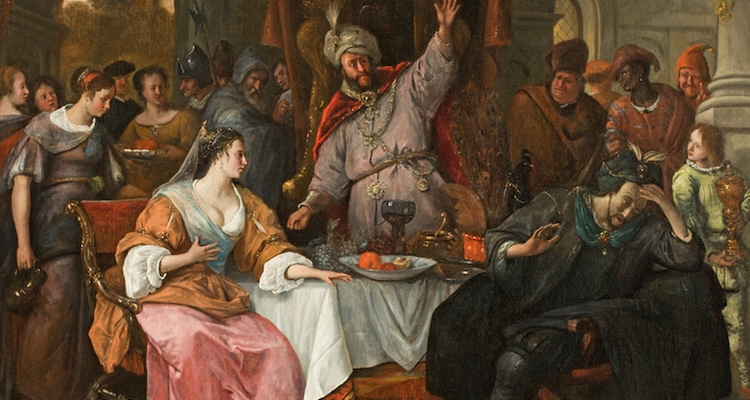
Image: Jan Steen, The Wrath of Ahasuerus, 1668–70. Courtesy of The Jewish Museum.
We want to hear your thoughts about this article. Click here to send a letter to the editor.