The first time I saw New Orleans it was through the window of a National Guard Blackhawk helicopter flying over the partially flooded metropolis. Hurricane Katrina had hit the Crescent City just three weeks earlier and I was on a reporting trip with two other Popular Mechanics editors to learn just what had gone wrong in that epic disaster. The Louisiana National Guard, which was helping in recovery efforts, showed us the worst of the damage. Over the next few days, we learned that most of the news reports we’d heard about the storm and its impact were deeply flawed.
In Katrina’s immediate aftermath, TV reporters stood in front of the Superdome credulously repeating rumors. They told viewers that armed gangs were roaming the streets and shooting at helicopters, and that dead bodies were stacking up like cordwood inside the arena. Rescue efforts were virtually nonexistent, the press insisted. And President George W. Bush was, of course, personally responsible for every tragic story in the region. Not one of those claims was true. In fact, just out of view of the network cameras, one of the biggest rescue operations in U.S. history was underway. Coast Guard helicopters were in the air as soon as Katrina’s winds subsided. Over the next few days, Coast Guard and National Guard personnel aided more than 50,000 people.
Throughout the ordeal, the media reflexively assumed the worst about the American people: On one hand, they didn’t question that the city’s poor black residents would immediately turn to looting and violence. On the other, they thought it obvious that any delays in rescue efforts could be explained only by racism. In truth, Katrina did expose huge shortcomings in infrastructure design and disaster preparedness. But it also brought out some of this country’s greatest strengths. As soon as news about the flooded city got out, sportsmen and fishing guides throughout the South hitched up their flatboats and headed to New Orleans. For the next week, this “Cajun Navy” patrolled the city looking for people to rescue. That story didn’t get too much coverage at the time. (The story of white good old boys going all out to help the mostly black survivors of New Orleans didn’t fit the media’s templates.) In the end, Katrina’s death toll, while heartbreaking, was much lower than predicted.
My Katrina experience taught me to be suspicious of easy narratives about disasters. Major catastrophes—whether natural or man-made—are complex, multifarious events. They contain contradictions: Heroism and incompetence exist side by side; black-and-white attributions of blame are generally wrong. Even the richest, most disciplined societies are never fully prepared for disasters. (Witness the entirely preventable meltdowns at Japan’s Fukushima Daiichi power plant following the 2011 tsunami.) Disasters are, by definition, events that exceed our imaginations and overwhelm our preparations.
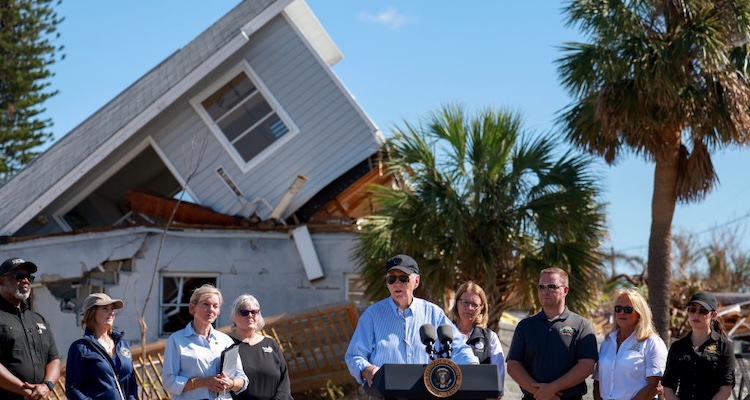
In the aftermath of Hurricane Helene, I see some similar patterns. As with Katrina, the media see the storm through a political lens. Of course, with a Democrat in the White House, the errors and oversights line up in the opposite direction. Whereas after Katrina reporters saw every bungle or delay as proof of the government’s lack of concern for victims, the media today seek to explain the reasons that it took a week or more for help to reach many survivors: The region is mountainous, the roads are out, the trees are down, and so on. The Biden administration’s media apologists are also quick to label criticisms of the Federal Emergency Management Agency as dangerous conspiracy theories. “Disinformation chaos hammers FEMA,” Politico reported. Both claims are partly true: It’s simply unrealistic to expect that relief workers will be able to reach every home in a ravaged area within a day or two. And, yes, wild fantasies about mysterious forces “controlling the weather” are being floated by Georgia Representative Marjorie Taylor Green, Alex Jones, and other nutjobs. After Katrina, Spike Lee and others made similar claims that the government “blew up the levees.” But you didn’t see the media fighting quite so hard to set the record straight when the craziness was coming from the left.
At the time of Katrina, FEMA’s mandate was primarily to deliver quick funding for recovery efforts led by state and local authorities, not—as commonly believed—to surge first responders to disaster areas. But that didn’t stop the press from blaming the agency for every local failure. Since then, FEMA’s brief has expanded to include a bigger front-line role. But today the press takes pains to defend the agency—and the administration that controls it—when relief is slow to reach the needy. When Elon Musk complained that “FEMA used up its budget ferrying illegals into the country instead of saving Americans,” the watchdog site NewsGuard quickly challenged the claim. FEMA has a separate budget for its Shelter and Services Program, the fact-checkers noted, therefore no money was diverted from its disaster fund.
What NewsGuard didn’t ask was why Congress had been forced to allocate money to FEMA’s shelter program. The answer, of course, lies in the Biden administration’s reckless border policy, which created a surge of undocumented migrants that overwhelmed cities across the country and necessitated federal help. So Musk’s broader point holds true: Due to the manufactured border crisis, FEMA’s focus and resources were spread thin dealing with tasks that had nothing to do with natural disasters.
Several years ago, I wrote a piece for COMMENTARY about the aftermath of the 1964 Alaska earthquake. I described how, during disasters, authorities often worry that the public will panic or turn to lawbreaking. For example, instead of dispatching teams to search for survivors, the Anchorage police department quickly deputized civilian patrols to protect damaged downtown stores from the expected wave of looting. This “elite panic” on the part of authorities was uncalled-for. The looters never materialized. Instead, the people of Anchorage quickly organized themselves into teams of volunteers who rescued the injured, cleared debris, and fed the hungry.
We are seeing a similar grassroots response in the mountains of the Southeast. Thousands of good Samaritans are delivering food and water to stranded homeowners. Volunteers are using their own four-wheel-drive trucks, ATVs—and even donkeys—to carry supplies to areas where roads are washed out. And some 90 private helicopter pilots have joined an “Operation Helo” to serve locations land vehicles can’t reach. Predictably, some authorities have succumbed to elite panic and tried to clamp down on these freelance efforts. One helicopter pilot was told he’d be arrested if he kept flying sorties to stranded homeowners. And Musk has complained that some helicopters were blocked from delivering the Starlink satellite systems he donated. But, for the most part, volunteers and professional rescuers are working side by side.
That’s the way it should be. The people closest to a crisis usually have the most detailed knowledge of where the real needs are. And, while state and federal assistance is important, Americans are not the sort of people to simply wait for the central government to solve their problems. “We’ve never depended on them before,” one volunteer in the small town of Cruso, North Carolina, told the New York Times. “Why should we depend on them now?”
As this article goes to press, Hurricane Milton is ripping through Florida. In its aftermath I don’t doubt that we will see many similar examples of local resilience, a few cases of elite panic, and a media eager to frame the story to fit bigger political narratives.
Photo: Joe Raedle/Getty Images
We want to hear your thoughts about this article. Click here to send a letter to the editor.