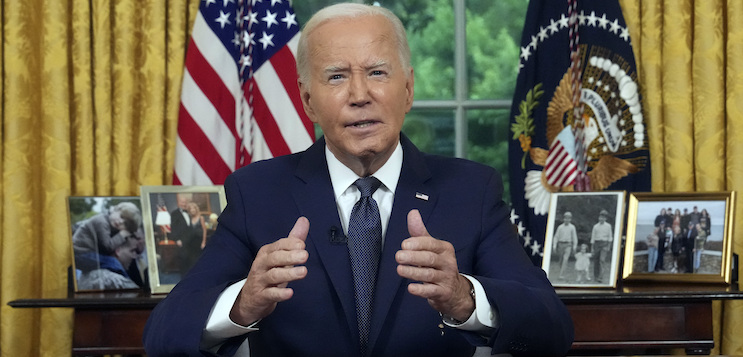
In the wake of the attempted assassination of Donald Trump, “unity” became the word of the week. Trump himself called for the country to “stand United”; President Biden stressed that “Unity is the most elusive goal of all, but nothing is more important than that right now — unity.” At the New Yorker, David Remnick asks: Who will be our unifier?
I would expect it to be the same person who is responsible for national unity in times of lesser anguish: no one.
Unity is a fine thing but it is too amorphous to be a national goal. More important, hoping or expecting for some figure to deliver unity as if he were the FedEx guy has the effect of lifting the burden of individual responsibility off the shoulders of a self-governing people who need to learn to have some perspective.
In politics it has become increasingly impossible for people to grasp the concept that a person or a party can be bad but not fascist; that legislation can be ill-advised but not unconstitutional; that war can be bloody and tragic but not genocide; that not every want is a need.
That the world, in other words, can be complicated. But how are people supposed to learn to make these distinctions when they are encouraged at every turn to be mad as hell?
There is something especially unnerving about the amount of violent chaos emanating from young American adults. The man who has been identified as Trump’s would-be assassin was 20 years old. The man who attempted to assassinate Justice Brett Kavanaugh was 26 at the time. When James Fields mowed down a counterprotester at the white supremacist rally in Charlottesville, he was 20. And that is a pretty good ballpark guess for the average age of the pro-Hamas demonstrators who have, by the thousands, paralyzed college campuses with their deafening calls for mass violence and their own lawbreaking and mob harassment of visible Jews.
Which is why I thought, after this Reuters article was published, that Biden was beginning to understand the problem. “Rather than verbally attacking Trump in the coming days,” we read yesterday afternoon, “the White House and the Biden campaign will draw on the president’s history of condemning all sorts of political violence including his sharp criticism of the ‘disorder’ created by campus protests against Israel over the war in Gaza with Hamas, campaign officials said on condition of anonymity.”
It seemed an implausibly reasonable path. And indeed it was—implausible. The backlash from the left was swift, the White House denied it, and that paragraph was removed from the story by evening. The foreign-funded “anti-Zionist” mobs didn’t make it into Biden’s nighttime speech.
But they sure should have. The problem with our political discourse is not merely the Hitler comparisons and their specific violent connotations. (A popular philosophical question some years ago was “If you could go back in time, would you kill baby Hitler?”) It is, rather, the shapeless rage and hopelessness that politicians encourage among the public. If you are around the age of Saturday’s attempted assassin, your era of political consciousness consisted mostly of the George Floyd riots, the Covid lockdowns, and the pro-Hamas marches. Which is to say: You were caged with periodic releases to cause chaos.
When Vice President Kamala Harris was asked recently for her opinion on the pro-Hamas rallygoers, she said: “They are showing exactly what the human emotion should be, as a response to Gaza.”
Are they? These demonstrations began immediately after Hamas murdered more than a thousand men, women, and children in cold blood in the most shocking ways imaginable. Is elation the correct human emotion as a response to the slaughter of children and the sexual torture of young women? It’s true, the protests did adjust their message to include opposition to Israel’s military mission in Gaza, begun three weeks after these celebratory rallies, but that hardly changes their character.
The human emotion protesters are showing these days is mostly blind rage, and it seems to be encouraged in response to every major domestic or global event. Now, if the Biden administration agrees with the protesters—that Israel is committing genocide and that Jews have no right to live in Israel—then Harris’s comments at least make some intuitive sense. But that is the only context in which they make sense. If you believe, as the administration claims it does, that the protesters are wrong on the facts and that their violence is un-American, why pat them on the head?
Blind rage is not, in fact, “exactly what the human emotion should be”—not toward the war in Gaza, not toward the Supreme Court democratizing abortion policy, not toward inclement weather, not toward a free and fair election. “Unity” is a terrible goal if collective madness is what unites a country.