Reading Graydon Carter’s often witty, always name-droppy, and selectively self-deprecating memoir, When the Going Was Good, I was transported through the mists of time. Picture an hourglass with expense receipts flying into clouds like calendar pages in an old movie as we travel back to a 1991 piece I’d written for Spy, the satirical magazine that put Carter on the map and led to his 25-year residency at the most gilded of print monthlies, Vanity Fair.
I guess my article was a little long, so it fell on the desks of Carter (I’ll call him that, though he’s always been known as “Graydon”) and Spy’s co-founder, Kurt Andersen, to be cut. Anderson excised a word here, a word there, whereas Carter slashed a giant X through the last three paragraphs—a concise metaphor for why Carter became hugely successful and Anderson…didn’t.
Carter was big-picture, with an eye for detail but never the type to get bogged down by one, lest it impede his relentless climb up from Canada’s backwater capital, Ottawa, to the firmaments of New York, Hollywood, and Cap d’Antibes. How did he do it? With tireless industry, no small amount of élan, and let the bodies fall where they may—unless they were useful for the upward climb, in which case he polished those vile bodies to a fine sheen.
The book opens with his biggest scoop: the identity of “Deep Throat,” Woodward and Bernstein’s Watergate source, which broke shortly after his third wedding, to the daughter of a British diplomat (the consummation of Carter’s lifelong Anglophilia). Also included in this chapter is the information that his family Christmas dinners often included New York party-circuit fixture Fran Lebowitz, because there’s always time to drop a name, even when the name in question hasn’t published anything of note in nearly half a century.
After establishing his journalistic and social bona fides, Carter rewinds to a languid sojourn down memory lane that Vanity Fair star writer Bryan Burrough dismissed as boringly “Canadian” in the Yale Review. (But that this Toronto-born reviewer devoured.) This was the same piece in which Burrough divulged that his peak salary at the magazine was $498,141, which came out to more than $166,000 per story. You’d think Burrough could have been a little nicer to his old patron, but apparently Carter used to make fun of this ink-stained wretch’s socks.
The early-years chapters vividly capture a time and sensibility lost to us now. Carter took summer and part-time jobs that would horrify Gen Z-ers today, including gravedigging and working as a lineman on the Canadian National Railway. Canadian boys were expected to pay their own way and were sent out west to toughen up and earn suffi-cient cash to cover their college tuition. When Carter recounts showing up at 5:30 a.m. at the New York Observer, a pink-hued Upper East Side weekly he revamped between Spy and Vanity Fair, it was nothing he hadn’t done for CNR as a teenager in the sweltering Saskatchewan prairie, minus the black flies.
_____________
“Growing up, I worried at times that I was destined to become little more than one of those faceless, nameless men in the scenery of someone else’s better life,” he writes. His first shot at a name and better life was editing a monthly called the Canadian Review, published in Ottawa. Which is to say no shot at all. He also wrote speeches for Pierre Trudeau, then, at the encouragement of wife No. 1, enrolled in a summer publishing program at Sarah Lawrence, which he leveraged into an interview at Time. Told they didn’t have a position for him, maybe in six months, Carter grabbed the editor’s arm, insisting, “No, no, I need a job now.”
It worked. In 1978, he was hired as a “floater”—a writer who migrated from section to section turning the voluminous “files” assembled by the reporter-researchers into trademark Time-ese. The Henry Luce stylebook included assigning Homeric epithets to famous people (“lizard-visaged country singer Lyle Lovett”). It was a style Carter would master and later repurpose at Spy, with epithets like “bosomy-dirty book writer Shirley Lord” (wife of New York Times editor “Abe ‘I’m Writing as Bad as I Can’ Rosenthal”) and, most famously, “short-fingered vulgarian Donald Trump.”
The going had indeed been indeed good at Time Inc., a template for the largesse Carter would dispense at Vanity Fair. On deadline nights at Time, meals were brought around on trolleys, a bar set up at the end of each corridor. There was a “cash window” for salary advances. Expenses were never questioned, including car services to the Hamptons. He dated Playmates and Rockettes, met wife No. 2, and commenced a lifelong affair with Savile Row suits. Carter has never been what one would call svelte. Asked if a jacket could be cut to make him look slimmer, his man at Anderson & Sheppard offered the Jeeves-ian riposte “We’re only tailors, sir.”
In 1986, he and his Time pal Anderson founded Spy, a New York–centric monthly that celebrated the rich and famous by cutting them down in a way readers either found wickedly funny or sophomorically mean-spirited. It could be both. I remember a Top 10 list of “Things Jesus Would do When He Comes Back.” Number One was “Burn all pictures that make me look fat.” The Hollywood coverage was filled with insider snark during an era of unbridled excess. It assigned real reporting to frivolous subjects, like following three tireless fixtures of the after-hours scene in a “Nightlife Decathlon.”
After the stock-market crash of 1987, the magazine start-up bubble burst and it was clear Carter had wrung all he could from Spy’s unique blend of sucking up through punching up. So he jumped ship—first to the Observer and then, in 1992, taking over Vanity Fair. “I was constantly worried that I was going to lose my job,” he says of his move into the glossy confines of Condé Nast, but he was by any measure very good at it. He banned tacky argot like “Tinseltown,” “glitzy,” and “A-List.” He courted celebrity writers or writers he could make into celebrities, like Maureen Orth, Christopher Hitchens, Michael Lewis, and Dominick Dunne—his own A-List. At its door-stop apogee, the magazine had 250 pages of advertising, at $100,000 for a full page. That paid for a whopping 150 pages of editorial content, which meant assigning a major piece every three days, a pace he likens to “building a locomotive on the fly as it barreled across the country.”
Money flew out the door as fast as it came in. The food budget for an Annie Leibovitz shoot—the “de facto court painter of the ruling members of the creative class”—was more than the editorial-content cost for an entire issue of Spy. The expenses for Dominick Dunne’s monthly dispatches from the O.J. Simpson trial were “ruinous.” But S.I. Newhouse, Condé Nast’s oddball billionaire proprietor, never batted an eye. The budget had “no ceiling.”
Every issue was a coffee-table Zeitgeist primer on Hollywood, Wash-ington, Wall Street, Silicon Valley, and far-flung correspondence—all for $12 a year. Vanity Fair’s Oscar party became the hottest ticket in town. Carter, who claims not to like crowds, soldiered through these star-packed extravaganzas with a beta blocker and a glass of vodka. His increasing clout led to cameos in a handful of TV shows and films that usually cast him as “Wall Street a—hole.” He produced flashy documentaries like The Kid Stays in the Picture, artily adapted a memoir by one of his Hollywood heroes, Robert Evans—the legendary producer, studio head, and “stickman” (that’s Canadian for Casanova).
Like his magazine, Carter doesn’t shy away from gossip. He says Evans had a framed Life magazine cover on him hanging in his office, but when he called the Life archives to get a copy for the doc, they couldn’t find it. Turned out, it was a fake that Evans had made for himself. At a PEN panel on the late Christopher Hitchens, Carter realized that the panelists—Salman Rushdie, Victor Navasky, and Ian Buruma—were all “jealous” of their old friend: “The venom that poured out just astounded me. I had found myself in a cauldron of acetous leftist politics and was the only one defending Christopher.”
He saves his own venom for the architect of his demise, Anna Wintour, mocking her affectation of always wearing dark sunglasses, even for a fashion show at their kids’ school. When the notoriously frosty “Nuclear” Wintour was elevated from editor in chief of Vogue to editorial director of Condé Nast, she instituted efficiencies. The 2008 financial crisis coupled with the rise of the internet had slowed the gravy train. One cost-cutting measure was to roll up all the magazines’ fact-checkers into a pool reporting directly to her. A meeting was called, chairs arrang-ed in a V formation, with Wintour’s desk at the point. Carter says he’d “seen cheerier faces in hostage videos.”
In 2017, Si Newhouse died, and by the end of that year, Carter exited Vanity Fair. It was the end of two eras. Condé Nast shuttered money-losing magazines to focus on digital platforms. Carter himself, after licking his wounds in the south of France, reemerged two years later with Air Mail—a sort of weekly digital version of the old Vanity Fair. It has its moments but is hardly the must-read VF once was. He hit up all his rich friends to launch it. Now they “duck into doorways when they see me coming.”
The memoir’s title is lifted from Evelyn Waugh (a 1946 travel anthology), but Carter’s journey is more Balzac. The cover photo—pocket square, cuff links, cigarette, and signet-ringed pinky—is pure Rastignac, the king of Paris high society in Balzac’s Human Comedy and original “young man from the provinces” made good. To prove his hard-won classiness, Carter uses New Yorker–ish line drawings to open each chapter. I, for one, would have preferred some juicy party pics.
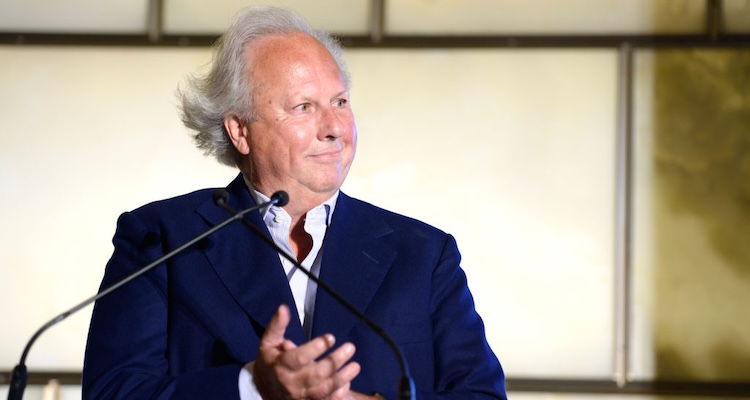
Photo: Dave Kotinsky/Getty Images for the Daily Front Row
We want to hear your thoughts about this article. Click here to send a letter to the editor.