The party of Donald J. Trump is not exactly known for its nuance. But this week the Republican National Convention speakers have been making an important distinction that Trump himself has long struggled with: the difference between the issue of anti-Semitism here at home and the issue of support for Israel’s self-defense.
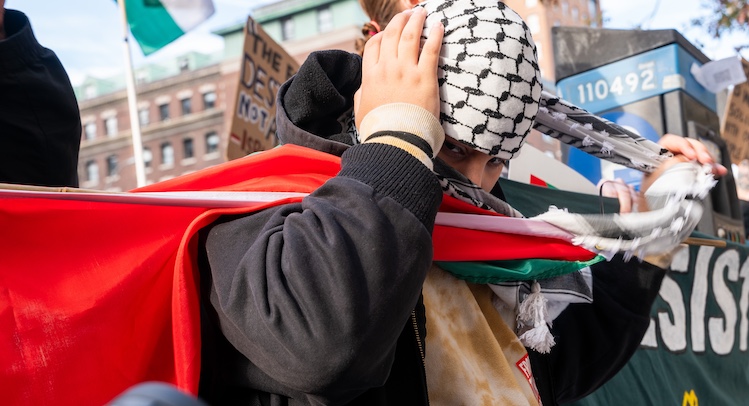
Republicans are strongly pro-Israel, skeptical of “elite” institutions of higher education, hawkish on terrorism, and keenly opposed to public disorder, so they’ve been a natural audience for Jewish students objecting to the massive outbreak in Jew-hatred on campuses, emanating from radical-chic encampments of Hamas supporters.
And one of those students is speaking tonight in a prime-time slot at the Republican National Convention.
Shabbos Kestenbaum, a recent graduate of Harvard Divinity School whose graduation did not conclude his battle with the university—he is suing Harvard for its egregious response to anti-Semitic harassment on campus—has the 8:25 p.m. slot, to be followed by a speech from the family of an American-Israeli hostage taken by Hamas on October 7. Both speeches are evidence that the Republican Party is increasingly able to do something that is necessary to effectively fight anti-Semitism in America: Connect the street violence against Jews to the current listlessness of big-city crime-fighting and the progressive attachment to general disorder as a political strategy.
The current crisis arguably has more to do with America than with Israel. The institutions that have been overtaken by it were already facing elements of it before October 7. And their terrorist-supporters share the overarching goal of erasing Jews from the public sphere, banishing them from societal participation in a way that suggests they are second-class citizens.
But the craven and utter refusal to do something about it too often comes down to Democratic officials’ fear. And that is not much different from their weird and catastrophic embrace of “defund the police” campaigns or downplaying the mayhem at the southern border.
And so what the Republican convention has deftly displayed thus far is a two-tiered system of justice. Manhattan District Attorney Alvin Bragg was to last night’s speeches what the evil Persian minister Haman is to megillah readings on Purim: Everybody knows to boo and hiss when the name is read aloud. Aside from Bragg’s role in the dubious felony prosecution of Trump, he was jeered last night when the mother of a murder victim blamed him for his soft-on-crime policies. Jews on campus might say the same: Bragg dropped the charges against the New York students who seized campus property on behalf of a “global” intifada. Another speaker last night told of his sister, murdered by an illegal immigrant who’d been expelled three times already yet was able to return to the U.S., all despite a record of violence in his native El Salvador. (This last case does not involve Bragg, to be clear.)
Kestenbaum has been a fixture in the anti-Semitism debate over the past several months. In 2020, he voted for Bernie Sanders and remains a registered Democrat. Challenged by the Forward to say whether he now supports Trump, Kestenbaum responded: “I am supporting Donald Trump’s policies of insisting on consequences for foreign students who violate our laws and desecrate our freedoms. I support Donald Trump’s policies of instilling patriotism in the curriculums. I support Donald Trump’s policies of taxing university endowments. And again, I don’t see why that’s a partisan issue, and I’m incredibly disillusioned with my party for not adopting those pretty obvious positions.”
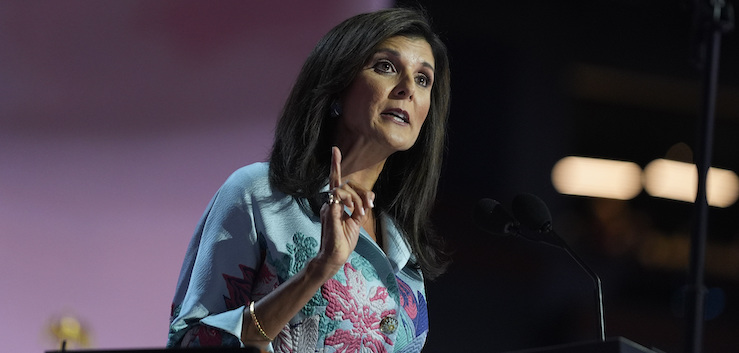
He’d speak where invited, he said—but as of now, only the Republican convention expressed interest in hearing what he has to say about anti-Semitism. In her speech last night, Nikki Haley mentioned that “the Jewish community is facing an obscene rise in anti-Semitism.” This was not during the Israel portion of her remarks. Rather, it was followed by: “Too many minorities are trapped in communities devastated by crime,” and was preceded by criticism of the institutions that “indoctrinate” young Americans “to think our country is racist and evil.”
The view of anti-Semitism at the RNC this week, then, has not treated it as a result of a foreign conflict, which can often leave the impression that the solution to it is “over there.” As mentioned above, the hostage whose family will be speaking tonight is American as well, one of several held by Hamas or Hamas-aligned Palestinian families in Gaza. The shocking neglect of these hostages by the administration has left the impression that somehow their Jewishness has made them less American. The belief that the Arab-Israeli conflict must be solved in order to fix anti-Semitism here at home leaves a similar taste in one’s mouth and treads perilously close to blaming Jews for their own suffering.
That this distinction is getting such a public airing at the Republican convention feels like a breakthrough for the Jewish community. Perhaps there exists the will to turn the corner on a difficult period for American Jewry.