Ukraine’s brilliant surprise maneuver into Russian territory last month remains a strategic coup. But the attempt to use it to change the fundamentals of the war is running into two familiar obstacles: Vladimir Putin’s disregard for human life and Western red lines.
Putin has resisted redeploying troops from the Ukraine front into a defensive position to take back Kursk because, it seems, he doesn’t much care if Russians are subject to a foreign army while the Russian army is busy killing Ukrainians.
Even without forcing Russia to move some troops back home, the Ukrainian gamble into Kursk can still yield benefits, including a stronger negotiating hand for an end to the war. But that means Ukraine has to survive long enough to get to end-stage negotiations in the first place. And this is where Kyiv could sure use some more Western help.
Ukraine has never set its sights on conquering Moscow. It has merely been asking for the weapons sufficient to defend its own territory from an invader. Western Europe and the United States haven’t done that, however. The Western strategy has been to wait until Ukraine’s back is up against a wall and then giving Kyiv enough help to freeze the conflict in place and stop Russian troops from going further along their path. Russia then holds that line and sends other troops to a different perceived weak point in the Ukrainian defense, and the dance starts all over again.
We are not helping Ukraine survive as a state, we are merely forcing Russia to digest it slowly.
Germany, Ukraine’s most important European ally, has been wavering. Over the summer, a budget deal was reached that would cut Berlin’s aid to Ukraine by nearly half. A government spokesman insisted that, despite the budget cuts, accusing Germany of reducing its support for the war effort is “almost defamatory.” How to reconcile the slashing of the budget with the insistence nothing will change? Easy—Berlin (and other countries, we are told) will simply ramp up their seizure of Russian assets and use the proceeds to fund the gap in aid to Ukraine.
Now the Biden administration is apparently close to a deal that would provide Ukraine with slightly longer-range missiles. Washington has hesitated to do so because of its fear of “escalation”—though Ukraine wouldn’t have to force Russia to defend its own territory if its army had been provided the tools to repel the Russian invasion in the first place.
Russia is angry about the missiles. “They are joking about our red lines here,” warned Russian Foreign Minister Sergey Lavrov. “They shouldn’t joke about our red lines.”
But in fact what’s happening has nothing to do with Russian red lines and everything to do with American red lines. Ukrainian President Volodymyr Zelensky has been putting together a list of potential targets inside Russia that America has refused to sanction thus far but about which Zelensky wants Biden to reconsider.
“There should be no restrictions on the range of weapons for Ukraine, while terrorists have no such restrictions,” Zelensky said in late August. “Defenders of life should face no restrictions on weapons.”
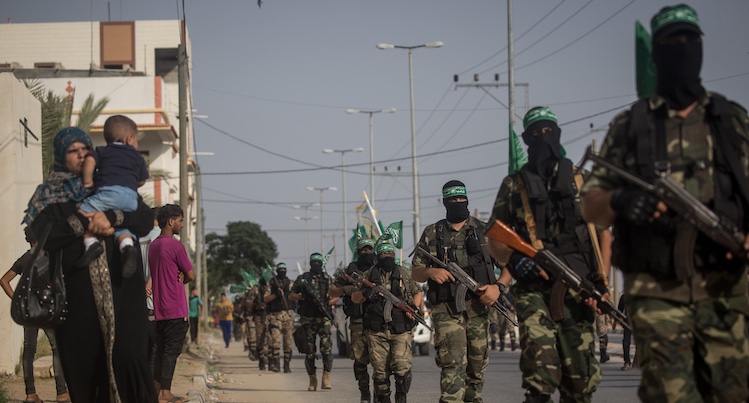
The “terrorists” referred to here are the Russians, but Zelensky could easily be describing another group of America’s enemies who benefit from this same dynamic: Hamas.
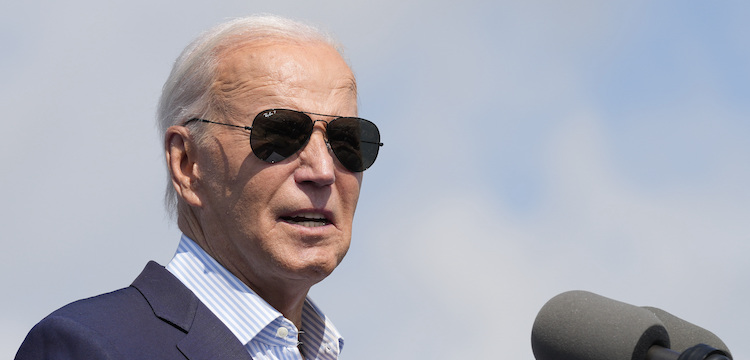
Barack Obama set red lines against Bashar al-Assad that Obama didn’t keep. That was controversial enough. But Biden was vice president at the time and the lesson he learned was apparently not that we should follow through on threats but that we should set red lines on friends, not foes.
On March 9, as Israel was preparing to go into Rafah—where hostages and high-level Hamas commanders were located—Biden was asked by Jonathan Capehart of MSNBC: “What is your red line with Prime Minister Netanyahu? Do you have a red line? For instance, would invasion of Rafah, [which] you have urged him not to do, would that be a red line?”
To which Biden responded: “It is a red line, but I’m never going to leave Israel. The defense of Israel is still critical, so there’s no red line I’m going to cut off all weapons so they don’t have the Iron Dome to protect them. But there’s red lines that if he crosses… Cannot have 30,000 more Palestinians dead.”
That last line was just the president losing his train of thought, it seems, but it was clear from the repetition of the phrase that even if he couldn’t clearly articulate all the red lines, he wanted Israel to know these lines existed, they were several in number, and he couldn’t remember them all.
This conversation has gotten renewed attention since the events of last weekend, when the remains of six hostages were found in the tunnels under Rafah. All six were taken by Hamas on October 7, tormented and denied food and proper medical care for eleven months, then executed last week in cold blood. This was mere days after the IDF rescued another hostage elsewhere in the Rafah tunnels.
What else was discovered in Rafah, the place on the map marked by Joe Biden’s red pen? Smuggling tunnels into Egypt large enough to fit military jeeps. The cause, in other words, of the perpetual state of war between Hamas and Israel.
The Biden administration delayed operations in Rafah to force Israel to jump through hoops in order to get around the president’s red lines. Just the same, Ukraine is constantly at a disadvantage in part because of Joe Biden’s red lines in that war. Hamas has no red lines. Russia has no red lines. Only our democratic allies have red lines, under Biden and Kamala Harris. And we wonder why terrorism and authoritarianism are on the march.