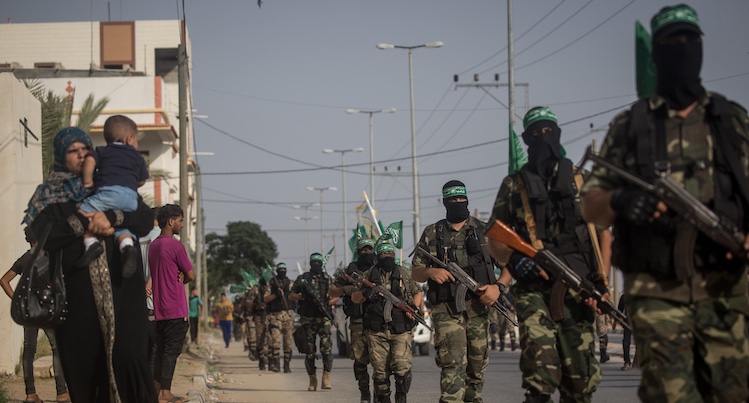
For more than a year, Hamas claimed that Kfir Bibas, along with his brother Ariel and mother Shiri, had been killed in an Israeli airstrike while being held captive in Gaza. Kfir was less than a year old when taken on October 7, 2023; Ariel was 4. During that time, there was no way for Israel to definitively rebut this charge. Although Hamas provided no evidence for its claim, the media tend to accept what it says at face value. Hamas used the claim to psychologically torment Yarden Bibas, Shiri’s husband and the boys’ father, whom it had kidnapped and held separately and eventually released. And the claim, as it set into the larger narrative of the war, became a rallying point for all those who wanted Israel to give up its pursuit of victory. It was an argument that the war was killing the hostages.
It was all a lie. This past February, a ceasefire-and-hostages deal brought home the bodies of Shiri and the boys—although Hamas actually at first sent a random woman’s body instead of Shiri’s. Their Palestinian captors, it turned out, had murdered these children with their bare hands, then mutilated the corpses to try to hide their handiwork.
There is no way to know how Israel’s domestic politics might have developed during those 15 months had there been no false narrative blaming the Israeli government for the Bibas deaths. But we very well might have a test case now for whether Hamas can get away with playing the exact same game at a critical moment.
Over the past week, Hamas has made it abundantly clear that they are counting on the public to blame Israeli Prime Minister Benjamin Netanyahu for anything that happens to the hostages that Hamas took, that Hamas held, that Hamas tortured, that Hamas starved, and that Hamas refused to return.
Just before the weekend, Hamas released new videos of two hostages, Guy Gilboa-Dalal and Alon Ohel. Gilboa-Dalal’s video shows him in Gaza City in late August (or so the viewer is told). The message from Hamas is clear: The hostages are human shields in Gaza City. The subtext we can glean from the Bibas murders, and from Hamas’s execution of six hostages in the vicinity of one of Yahya Sinwar’s likely hiding spots last year, is that Hamas is threatening to kill the hostages (again) and blame their deaths on Israel (again).
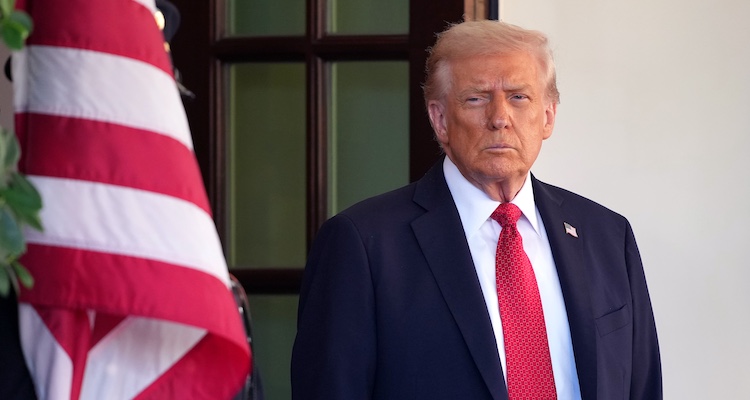
Which is why President Trump’s new proposed deal, which the president says Israel has accepted, puts Hamas in a bind. The terrorists are being offered what they say they want: a realistic, linear path to the end of the war. It would require the return of the remaining hostages immediately, which would be met with an immediate ceasefire—halting Israel’s Gaza City campaign—while the parties negotiate under American mediation.
The benefit to Israel is obviously getting the hostages home right away. The benefit to Hamas is that it stops Israel’s military campaign without Hamas’s having to agree up front to disarm.
If Netanyahu is seen as offering an end to the war in exchange for the hostages, he will have the backing of the Israeli public. Trump, meanwhile, expects to win the Israeli public’s support for ending the war if he can get the hostages back.
So why would Hamas say no? Because if Hamas can be seen as open to a deal while also of dragging its feet, thereby inviting the IDF’s full Gaza City operation, it will succeed in keeping a large segment of the Israeli public at Bibi’s throat.
Hamas’s response was noncomittal: “Hamas welcomes any step that supports the efforts to stop the aggression on our people and confirms readiness to immediately sit at the negotiating table to discuss the release of all prisoners in exchange for a clear declaration of ending the war, a complete withdrawal from the Gaza Strip, and the formation of a committee of independent Palestinians to run the Gaza Strip and to start its work immediately.”
If past is prologue, Hamas will find a way to blow up the deal. If and when it does so, Trump’s very public declaration of Israel’s support for the deal makes it clear that Hamas, and only Hamas, will be responsible for what follows.