London—Three days on from October 7, like many other people here in Britain and around the world, I was still absorbing the full horror of that day and the shock of Israel’s revealed inability to defend its population from Hamas’s slaughter squads. Thanks to social media, and in particular Elon Musk’s renamed Twitter, I had seen many of the snuff videos posted by delighted Gazans after they went house to house, car to car, or across the fields in pursuit of victims of all ages. Just about everyone who uses social media had some idea of the visceral, medieval savagery of that morning’s killings. People here who relied on TV news did not: The British TV establishment, led by the BBC, chose not to run the abundant footage taken on Hamas cellphones and body cameras.
Having so recently watched the videos of corpse defilement, of bloodied, evidently raped girls bundled into jeeps, I was all the more surprised when around the corner from my apartment, I caught sight of a middle-aged blonde woman holding a ladder for a man hanging strings of Palestine flags and two large banners from the twin balconies of their large stucco house, one of the only privately owned mansions in the neighborhood. Earlier in the day I had seen flag-bedecked SUVs driven by young Arab men hooting their horns as they paraded down Kensington High Street. That was only to be expected. This felt different, more disturbing.
My neighbors—the wealthy, white haut-bourgeois banner-hangers—were, whether they would admit it or not, celebrating October 7, rejoicing in the targeting of civilians for rape, murder, and mutilation, cheering the murder of Jews for being Jews. The first anti-Israel protests had already taken place in London, with the first ludicrous references to “genocide” (and the usual eliminationist chants of “from the river to the sea, Palestine shall be free”). But on the morning my neighbors hung their banner, Israel had not even begun its military campaign to free the hostages and destroy Hamas. Its troops were still clearing the last Hamas holdouts from the overrun kibbutzim and army bases, though its air force was bombing rocket-launch sites.
As a former New Yorker, the instant clamor about Israeli genocide reminded me of the immediate aftermath of 9/11—when the instinctive response in certain privileged quarters was to protest against a presumed or expected anti-Muslim backlash or to explore America’s purported responsibility rather than to mourn the slaughtered. But there is something more sinister about the responses to 10/7 here, one that the silliness of Oliver Stone and Susan Sontag and others never approached in the long-ago autumn. After all, you might expect that the literally visceral savagery of the Hamas-led attacks on southern Israel and in particular the mass murder at the rave musical festival—the Bataclan attack on steroids—would inspire at least a couple of days of shock before reflexive anti-Israel responses kicked in.
This was not the case, especially in the entertainment world. British Actors’ Equity, an organization whose leaders urged their members to join ugly anti-Israel demonstrations in 2021, was quick to put out statements attacking Israeli “genocide” and “apartheid,” while making the obligatory, emotionless condemnation of “all violence.” No one with any experience of the theater, TV, or film industries on either side of the Atlantic expects political subtlety or knowledge from actors, but the British thespian world is even more self-righteous and ignorant than its U.S. equivalent.
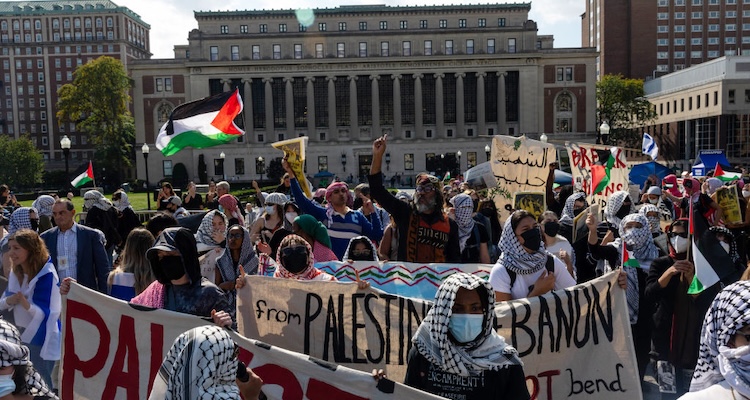
Every Saturday since 10/7, London has endured large anti-Israel demonstrations. At each one, students, Palestine-obsessives, Islamists, and hard-left extremists march shoulder to shoulder with tens of thousands of people from Britain’s Arab and Muslim communities. They wind their way from Parliament through central London to the Israeli Embassy in Kensington, where police in riot gear keep them back from the gates. As in past years, some of the demonstrators let off flares, scream anti-Jewish slogans, and break various minor laws that the police choose not to enforce. (London’s police have “form” in this selectivity: Climate protestors are routinely allowed to get away with things that demonstrators for “bad” causes such as immigration restriction would be arrested for.)
As you might expect, many of the marchers are relatively recent immigrants from Syria, Iraq, Sudan, and other Arab countries. More come from non-Arab Muslim countries such as Turkey, Iran, and Somalia. The great majority belong to Britain’s large minorities of Pakistani and Bangladeshi origin. It is no secret that large sections of these communities have not assimilated or given up old ways—and old prejudices—with the speed of Indian and other large immigrant communities. And it doesn’t help that many, unlike their American equivalents, came from the poorest, most backward parts of South Asia.
In any case, as I saw during my own years of reporting from Asia and the Middle East, Pakistan is probably the most anti-Semitic and anti-Israel country in the world—considerably more anti-Jewish than most Arab countries. Enormous pride is taken in the Pakistani military’s contribution to the Arab side in the 1973 Yom Kippur War—and supposed Pakistani air-force victories against the IDF. Even at the highest levels of Pakistani society, you hear much Nazi-style rhetoric about Jews controlling the world economy or the Rothschilds running the Federal Reserve. Pakistani immigrants to Britain are often surprised to find that it is considered impolite or worse by the host culture to make overtly anti-Jewish remarks. The prejudice endemic in their community has been on full display in the protests of the past two months.
Much of the reaction here is similar to that in the United States. Here too, there is an entire generation of young people who know nothing of international politics or history they haven’t learned from TikTok and Instagram, and who have therefore been conditioned to hate Israel. We may have even more academics here than in the U.S. who think it’s clever to remove any real meaning from the word “genocide.” Here too the “decolonization” narrative has been embraced by NGOs, city governments, and grant-giving institutions, and it’s linked to the propagandistic drive to mischaracterize Israel as a white “settler-colonial” society akin to Rhodesia or French Algeria.
The main difference may be that this country, or a section of its indigenous middle class, has long had a “thing” about Palestine, i.e., about Israel. Among upper-middle-class women, the Palestinian cause has come to inspire the kind of passion that attached to anti-nuclear campaigning and the Greenham Common movement of the 1980s. To some degree, this obsession derives from the old-fashioned romantic Arabism that affected much of the ruling class during the 20th century, although there has never been any British activism on behalf of Arabs oppressed by other Arabs or Iranians. British publishers and British authors—especially female ones—have been the prime foreign movers of the annual ‘Palfest’ Palestinian Festival of Literature, at which you would be hard-pressed to find any speakers keen to stress tolerance or the need of both sides to understand each other’s point of view.
The obsession with Palestine that grips swathes of the professional classes has large real-world consequences because Britons play such a disproportionate role as presenters, producers, and technical staff in English-language media around the world, such as CNN, Al-Jazeera, Euronews, and RT. Al Jazeera English, the global propaganda arm of the Qatari monarchy, and a mouthpiece for al-Qaeda and the Sunni Arab “resistance” during the Iraq War, was set up by British media veterans and is still dominated by them.
On the other hand, anti-Israel animus is hardly something that unites the nation. Working-class white (and Afro-Caribbean) people are generally less likely to be drawn to the anti-Zionist cause, even though the hanging of two British army sergeants by the Irgun in 1947 fomented a genuine popular hostility to Israel for a couple of decades, and even though relatively mild anti-Semitism was rife in British working-class communities until the 1960s.
It is telling that, unlike actors and journalists and lawyers, British rock and pop stars, many of whom are working-class in background, consistently defy pressure to boycott Israel (Roger Waters, formerly of Pink Floyd, and a lifelong anti-Semite, is the exception that proves the rule). The UK’s military and security establishment are much more pro-Israel today than they were even 30 years ago (let alone in the immediate aftermath of Palestine’s partition) and often work closely with their Israeli equivalents.
The behavior of many anti-Israel demonstrators has done the cause few favors in the wider society. It won few converts when pro-Hamas activists brought railway stations to a halt in cities across the country, in several of them harassing elderly Royal British Legion sellers of Remembrance Day poppies. Their joyful desecration of public monuments in London, including war memorials and statues of national figures, was an awkward reminder of the degree to which the indigenous culture is held in contempt by the sort of person who believes that beheading babies, or gang-raping teenaged girls before killing them, is a justified response to “colonial” oppression.
Bizarrely, British police forces are much more understanding of the demonstrators’ conduct and attitudes than the general public is. In London and Manchester, officers were filmed tearing down posters of kidnapped children taken to Gaza. They claimed it was in order to “avoid community tension,” police commanders having apparently determined that calling for the release of Hamas hostages was somehow offensive to Arabs and Muslims. However, the craven behavior of London’s Metropolitan Police at the largest demonstrations—during one of them, a pair of officers posed for photographs with toddlers dressed and masked up as Hamas terrorists—has brought that force into even greater disrepute, along with the stringent laws against “hate speech” that for some reason are rarely enforced against mullahs who give anti-Jewish sermons.
Even so, the failures of the police hint at a dark future. As British Jews have begun to realize, it is only a small step from these kinds of selective inaction by the police to turning a blind eye to the beatings of Jews in the street, Weimar-style—if carried out by passionate young men from certain highly sensitive communities. It would be a different story if the assailants came from the miniscule “far right.”
Then there is the fact that it may be only a matter of time before the sheer size of solidly anti-Zionist ethnic minorities and their political domination of certain cities start to have an impact on central government policy. It is just as well that Britain’s system of parliamentary government uses a “first past the post” voting system, which tends to disadvantage small, non-mainstream political parties. If it had proportional representation like many continental states (and Israel), Islamist parties might long ago have played a key role in the forming of coalition governments.
Hence a new phenomenon in British Jewish life: late-night “what if” conversations. What if anti-Semitism at home were to spread in the guise of an anti-Zionism that happily targets Jewish businesses, individuals, and places of worship? And what if Israel were to collapse under a multifront attack (which no longer seems as impossible as it once did) and disappear as a sanctuary? Where would you and your family go? Not France—despite President Emmanuel Macron’s creditable zero-tolerance policy on anti-Jewish demonstrations. Not Germany, where the small Jewish community has to be protected from anti-Semites from Syria who were invited to settle by former Chancellor Angela Merkel in 2015. Almost all the Western European countries have imported millions of Jew-haters from less enlightened parts of the Third World—often encouraged, as in Britain, by progressive Jews who chose to imagine inflows of economic migrants as the equivalent of the kindertransports. Poland, Portugal, even Serbia—these might be the safest bets if the worst comes to the worst and you cannot escape to the United States.
All that said, it has not all been dismaying news. Other than the Guardian, the mainstream British newspapers reacted to the 10/7 attacks with the shock and disgust you would expect from decent people. Even more reassuring has been the reaction of the British government. No British administration since the founding of the Jewish state in 1948 has been as stalwart in its support of Israel and its right to defend itself as that of Prime Minister Rishi Sunak, who quickly declared, “There are not two sides to these events. There is no question of balance, I stand with Israel, we stand with Israel.”
When the objectively pro-Hamas protests got going, with jihadist groups such as Hizb ut-Tahrir among the organizers,1 Sunak made his disgust clear, telling a Jewish community group, “We’ve already seen vile words on our streets … I say not here, not in Britain, not in our country, not in this century. My first duty is to protect you, we will not tolerate this hate, we will not tolerate this anti-Semitism, and I promise you I will stop at nothing to keep you safe.”
Many Jewish and pro-Israel Britons have also been impressed by the opposition leader, Sir Keir Starmer. The resolute stance taken by the Labour Party chief took even more courage than Sunak’s: The party is still awash in radicals who supported the openly anti-Zionist Corbyn, and many Labour MPs represent constituencies with large South Asian communities in which anti-Israel sentiment is extreme and anti-Semitism is rife .
The royal family has also been more forthright in defense of Israel than ever before. King Charles immediately “condemned barbaric acts of terrorism against the people of Israel” without any qualification, as did the Prince and Princess of Wales. The response of the government and the royal family has been all the more remarkable given the enormous power and influence in the UK of Qatar, the oil rich Gulf state that backs and hosts Hamas’s leaders, having previously backed and hosted the Taliban leadership, subsidized al-Qaeda, ISIS, and various branches of the Muslim-Brotherhood.
The stance of the country’s top leaders feels all the more reassuring given the morally miserable response to the new war by the prime ministers of Ireland and Spain. Sad to say, much of the most overtly anti-Semitic discourse in the British Isles since the October 7 attacks has come from Eire. Niall Holohan, a retired Irish diplomat, explained to the Guardian what he considered to be Ireland’s principled approach to the Palestinian–Israeli conflict by “the relative lack of influence” of Ireland’s tiny Jewish population—echoing inadvertently the notorious scene in Joyce’s Ulysses in which the anti-Semitic schoolteacher Deasy rejoices in the fact that Ireland “never let them in!” (It is no coincidence that in the past few decades some of the most hostile Anglophone media coverage of Israel has come from Irish journalists working for British and foreign news organizations, among them the BBC’s Orla Guerin, notorious for stories such as “How the Israelis stole Christmas.”)
British public opinion might shift more in an anti-Israel direction in the months to come owing to reports and imagery of suffering in the brutal war in Gaza, where the BBC, Sky, and other news organizations rely on Hamas-employed or -approved stringers. Still, as I write this, more than 100,000 people are marching peacefully and without calls for anyone to be exterminated, in the first march against anti-Semitism to be staged in London. It is an impressive number (there are only 270,000 Jews in the entire country) and one that suggests considerable participation by non-Jews. It also suggests that Hamas and its local allies have not cowed and will not cow those who stand in solidarity with the victims of October 7.
1 On October 7, a few hours after the first reports from Israel, Hizb ut-Tahrir UK tweeted, “If this can be done by a resistance group, imagine what a unified response from the Muslim world could achieve.”
Photo: AP Photo/Alberto Pezzali
We want to hear your thoughts about this article. Click here to send a letter to the editor.