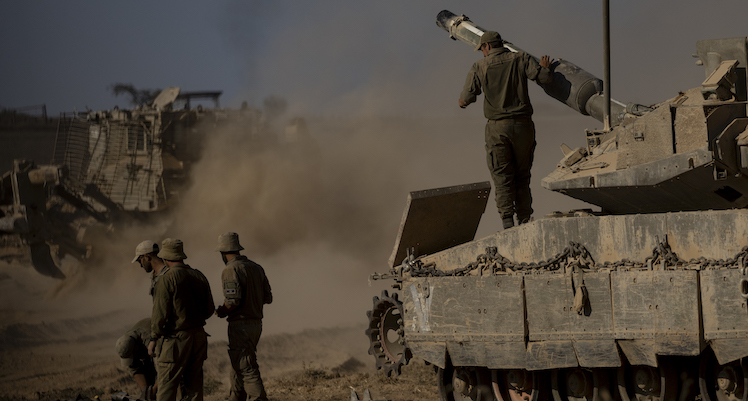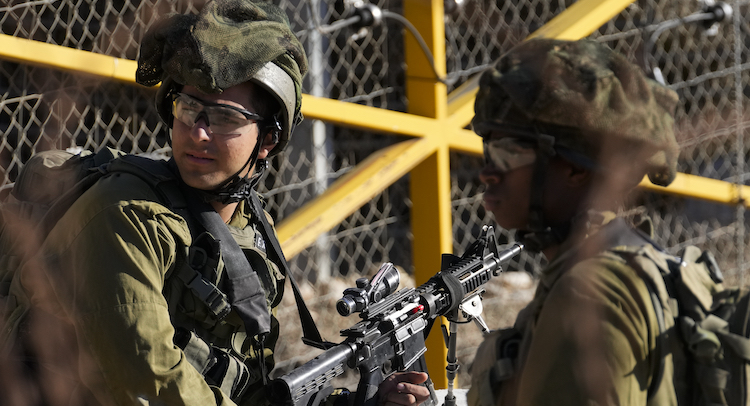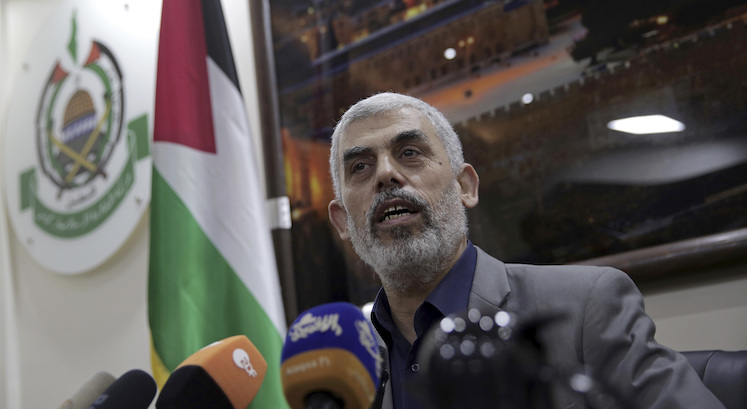
The asymmetric urban-warfare campaign launched by the remnants of Hamas is beginning to take its toll on the Israeli military. The continuous drumbeat of KIA announcements in the Israeli media is steadily eroding morale. At the same time, allegations of systematic starvation in the Gaza Strip—leveled primarily by the Hamas-run Gaza Ministry of Health and Hamas’s enablers at the United Nations—has put the Israelis on the defensive in the global battle for public opinion. A cease-fire with Hamas could have ended crisis. But Hamas spurned the latest deal, choosing instead to keep the pressure on its enemies. It’s not hard to understand why.
The ball is now in Israel’s court. With no hostage deal to be made, and with the international pressure building for Israel to end its just war, Israeli brass must soon make some consequential decisions. But the options are not necessarily binary. It need not be a choice between ending the war or fighting on. There may be a third way.
Israel can withdraw from the war zone, provide ample food to the population, and then prevent any reconstruction of the Gaza Strip until its terms for an end to the conflict are met.
Let’s begin with the withdrawal. Hamas is decimated. While the group is still able to occasionally fire off an occasional rocket, that capability is severely diminished. The overwhelming majority of the group’s top leaders are dead. In fact, according to one senior Israeli official I spoke to last week, there may be fewer than five high-value targets left among Hamas’s ranks. That hardly seems like a threat environment necessitating the deployment of thousands of Israeli troops, or the casualties associated with such a deployment.
Israel has an opportunity to declare victory, because it has truly vanquished the Hamas organization that launched the 10/7 attack. From there, it can withdraw to the perimeter of Gaza. It can continue to enforce the demilitarized perimeter inside the Gaza Strip. It can maintain forces in the Philadelphi corridor along the border with Egypt. And it can even keep forces deployed in the Morag and Netzarim corridors that slice into Gaza territory.
Under such circumstances, Israel can then strike as needed against imminent threats posed by Hamas, just as it does currently in places like Lebanon, Syria, or Judea and Samaria. This includes air strikes, drone strikes, and incursions. Nothing is off limits. After all, Israel controls the land and sea borders surrounding Gaza, and it controls the air space. It has full operational freedom. And that freedom of operations obviously applies when intelligence points to opportunities to rescue hostages.
From there, the Israelis must then begin to address the nutrition crisis in Gaza. Admittedly, there are more than a few Israeli officials who insist that there is no crisis. The Gaza Humanitarian Foundation (GHF) further reports that it is providing ample food to sustain the population. This matters little. A vicious campaign to discredit Israel is already in full swing. Israel stands accused right now of deliberately starving the people of Gaza.
Perception is reality. So, the Israelis must flood the zone with food. Yes, Hamas will be able to sell the food for a profit. And yes, the administration of food will continue to enable Hamas to act as a quasi-government in Gaza. And that will not redound to Israel’s benefit in the short term.
But Israel must begin to think about the long term. And herein lies the opportunity to place immense political pressure on Hamas. Israel should declare that not one ounce of construction material will enter the Gaza Strip until Hamas meets its demands.
The promise of reconstruction—the day after—ranks among the most important priorities for Hamas, the people of Gaza, and the international community. And it’s widely understood that Israel won’t allow for reconstruction until the war is over. This is Israel’s greatest point of leverage.
The Israelis should thus declare their demands for an end of conflict. Every last hostage must be released. The remaining Hamas leaders (notably Izz ad-Din Al-Haddad, who is running the war on the ground right now, but also others) must be exiled to another country. The remaining rockets in Gaza must be turned over for destruction. And engineers must be allowed to enter Gaza to destroy the tunnel system. Until those demands are met, there will be no rebuilding. None.
Of course, this strategy carries some risk. First and foremost, allowing the hostages to remain in Hamas custody puts them in greater peril. Then again, if Hamas refuses to turn them over anyway, the risk remains the same.
Apart from that, the remaining leaders of Hamas can refuse Israel’s terms and attempt to stay in control. But here’s the key question: How long will the people of Gaza allow for this status quo?
Living in squalor with no prospects for reconstruction is bound to push the Gaza population to the point of desperation. And while some of the Gazans’ anger will remain focused on Israel, Hamas’s refusal to meet the terms of a cease-fire that could end their nightmare will not sit well. Eventually, the people of Gaza will want to voice their frustration, and perhaps even act on it. We see signs of this already across the Gaza Strip.
Admittedly, the dynamics of this war may already be changing. When Hamas spurned the most recent cease-fire deal, Donald Trump gave a tacit green light for Israel to unleash on Hamas in Gaza. And that is likely to be very tempting for the IDF.
But wading deeper into a brutal urban war is not necessarily the optimal way forward. Withholding reconstruction until cease-fire terms are met is a viable option. It could yield the results Israel seeks without losing another soldier. And if, for some reason, this strategy fails to deliver results, Israel always has the option of putting more boots on the ground again and fighting on.