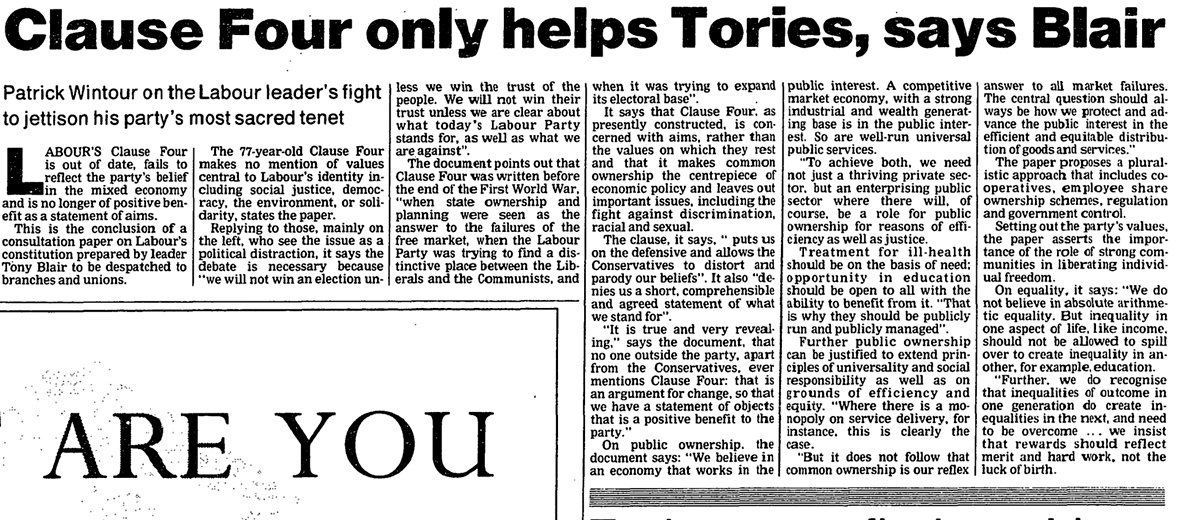
On April 29, 1995, socialism died. Tony Blair killed it.
It was Britain’s young, fresh-faced Labour Party leader who led the charge to finish what Margaret Thatcher and Mikhail Gorbachev had started. To rehabilitate the British left, Blair set out to bury forever the central tenet of Marx-Engels-style socialism to which his comrades still clung: the state ownership of the levers of the economy. To achieve that, he pushed for his Labour Party to move forward with a revision of its controversial constitution. In particular, Clause IV, which since 1918 had held that the state should own the levers of the British economy. It was a clause put into practice with radical success by Clement Attlee in his short period in Downing Street, and which was undone by Thatcher only after considerable social upheaval and economic stagnation. The reconstruction of Clause IV had been tried before, but it was Blair who succeeded in convincing his party to abandon the past. In so doing, he led his party out of the wilderness and the British left out of the wilderness.
There were some British liberals who argued that Clause IV had to go, first and foremost, because it was a political drag on Labour. “A competitive market economy, with a strong industrial and wealth generating base is in the public interest. So are well-run universal public services,” read a famous 1994 op-ed authored by Blair. “To achieve both, we need not just a thriving public sector, but an enterprising public sector.” Former Labour MP Anthony Wright has since noted that his party remains a socialist party, but it is one unshackled from the hindrances of the past and, in particular, the brand of Marxism practiced in Moscow and the former Warsaw Pact. “From that time, you were free of that contamination. You were free of that guilt by association,” he observed. “You had to be taken on your own terms, and that deprived the right of a major chunk of its armory.” He was right.
Unaware of its own passing, the ghost of socialism continues to haunt the West. Occasionally, men of a bygone generation like Bernie Sanders in America and Jeremy Corbyn in the U.K. — both committed to a 19th Century vision of socialistic values — enjoy passing popularity. Their ideas fail to generate the traction they once did. Conservatives might take some solace in that, but it’s a misplaced source of satisfaction. Many of the tenets of centralized government have become less distasteful to the West as the generations passed since the fall of the Berlin Wall and the memory of the Tiananmen massacre fades. Central to the renewed allure of expansive government is the notion of trust. In nations without a tradition of individualism and mistrust in a centralized authority, creeping governmental authority is making a comeback. In America, meanwhile, this manner of trust in the central government remains anathema. But for how long?
That question came to my mind following a series of moves by Congressional Republicans to block reforms to the process of filing an annual tax return. “Senate Republicans block proposal to regulate tax preparers,” read the headline in the Wall Street Journal. That sounds rather nasty, doesn’t it? Who wants the tax preparatory landscape to resemble the Wild West? The Democrats certainly do not, and neither does Finance Committee Chairman Orrin Hatch. He contended that he voted to block the measure, along with his GOP colleagues in a party-line vote, not because of its aims but because of the authority it would convey to the government. The measure would have imposed on every state minimum standards and training for tax preparers – a move the IRS attempted in 2013 but was shut down by the courts. Though supporters of this new proposal contend it would only empower the Treasury Department and not the IRS, suspicions poison the well.
Another effort to empower the IRS has recently been proposed by Senator Elizabeth Warren, and it is being met with all the skepticism you might think it would. Her legislation, the harmlessly-named Tax Filing Simplification Act, would do away with a safeguard that prevents the IRS from creating its own proprietary tax filing software. Since 2001, the IRS has offered a free tax preparation service to users who make $62,000 or less, but they have to use a third-party software vendor by law. “Currently, both Democratic presidential candidates have voiced support for Warren’s bill,” wrote The Atlantic’s Bourree Lam. “And while the program would cost taxpayers money, the net savings could be huge.” In fact, the only institutions that oppose this well-meaning proposal, according to Lam’s piece, are the tax preparatory services and software firms that spend millions lobbying the government against measures like these (as well as tax code simplification, it should be noted). Boston Magazine’s Matt Juul took a more unmistakable step toward advocacy. “Tax Day is just around the corner,” he wrote, “and Senator Elizabeth Warren wants to make the complicated system of filing taxes a lot easier for Americans.” So take off your tinfoil hat and get with the program, you hillbillies.
In a follow-up to her enlightening post on the subject, Lam boiled down this issue to its very essence. In doing so, she rendered the choice before the American public a clear one. “Do you trust the government to do your taxes?” she asked. In a collection of letters from abroad in which the national tax collection agencies themselves provide users with simple tax preparation forms and software, she found the answer is a resounding, 100 percent “yes!” A Swedish-American suggested that the problem with tax preparation reform proposals from an American perspective is that the U.S. government is simply seen as not competent enough.
Humbly, I would submit to this expatriate that the average American does not think about Washington in terms of its competency. Baked into the country’s psyche is the notion that centralized power is by its nature unwieldy and corrupting. Washington is not your advocate but your adversary, no matter how efficiently the trains run. This is a country founded on the mistrust of a central authority. No amount of scolding judgmentalism from the comfort of a Scandinavian constitutional monarchy will or should change that.
It has become vogue to talk about collectivism as though it were a functioning system of social organization and not a bit of self-indulgent nostalgia. But the system envisioned by socialism’s founders is as dead as Lenin. The socialism that exists today is a pale reflection of that which existed in the 20th Century. It is, as I wrote, dedicated to the rationing and consumption of consumer goods produced by the infinitely more efficient market economy. What died in 1995 was the obdurate refusal of socialism’s advocates to recognize that they had lost the trust of the public; even the British, and God knows they wanted so desperately to believe. In America, trust in the government may never be an article of faith. It is always something that must today be earned. Unfortunately for those who wish to see more public trust in the public sector, the government continues to demonstrate on a daily basis why that trust is undeserved.