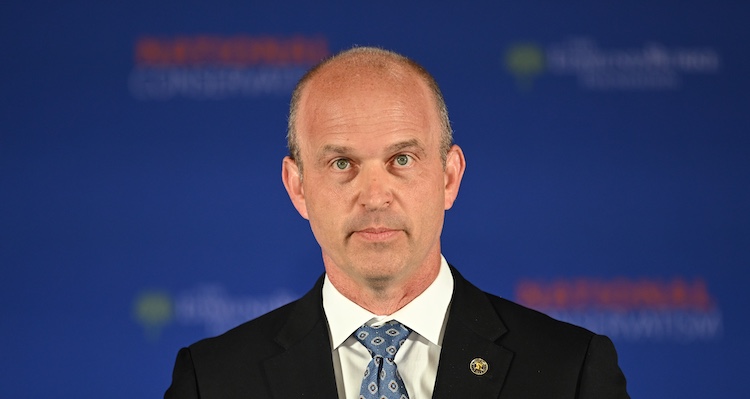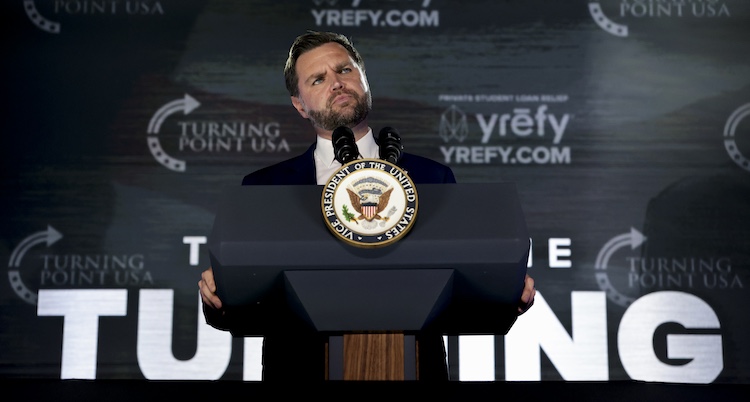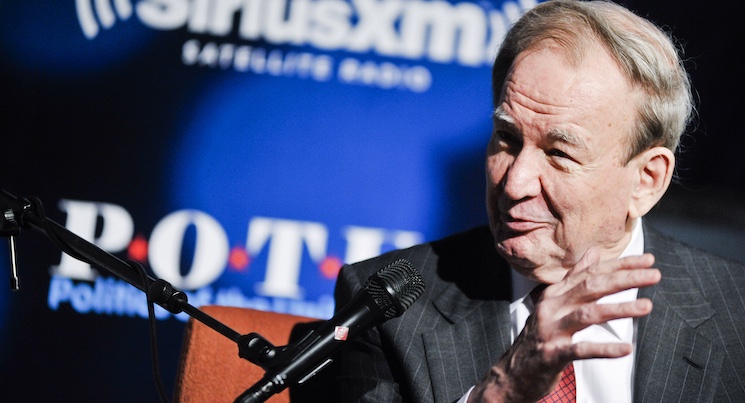
Sen. Eric Schmitt, Republican of Missouri, has encouraged President Trump to award the Presidential Medal of Freedom to Pat Buchanan, the former Nixon staffer and godfather of the modern right-wing World War II revisionists. The idea to award the medal to Buchanan originates from staffers at the magazine he founded, so there is an element of trolling to it. In that sense, Buchanan is a perfect candidate. For what those who idolize him today don’t understand is that Buchanan was driven by an obsession with baiting and trolling as a substitute for rigorous intellectual pursuit.
Buchanan failed politically, but not because he was early. He failed because he was shallow—and that is the lesson his confused would-be disciples should learn.
Unlike in cars, in politics rearview mirrors are overly flattering. So the rise of a populist, isolationist-leaning conservative faction with a race-baiting “influencer” corps seems like it vindicates the politics of Pat Buchanan. But that’s the ChatGPT summary of Buchanan’s ideological contributions. Without the nostalgic glaze, the truth is that Buchanan’s politics were cheap.
The devil is in the details. Plenty of Buchanan’s admirers are expecting the objection to his nomination for secular sainthood to be “he’s an anti-Semite.” But the problems with Buchanan were not what he believed about Jews but what he said about them: His expressions of anti-Semitism were lazy and designed to provoke, and eventually the act just got tiresome.
When William F. Buckley handed down his verdict on Buchanan in an essay in National Review that was expanded into a 1992 book on anti-Semitism, this was the more pertinent detail. “I find it impossible to defend Pat Buchanan against the charge that what he did and said during the period under examination amounted to anti-Semitism,” Buckley wrote, “whatever it was that drove him to say and do it: most probably, an iconoclastic temperament.”
The comment at the time that earned a column-length denunciation from the New York Times’s A.M. Rosenthal, which itself tipped off a wider debate over Buchanan and anti-Semitism, was his famous line about Israel “and its amen corner in the United States” being the only two groups “beating the drums for war in the Middle East” during the term of George H.W. Bush. Buckley first pointed out that this was grossly inaccurate: Three-quarters of the public stood opposite Buchanan on the subject. So why did Buchanan lie about these specific groups? What was it that bothered him so much about his targets?
Buchanan named four examples: Rosenthal, Charles Krauthammer, Richard Perle, and Henry Kissinger. Buckley noted that, off the top of his head, he could think of four Christians in the prominent anti-Saddam camp that Buchanan could have named instead of four recognizable Jews. The reason Buchanan chose the Jewish names was made clear when he said that if the war happened, the fighting would done by “kids with names like McAllister, Murphy, Gonzales, and Leroy Brown.”
It was at that point that Buchanan’s game became clear, and it was a game he’d play for the rest of his career. He wasn’t trying to avoid anti-Semitism; he was trying to make his point in the most ostentatiously anti-Semitic way possible. Was this because he hates Jews, or because he likes to upset people and distract from the policy by baiting the discourse into the swamps of race-taunting? It doesn’t really matter: Buchanan wants to talk about Rosenthals and Leroy Browns, not Saddam Hussein and George H.W. Bush. The war wasn’t what was important to Buchanan; ethnic rivalry and shock-jock politics were.
Indeed, even more important, Buchanan chose race-baiting at the expense of the policies he claimed he was advocating. For example, the previous year in COMMENTARY, Joshua Muravchik had pointed out that Buchanan was a staunch anti-Communist and so were the neoconservatives with whom he was obsessed. He was undermining the American anti-Communist coalition all because he hated “neocons” with names like Perle. Buckley calls Muravchik’s point “unanswerable.”
If you share Pat Buchanan’s preferred policies, you have spent your entire adult life seeing him set them on fire because of his lust for public confrontation. If you share Buchanan’s politics, that is, you don’t want him to be awarded a medal; you want him to shut up just as much as the rest of us do.
There is another reason Buckley devoted so much time and effort to this subject, and it’s relevant again today. Writing in 1992 in the New York Times, Nathan Glazer noted that the subtitle of Buckley’s original article on the controversy was “What Christians Provoke What Jews?” Glazer concludes: “I don’t think it is an accident that [Buckley] uses the term ‘Christian,’ even though he is aware that this is not a war of religious believers, because he is truly concerned with how Christians should conduct themselves.”
Buckley was conscious of relations between Christians and Jews in America, and he wanted to keep the peace. Buchanan wanted to provoke religious strife. Today, there are plenty of folks on both the right and the left who pronounce themselves uncomfortable with Israel’s conduct, yet only a few of them invoke a supposed incompatibility between Christianity and support for Israel. Those few are Buchanan’s heirs, seeking to make this not about the war but about the Jews. Presumably most conservative critics of Israel’s war in Gaza would prefer that the conservative political coalition survive this disagreement. Buchananites would rather the coalition crumble than have to share it with Israel’s supporters. This is where Trump and Buchanan are nothing alike, and why Trump was a successful politician while Buchanan was a failure.
Whatever of Buchanan’s politics survived and thrived in the modern conservative movement did so despite Buchanan, not because of him. To canonize him now just because it would make Jews upset would be a very stupid, and very Buchananite, thing to do.