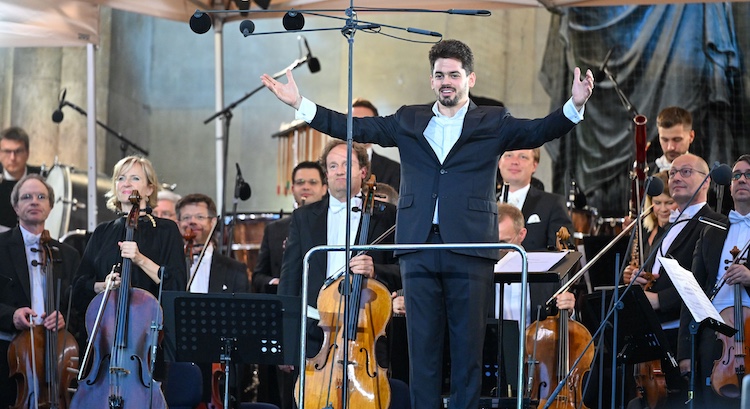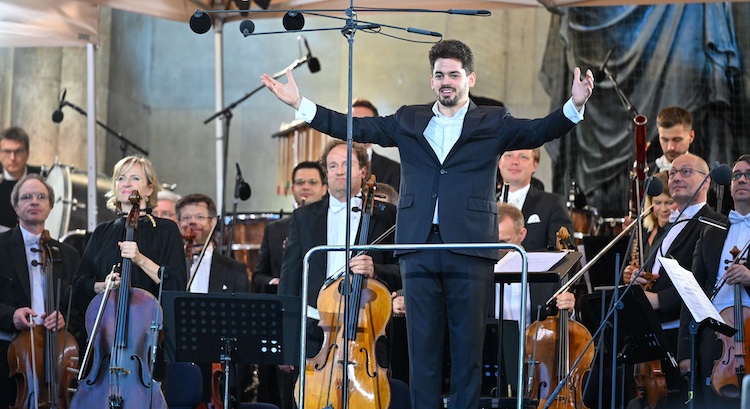
Germany’s perennial position as the only adult left in Europe causes some very strange conflicts on the continent. Here’s a new one: Ghent’s chapter of Belgium’s annual Flanders Festival has disinvited the Munich Philharmonic because its incoming chief conductor is Israeli.
So what we have here is a major German cultural institution being punished by a Western European country because its conductor was born in the Jewish state. One would think a German orchestra hiring an Israeli conductor would be a mark of progress, one of those increasingly rare situations in which we might marvel at how far Germany has come and how the fates of the two peoples have intersected again but this time in an inspiring way.
Instead, both German and Jew are being ostracized.
This is especially notable considering one of the early and more famous conductors of the philharmonic was Gustav Mahler, a German Jew who felt compelled to convert to Catholicism in order to be eligible to be hired as an opera house director a few years earlier, and who continued to face anti-Semitism despite the conversion.
The conductor at the center of the current storm is Lahav Shani, music director for the Israel Philharmonic Orchestra. According to Norman Lebrecht, the city of Munich responded to the cancellation with appropriate outrage: “In both his artistic work and personal conduct, Lahav Shani stands for dialogue, humanism, and mutual understanding. We firmly reject the practice of placing Israeli artists under general suspicion and subjecting them to collective punishment. Excluding individuals from the stage, the concert hall, or other public venues based on their ethnic origin or religious affiliation constitutes an attack on fundamental European and democratic values.”
Lebrecht adds that “Shani is a peace campaigner whose close association with Daniel Barenboim underlines his position on the Middle East conflict.” And yet, one gets the impression that it doesn’t actually matter what Shani’s positions are unless he really goes over the edge. The city of Ghent produced an absolutely deranged statement in its defense:
“Lahav Shani has spoken out several times in the past in favor of peace and reconciliation, but in light of his position as chief conductor of the Israel Philharmonic Orchestra, we cannot provide sufficient clarity regarding his stance on the genocidal regime in Tel Aviv. In line with the call from the Minister of Culture, the Ghent city council, and the Ghent cultural sector, we choose not to enter into collaborations with partners who do not unequivocally distance themselves from these principles.”
As with Spanish Prime Minister Pedro Sanchez’s ludicrous public statement that he cannot stop Israel’s war in Gaza because Spain “doesn’t have nuclear bombs, aircraft carriers, or large oil reserves,” you have to wonder if these officials can hear themselves. Apparently Germans are the only European politicians who can speak about the Jews with any rationality or nuance. Strange days, indeed.
Speaking of which, German Culture Minister Wolfram Weimer’s statement ought to be read far and wide in the world of the arts these days: “Under the guise of supposed criticism of Israel, a cultural boycott is being carried out here.”
What’s interesting about that statement is that in Hollywood, the blacklisters say openly they are conducting a cultural boycott. European countries find the idea of a cultural boycott morally appalling such that boycotters avoid admitting that that is what they are doing. In America, a cultural boycott aimed at Jews is somehow considered a badge of honor, as demonstrated this week. The disenlightenment of the West is quite a thing to watch.
And again, to the cultural gatekeepers, a commitment to peace isn’t enough. A Jew must disavow his compatriots and coreligionists while pledging loyalty to those advocating for his destruction. That principle has spread from the college campus to the arts and will no doubt spread further unless Western institutions put the brakes on their moral regression.