H
ollywood was running on fumes in the mid-1960s. The studio system had run its course, and the creative energy in filmmaking was coming not from the U.S. but from Europe, where Michelangelo Antonioni, Federico Fellini, Jean-Luc Godard, and François Truffaut had pioneered a more complex, sexually franker style of filmmaking whose vitality was the envy of their American contemporaries. Meanwhile, the best-picture Oscars continued to go to such old-fashioned big-budget box-office smashes as Lawrence of Arabia, A Man for All Seasons, My Fair Lady, and The Sound of Music, none of which reflected the decade’s fast-rising turmoil. An industry that prided itself on being in touch with America’s prevailing cultural winds had lost its touch and its way.
All this changed with the release in 1967 of Arthur Penn’s Bonnie and Clyde and Mike Nichols’s The Graduate. These two films, made in nouveau European style, treated familiar subjects—a pair of Depression-era bank robbers and a college graduate in search of a place in the adult world—in an unmistakably modern manner. Both films were commercial successes that catapulted their makers and stars into the top echelon of what came to be known as “the new Hollywood.”
Bonnie and Clyde inaugurated a new era in which violence on screen simultaneously became bloodier and more aestheticized, and it has had enduring impact as a result. But it was The Graduate that altered the direction of American moviemaking with its specific appeal to younger and hipper moviegoers who had turned their backs on more traditional cinematic fare. When it opened in New York in December, the movie critic Hollis Alpert reported with bemusement that young people were lining up in below-freezing weather to see it, and that they showed no signs of being dismayed by the cold: “It was as though they all knew they were going to see something good, something made for them.”
The Graduate, whose aimless post-collegiate title character is seduced by the glamorous but neurotic wife of his father’s business partner, is part of the common stock of American reference. Now, a half-century later, it has become the subject of a book-length study, Beverly Gray’s Seduced by Mrs. Robinson: How The Graduate Became the Touchstone of a Generation.1 As is so often the case with pop-culture books, Seduced by Mrs. Robinson is almost as much about its self-absorbed Baby Boomer author (“The Graduate taught me to dance to the beat of my own drums”) as its subject. It has the further disadvantage of following in the footsteps of Mark Harris’s magisterial Pictures at a Revolution: Five Movies and the Birth of the New Hollywood (2008), in which the film is placed in the context of Hollywood’s mid-’60s cultural flux. But Gray’s book offers us a chance to revisit this seminal motion picture and consider just why it was that The Graduate spoke to Baby Boomers in a distinctively personal way.
T
he Graduate began life in 1963 as a novella of the same name by Charles Webb, a California-born writer who saw his book not as a comic novel but as a serious artistic statement about America’s increasingly disaffected youth. It found its way into the hands of a producer named Lawrence Turman who saw The Graduate as an opportunity to make the cinematic equivalent of Salinger’s The Catcher in the Rye. Turman optioned the book, then sent it to Mike Nichols, who in 1963 was still best known for his comic partnership with Elaine May but had just made his directorial debut with the original Broadway production of Barefoot in the Park.
Both men saw that The Graduate posed a problem to anyone seeking to put it on the screen. In Turman’s words, “In the book the character of Benjamin Braddock is sort of a whiny pain in the fanny [whom] you want to shake or spank.” To this end, they turned to Buck Henry, who had co-created the popular TV comedy Get Smart with Mel Brooks, to write a screenplay that would retain much of Webb’s dryly witty dialogue (“I think you’re the most attractive of all my parents’ friends”) while making Benjamin less priggish.
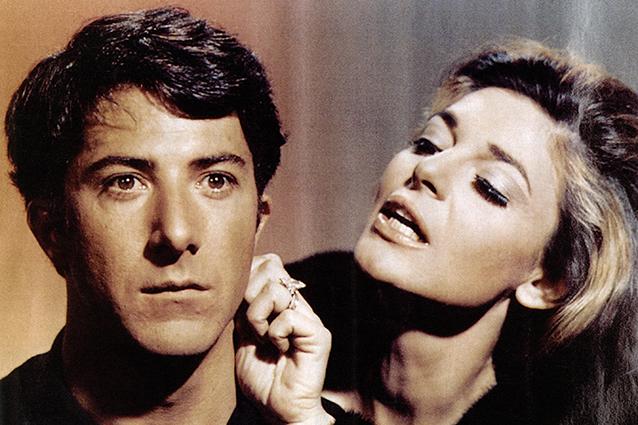
Nichols’s first major act was casting Dustin Hoffman, an obscure New York stage actor pushing 30, for the title role. No one but Nichols seems to have thought him suitable in any way. Not only was Hoffman short and nondescript-looking, but he was unmistakably Jewish, whereas Benjamin is supposedly the scion of a newly monied WASP family from southern California. Nevertheless, Nichols decided he wanted “a short, dark, Jewish, anomalous presence, which is how I experience myself,” in order to underline Benjamin’s alienation from the world of his parents.
Nichols filled the other roles in equally unexpected ways. He hired the Oscar winner Anne Bancroft, only six years Hoffman’s senior, to play the unbalanced temptress who lures Benjamin into her bed, then responds with volcanic rage when he falls in love with her beautiful daughter Elaine. He and Henry also steered clear of on-screen references to the campus protests that had only recently started to convulse America. Instead, he set The Graduate in a timeless upper-middle-class milieu inhabited by people more interested in social climbing than self-actualization—the same milieu from which Benjamin is so alienated that he is reduced to near-speechlessness whenever his family and their friends ask him what he plans to do now that he has graduated.
The film’s only explicit allusion to its cultural moment is the use on the soundtrack of Simon & Garfunkel’s “The Sound of Silence,” the painfully earnest anthem of youthful angst that is for all intents and purposes the theme song of The Graduate. Nevertheless, Henry’s screenplay leaves little doubt that the film was in every way a work of its time and place. As he later explained to Mark Harris, it is a study of “the disaffection of young people for an environment that they don’t seem to be in sync with.…Nobody had made a film specifically about that.”
This aspect of The Graduate is made explicit in a speech by Benjamin that has no direct counterpart in the novel: “It’s like I was playing some kind of game, but the rules don’t make any sense to me. They’re being made up by all the wrong people. I mean, no one makes them up. They seem to make themselves up.”
The Graduate was Nichols’s second film, following his wildly successful movie version of Edward Albee’s Who’s Afraid of Virginia Woolf?. Albee’s play was a snarling critique of the American dream, which he believed to be a snare and a delusion. The Graduate had the same skeptical view of postwar America, but its pessimism was played for laughs. When Benjamin is assured by a businessman in the opening scene that the secret to success in America is “plastics,” we are meant to laugh contemptuously at the smugness of so blinkered a view of life. Moreover, the contempt is as real as the laughter: The Graduate has it both ways. For the same reason, the farcical quality of the climactic scene (in which Benjamin breaks up Elaine’s marriage to a handsome young WASP and carts her off to an unknown fate) is played without musical underscoring, a signal that what Benjamin is doing is really no laughing matter.
The youth-oriented message of The Graduate came through loud and clear to its intended audience, which paid no heed to the mixed reviews from middle-aged reviewers unable to grasp what Nichols and Henry were up to. Not so Roger Ebert, the newly appointed 25-year-old movie critic of the Chicago Sun-Times, who called The Graduate “the funniest American comedy of the year…because it has a point of view. That is to say, it is against something.”
Even more revealing was the response of David Brinkley, then the co-anchor of NBC’s nightly newscast, who dismissed The Graduate as “frantic nonsense” but added that his college-age son and his classmates “liked it because it said about the parents and others what they would have said about us if they had made the movie—that we are self-centered and materialistic, that we are licentious and deeply hypocritical about it, that we try to make them into walking advertisements for our own affluence.”
A year after the release of The Graduate, a film-industry report cited in Pictures at a Revolution revealed that “48 percent of all movie tickets in America were now being sold to filmgoers under the age of 24.” A very high percentage of those tickets were to The Graduate and Bonnie and Clyde. At long last, Hollywood had figured out what the Baby Boomers wanted to see.
A
nd how does The Graduate look a half-century later? To begin with, it now appears to have been Mike Nichols’s creative “road not taken.” In later years, Nichols became less an auteur than a Hollywood director who thought like a Broadway director, choosing vehicles of solid middlebrow-liberal appeal and serving them faithfully without imposing a strong creative vision of his own. In The Graduate, by contrast, he revealed himself to be powerfully aware of the same European filmmaking trends that shaped Bonnie and Clyde. Within a naturalistic framework, he deployed non-naturalistic “new wave” cinematographic techniques with prodigious assurance—and he was willing to end The Graduate on an ambiguous note instead of wrapping it up neatly and pleasingly, letting the camera linger on the unsure faces of Hoffman and Ross as they ride off into an unsettling future.
It is this ambiguity, coupled with Nichols’s prescient decision not to allow The Graduate to become a literal portrayal of American campus life in the troubled mid-’60s, that has kept the film fresh. But The Graduate is fresh in a very particular way: It is a young person’s movie, the tale of a boy-man terrified by the prospect of growing up to be like his parents. Therein lay the source of its appeal to young audiences. The Graduate showed them what they, too, feared most, and hinted at a possible escape route.
In the words of Beverly Gray, who saw The Graduate when it first came out in 1967: “The Graduate appeared in movie houses just as we young Americans were discovering how badly we wanted to distance ourselves from the world of our parents….That polite young high achiever, those loving but smothering parents, those comfortable but slightly bland surroundings: They combined to form an only slightly exaggerated version of my own cozy West L.A. world.”
Yet to watch The Graduate today—especially if you first saw it when much younger—is also to be struck by the extreme unattractiveness of its central character. Hoffman plays Benjamin not as the comically ineffectual nebbish of Jewish tradition but as a near-catatonic robot who speaks by turns in a flat monotone and a frightened nasal whine. It is impossible to understand why Mrs. Robinson would want to go to bed with such a mousy creature, much less why Elaine would run off with him—an impression that has lately acquired an overlay of retrospective irony in the wake of accusations that Hoffman has sexually harassed female colleagues on more than one occasion. Precisely because Benjamin is so unlikable, it is harder for modern-day viewers to identify with him in the same way as did Gray and her fellow Boomers. To watch a Graduate-influenced film like Noah Baumbach’s Kicking and Screaming (1995), a poignant romantic comedy about a group of Gen-X college graduates who deliberately choose not to get on with their lives, is to see a closely similar dilemma dramatized in an infinitely more “relatable” way, one in which the crippling anxiety of the principal characters is presented as both understandable and pitiable, thus making it funnier.
Be that as it may, The Graduate is a still-vivid snapshot of a turning point in American cultural history. Before Benjamin Braddock, American films typically portrayed men who were not overgrown, smooth-faced children but full-grown adults, sometimes misguided but incontestably mature. After him, permanent immaturity became the default position of Hollywood-style masculinity.
For this reason, it will be interesting to see what the Millennials, so many of whom demand to be shielded from the “triggering” realities of adult life, make of The Graduate if and when they come to view it. I have a feeling that it will speak to a fair number of them far more persuasively than it did to those of us who—unlike Benjamin Braddock—longed when young to climb the high hill of adulthood and see for ourselves what awaited us on the far side.
1 Algonquin, 278 pages